- The University
- 5 min
- 02/07/2026

TU/e flagship aims to shape the future of advanced materials
University intends to build on “remarkable scientific profile”
TU/e is launching a new university-wide flagship focused on advanced materials. The initiative has recently secured five years of seed funding and aims to strengthen collaboration across the university, while positioning TU/e as one of Europe’s leaders in next-generation materials research.
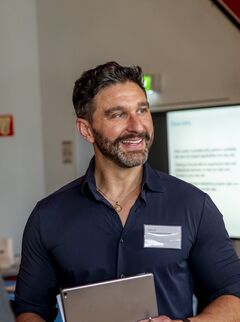

Leading the flagship is Nicholas Tito, part of TU/e’s Institute for Complex Molecular Systems (ICMS). A physical chemist by background, he has been affiliated with TU/e for a decade and also brings experience from the startup world.
He was invited to shape the flagship’s strategy and operations, working alongside scientific lead Marc Geers, strategy co-lead Monique Bruining, and a cross-department cross-institute team of faculty and action-takers.
“The university has a long tradition of excellence in materials research. We actually span many domains: polymers, energy materials, biomaterials, semi-con, quantum materials, building materials, and others,” Tito says.
“This is a remarkable scientific profile. The flagship is about building on and connecting these strengths, and setting an ambitious goal for ourselves in the next ten years.”
That goal? To become a European leader in AI & Automation for Advanced Materials research and discovery.
What are advanced materials?
“The term ‘advanced materials’ is a bit of a buzzword,” Tito says. Although now widely used today, it has no strict scientific definition and mainly serves as an umbrella label for materials with properties or behaviors beyond those of conventional materials.
“Think of a boat sailing in the ocean,” he explains. “The part in contact with water gets damaged over time, and you normally have to reapply protective layers.”
A newer approach is the development of self-healing materials, for example based on dynamic polymers. These “self-repair” microscopic damage at a molecular level, reducing the need for external maintenance.
Artificial bones
Another application lies in medicine. Materials are used in implants such as artificial bones and heart valves designed to function inside the body for long periods. Research today—including a large effort at TU/e—has unearthed new advanced (bio)materials and “regenerative medicines”.
“You can implant these new materials, and they actually encourage the body to regrow its own tissue—like bone, cartilage, or blood vessels,” Tito explains, “and the implanted material biodegrades in a healthy way over time too.”
Strategic domains
According to Tito, the initiative for the Flagship grew out of TU/e’s effort to identify the research domains where it can have the greatest international impact. Advanced materials naturally emerged as one of those strengths.
The field is also one of the four strategic priority domains in the university’s new Institutional Plan and aligns with the European Union’s Advanced Materials for Industrial Leadership (AMIL) initiative. With Europe investing heavily in advanced materials, universities that can present a coherent strategy are likely to benefit.
“The flagship is designed as a ten-year vehicle,” he explains. “Our ambition is not just to continue doing excellent materials research, but to help shape what advanced materials research will look like ten years from now.”
AI and automation
Central to that vision is the integration of artificial intelligence and laboratory automation. Rather than relying solely on traditional trial-and-error experimentation, researchers increasingly use AI and automated workflows to accelerate the discovery and development of new materials.
“We believe AI and automation will fundamentally change how new materials are discovered,” Tito says. “Our goal is to embrace that paradigm and become one of Europe’s leaders in this area over the next decade.”
Unlike many universities, TU/e covers much of the full materials knowledge chain—from sustainable design, computational prototyping, and synthesis to engineering, processing, testing and implementation.
That makes it possible, according to Tito, to connect data across disciplines in a way that is often not feasible elsewhere. The flagship is intended as an open platform rather than a fixed program, encouraging researchers across the university to contribute ideas and build new initiatives.
“We want this to be something the entire university can help shape,” Tito says. “By bringing together researchers from different departments and presenting a shared story externally, we can strengthen collaboration within TU/e while also increasing our visibility towards European funding agencies and other partners.”
“ChatGPT for materials research”
A key part of the flagship’s long-term strategy is the development of a TU/e Materials Hub, planned within the first five years. Rather than a physical center, it is envisioned as a virtual platform that brings together decades of materials research across the university.
“Almost like a ChatGPT-style tool,” Tito says. Researchers would be able to query the university’s collective knowledge base, receiving synthesized insights from years of published research. “This oracle should turn accumulated knowledge into answers—text, illustrations, tables, graphs—and hopefully even suggest new scientific directions.”
The concept addresses a broader challenge in materials science: research is often spread across different stages of the knowledge chain, from early design and synthesis to later processing, testing and application. Insights generated in one part of the process are not always visible to researchers working in another.
The goal of the Materials Hub is not only to map existing expertise, but to make it actively usable: a system that helps researchers identify connections across disciplines and reveal opportunities that might otherwise remain hidden in scattered publications and data.
Intelligent lab
Within ten years, the flagship also aims to develop an Intelligent Materials Lab. The concept builds on TU/e’s existing network of laboratories, which are spread across different buildings and each combine their own instruments and expertise. Rather than consolidating them into a single space—which Tito stresses would not be practical—the focus is on connectivity.
“One way to do that is by introducing automation into these laboratories—robots and processes that carry out experiments and measurements for you.” In this vision, these systems would be directly linked to an “AI core”, allowing experimental data to flow automatically into a central layer.
“One way to do that is by introducing automation into these laboratories—robots and processes that carry out experiments and measurements for you.” In this vision, these systems would be directly linked to an “AI core”, allowing experimental data to flow automatically into a central layer.
From there, AI could operate across the labs: analyzing data, generating ideas for new materials research, and potentially suggesting or triggering follow-up experiments. “But in this paradigm, human creativity and scientific expertise remains firmly at the head, in the driver’s seat,” says Tito.
Tito acknowledges the concept is ambitious, but sees it as a realistic trajectory. “It might sound a bit like science fiction,” he says, “but given the speed at which AI and automation are progressing, it’s not too unrealistic.”
Agility
The flagship’s ambitions are clear, but the path toward them is not fixed. Rather than following a detailed roadmap, the initiative is built around adaptability. “We have not set a super explicit month-by-month plan for ten years,” Tito explains. “We simply don’t know what the future will hold.”
That uncertainty is not seen as a weakness, but as a condition for progress. The coming years are likely to bring unexpected opportunities, shifts in direction, and necessary adjustments. “The path we take will be complicated and challenging,” Tito says. “It might change, it might take detours—but the 10-year goal is fixed, and achieving this requires agility.”
Asked what success would look like in ten years, Tito points not to a single breakthrough, but to broader recognition of TU/e’s research. “I would like to see the people of TU/e—researchers, students, and staff—in the scientific and national media, with our achievements in the spotlight.”
“Making an impact, for example through major grants to push the boundaries of AI and automation for advanced materials. The flagship is about people, challenging our community to do something new and exciting, and giving it international visibility.”
Discussion