
- The University
- 17/06/2026

Vertigo elevator A back in service after months of downtime
For almost the entire spring semester, one of the three elevators in the Built Environment building was out of service. Elevator traffic in Vertigo does not always run smoothly; recently, someone was even trapped for hours. Still, there are no more malfunctions than in other campus buildings, according to Campus & Facilities.
Students and staff who spend time in Vertigo know the situation well: sometimes the elevators take a while to arrive. According to master’s student Quin Jakobsen, this is partly because the elevator system is not always intuitive for users. Every day, he selects floor 5 on the control panel, where his studio is located.
“But if an impatient person presses the button again... and then two more times... the system thinks four people want to go to the fifth floor. The elevator may then only arrive once there is enough capacity—registered as weight—for four people,” he explains. “That can take a while.” As a result, Jakobsen usually takes the stairs when going down. “Good exercise, too.”
He has noticed that demand for the elevators is especially high around break times. “That’s when it gets really busy, and everything takes longer.” Especially when one of the three elevators has been out of service for months.
Defect
“Regular elevator malfunctions occur in every elevator system in the Netherlands. Over the past year, the elevators in Vertigo have not experienced an unusual number of malfunctions compared with other elevators on campus,” says Jonathan Smit, communications advisor at Campus & Facilities (C&F).
Nevertheless, one of the three elevators in Vertigo was out of service from mid-February until early June. In addition, someone recently became trapped in that same elevator for two hours—on the very day it had been repaired. C&F describes that incident as “obviously very unfortunate.”
“The person involved was never in any danger,” Smit emphasizes. He explains that the elevator has been operational again since last week and outlines why the repair took so long.
“Around Carnival, the elevator went out of service due to a defective sliding door on the fourth floor. C&F began repair efforts that same day. Because the sliding door had to be replaced, a new door was ordered. This was a custom-made component, and we were dependent on the supplier’s production capacity and delivery times.”
Maintenance
Smit would also like to reassure users. “As can be expected from C&F, the elevators in Vertigo receive the attention they deserve, both from us and from our maintenance partners, subcontractors, and suppliers. The elevators undergo regular maintenance six to eight times a year. This work is carried out by certified technicians. In addition, the elevators are legally inspected every 18 months by the Liftinstituut.”
The elevators in Vertigo differ from those in other campus buildings in two ways. First, they use a destination-control system, as Jakobsen described: users select the floor they want to go to before entering the elevator. Second, they use belts rather than steel cables to move the elevator car. Incidentally, neither of these features was related to the malfunctioning sliding door.
Taking the stairs is an option too
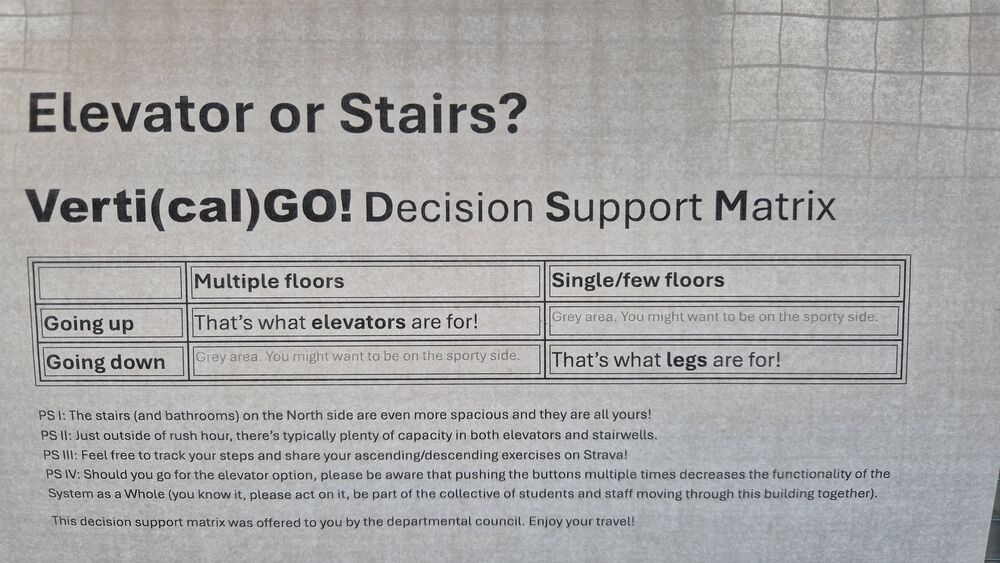
The department council recently posted an A4-sized notice next to the elevator doors. Do you really need to take the elevator, or could you use the stairs instead? A humorous decision matrix helps users make that choice.
This article was translated using AI-assisted tools and reviewed by an editor.
Discussion