
- The University
- 02/04/2026
The Dutch Tax Administration has won a court case concerning the VAT rate for scientific journals: when are they allowed to charge the lower rate, and when must they apply the higher rate?
In the past, this was not an issue. A journal subscription was subject to the lower rate: not 21 percent, but 9 percent. So if you spent one hundred euros on a subscription, only 9 euros in VAT would be added.
But universities would rather stop paying for subscriptions. Instead, they pay for publishing in those journals by their own researchers. And according to the Dutch Tax Administration, the higher VAT rate applies in that case.
Ideal situations
The case comes against the backdrop of ever-rising subscription costs for scientific journals. Universities around the world (including in the Netherlands) were spending increasing amounts of money on them, even though their own researchers wrote the articles and reviewed them for quality. What exactly are we paying publishers for, they began to ask more and more often.
Politics also became involved. Why should the results of publicly funded scientific research disappear behind journal paywalls? In principle, everyone should have the right to access that knowledge.
The Netherlands aimed to become a frontrunner in the push for open access, meaning free access to scientific articles. Universities entered into tough negotiations with major publishers.
Business model reversed
With open access, the publishers’ business model is turned upside down. Universities no longer pay to read journals, but to publish in them. Those articles are then made freely available to everyone.
Financially, this should amount to the same thing. Outside universities, no one subscribes—it’s simply too expensive. As long as universities continue to pay, the paywall might as well disappear.
Court case
However, according to the Dutch Tax Administration, ‘reading’ is subject to a different VAT rate (9 percent) than ‘publishing’ (21 percent). The court has sided with this view, as shown in a recent ruling against ICT cooperative SURF, which manages the subscriptions.
VAT makes the transition to open access more expensive. The amounts involved are substantial. In 2020, knowledge institutions paid 62 million euros for subscriptions and publication rights, according to Universities of the Netherlands (UNL).
UNL supported SURF in the case with a letter to the judges. In reality, nothing has changed, the letter argued—not for the journals and not for us. The only difference is that the paywall disappears, which serves the public interest. So why should we have to pay extra for that? But the letter did not sway the court.
UNL considers the VAT rules contradictory, says president Caspar van den Berg. “As a result, researchers and institutions are unnecessarily burdened, while the government aims to stimulate innovation and knowledge sharing.”
Costs
The costs themselves (for subscriptions or publishing) are also under scrutiny: what exactly do publishers do? Researchers write the articles and other researchers assess their quality, so what tasks remain in practice? Could the scientific community not establish its own journals?
That is happening, but only on a limited scale. Major publishers still firmly dominate the field. Publishing remains a profession in itself, and the reputations of leading journals are hard to challenge. Researchers still prefer to publish in the ‘top’ journals.
Dutch publications
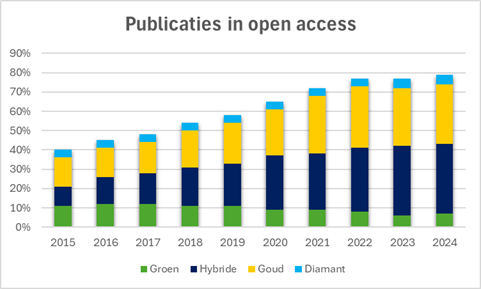
Nearly 80 percent of Dutch scientific publications are now open access, according to figures from the Rathenau Institute.
Diamond, gold, green or bronze?
There are various types of open access. With diamond open access, nothing is paid at all: no subscription fees and no publication fees (and therefore no VAT). In this model, universities themselves act as publishers. However, this share remains very small.
The ‘golden’ route involves publication in a journal where all articles are accessible. Hybrid journals combine the two models: some articles are behind a paywall, while others are freely available.
Finally, there is the ‘green’ route. In this case, the journal article remains behind a paywall, but can also be found in a digital archive of the university.
There is also a bronze variant of open access, which is now rarely used. With bronze open access, articles are made public only after some time, or only temporarily.
This article was translated using AI-assisted tools and reviewed by an editor.
Discussion