
- The University
- 08/06/2026

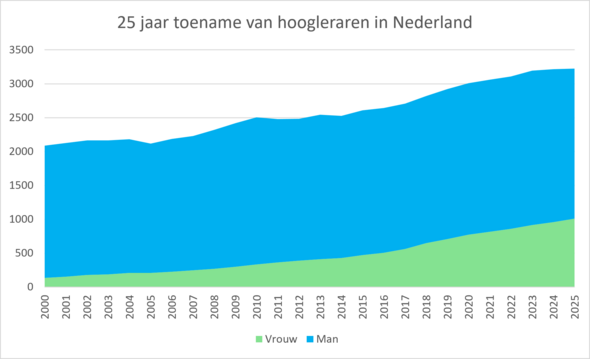
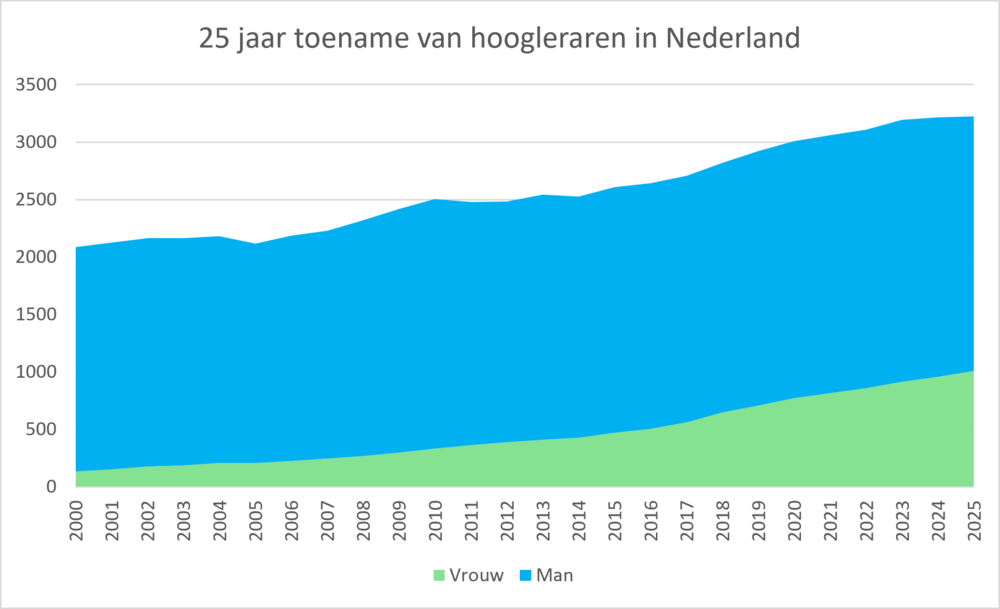
In 2000, there were only 136 female professors in the Netherlands, spread across fourteen universities—fewer than ten per institution. Today, there are more than one thousand. The number of male professors has also increased over the past 25 years, though less sharply: from around 1,950 to just over 2,200.
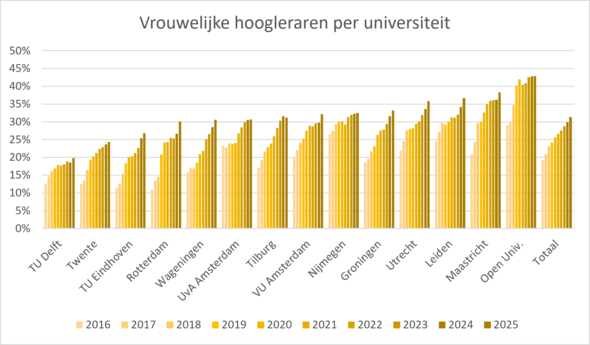
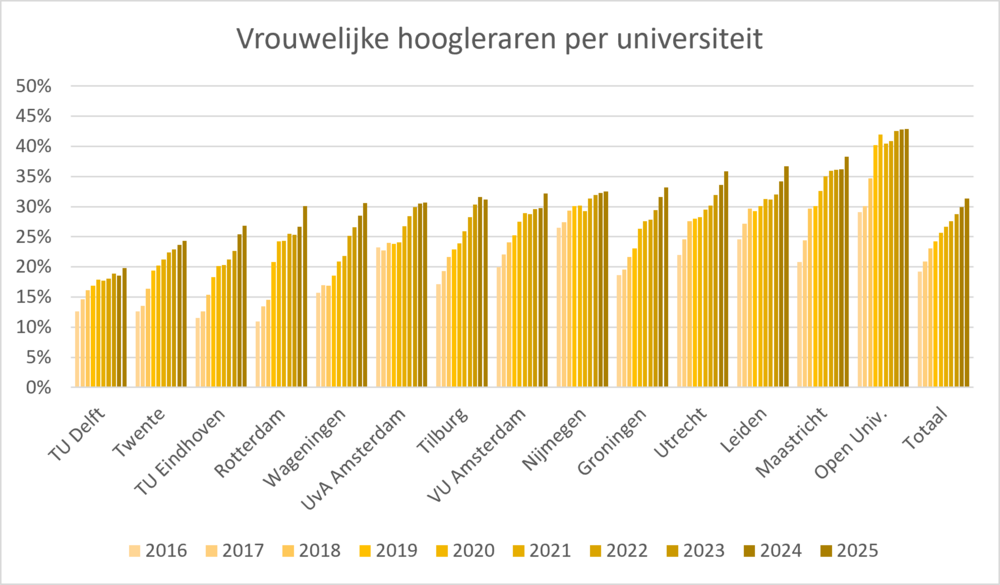
As a result, universities now employ a steadily growing proportion of female professors. At universities in Wageningen and Rotterdam, which had previously lagged behind somewhat, more than 30 percent of professors are women for the first time, according to new figures from the Universities of the Netherlands (UNL). Maastricht is approaching the 40 percent mark. The Open University, which specializes in distance education, has been above that level for years.
Among Dutch universities, TU Delft remains the only one where fewer than 20 percent of professors are women. The proportion of female professors is also relatively low at the technical universities of Twente and Eindhoven, where women account for 24 and 27 percent of professors, respectively.
Assistant and associate professors
Becoming a professor is not something that happens overnight. Academics generally first become assistant professors and then associate professors. To ensure that more women can eventually hold professorships, sufficient numbers of women must advance through those ranks.
Among professors, the share of women increased by 1.5 percentage points in 2025. Among assistant and associate professors, however, growth was much slower: only 0.4 percentage points. It is the smallest increase seen in years.
Budget cuts
This stagnation is likely related to budget cuts and declining student numbers. In previous years, universities expanded year after year, creating career opportunities for new talent, including women. But the number of professors and associate professors is now almost unchanged compared with a year ago, while the number of assistant professors has actually fallen by 336—from more than 7,200 to fewer than 6,900. That leaves little room for new appointments.
UNL also points out that women now make up 48 percent of assistant professors, while their share among associate professors continues to grow. This may partly explain why growth is beginning to level off.
The university association offers another possible explanation. Professors who retire—known in academia as becoming emeritus—are still predominantly men. Women who replace them are often drawn from the ranks of associate professors. While more women are entering the associate professor level, some of them leave that category again when they are promoted to full professor.
This article was translated using AI-assisted tools and reviewed by an editor.
Discussion