
- News
- 20/10/2026

Falling in love with a 3D-printed concrete house
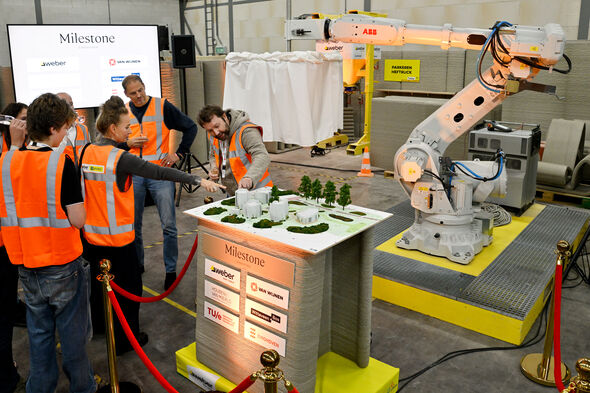
From digital design to digital construction: that is the idea behind the Milestone housing project. At the symbolic start of construction, visitors get a behind-the-scenes look: inside a large industrial hall, a concrete printer is printing the first components of the houses. Cursor spoke with some of the future homeowners.
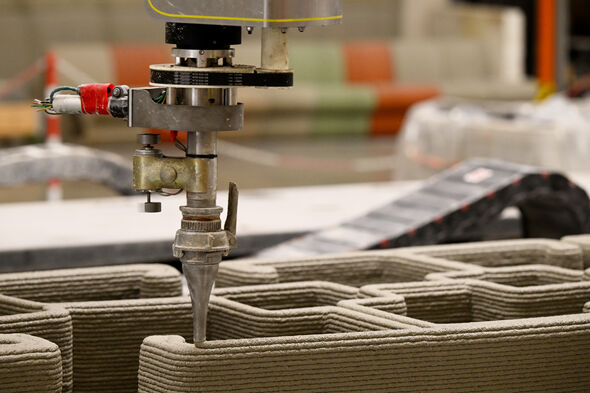
While houses are usually built on the site where they will stand, the houses in the Milestone project are being printed inside an industrial hall owned by Saint-Gobain in Eindhoven. The machine prints the different components of the houses layer by layer.
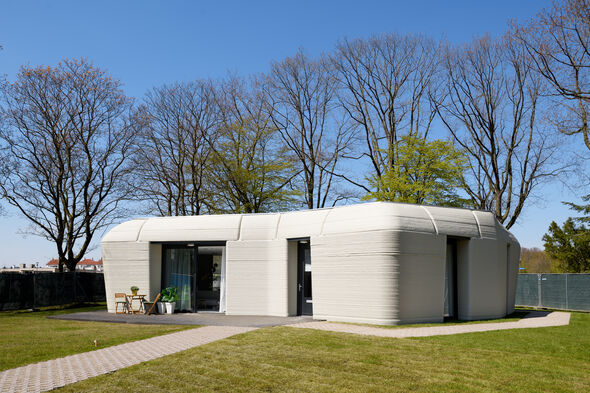
The Milestone project began with the construction of a 3D-printed house in the Bosrijk neighborhood of Eindhoven, which was completed in 2021. TU/e also contributed to the development of the printing technology as a knowledge partner. That first house has one floor, while the four new houses will have multiple floors.
The future residents
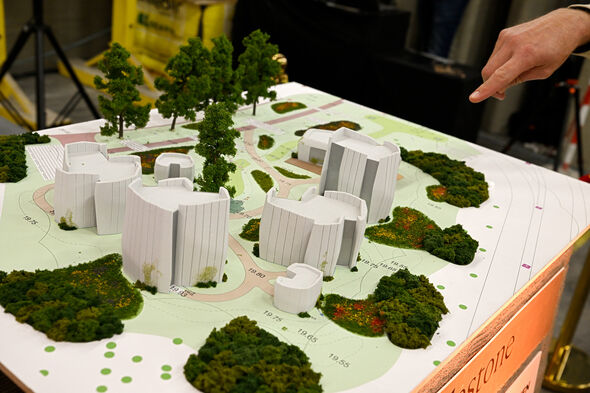
The future residents who attended the event gave the symbolic go-ahead for printing the houses. At the push of a button, a robotic arm revealed a scale model of the project.
For two future residents, both TU/e alumni, René Potters and Stephan van der Sman, it was love at first sight. They had both previously seen the first 3D-printed rental house. When it became clear that more houses would follow, they knew they wanted to own one themselves.
Potters explains: “My wife and I thought, ‘If they’re going to build houses for sale as well, we’d like to get in on that.’”
While searching for a house, Van der Sman found that all conventional new-build homes looked the same, with their repetitive concrete-panel construction. “I thought that first Milestone house was so cool. I immediately thought: I want one of those.”
For both buyers, the distinctive appearance of the organically shaped houses played an important role. The designs are inspired by glacial erratic boulders in the Scottish landscape. If the houses had looked like ordinary new-build homes, they would not have been interested.
A new way of building
“We call them Flintstone houses,” says Theo Salet with a chuckle. Salet is dean of the Department of the Built Environment and a part-time professor of Structural Design/Concrete Structures. “But that doesn’t really do the houses justice.”
He stands proudly among the various components of the future homes. Together with his research group, Salet developed the technology behind the houses.
“It really is a breakthrough,” Salet says. He does not expect 3D concrete printing to produce thousands of homes in the short term, but he believes the technology could contribute to a different, new way of building.
To build digitally on a large scale, the first step is to think a design through carefully. “The design itself, sending it to the machine, and the actual construction process: you have to make that process as simple as possible.”
Companies
The technology developed in academia must also be put to use in society if it is to help address the housing shortage.
Salet sees various companies taking steps toward the digitalization and industrialization of construction, each in its own way. “I think you inspire one another, and I think that is the movement that will eventually allow us to meet the housing challenge in the Netherlands.”
The first few components of the houses are already being printed. Assembly — “building them up like Lego,” as Salet puts it — will begin in January next year.
This article was translated using AI-assisted tools and reviewed by an editor.


Discussion