
- Student
- 2 min
- 27/08/2026
Moving out? Women go to Maastricht, men to Delft
CBS investigated which university cities young people in the Netherlands move to when they leave home
Nearly 32,000 young people moved from their parents’ homes in the Netherlands to a Dutch university city last year, Statistics Netherlands (CBS) reports. Maastricht attracted a relatively large share of women, while Delft attracted the largest share of men. In recent years, fewer and fewer young people have been moving into student housing within the Netherlands.
Statistics Netherlands investigated how many young people (ages 17 to 22) move to a city that has a university. There are bound to be exceptions, but CBS believes that the vast majority of these young people are students.
CBS looked at moves within the Netherlands; international students were not included in the study.
Housing shortage
From 2015 through 2021, around 36,000 young people per year moved from their parents’ home to a university city. That number has since fallen by 4,000. This is likely related to the housing shortage and rising rents, says CBS expert Tanja Traag.
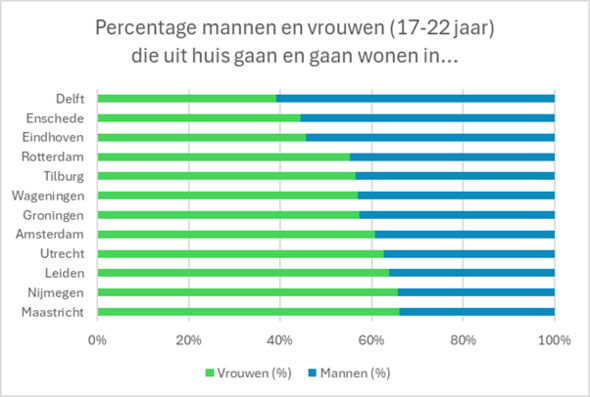
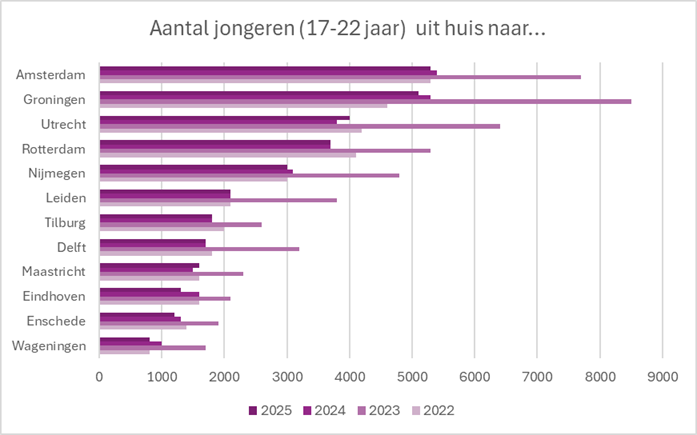
Around 1,300 young people moved to Eindhoven last year, compared with around 1,600 in 2022. In the peak year of 2023, when the basic student grant was reintroduced, the figure was as high as 2,100, according to CBS data. These figures include only young people who moved from other Dutch municipalities. International students are not included.
In recent years, students have been more likely to continue living with their parents. “Most eventually move out during their studies,” Traag says. “They just tend to do so more often in their second or third year these days.”
Twelve cities
Of the twelve university cities, Amsterdam and Groningen attract the most young people. In the peak year of 2023, Groningen was the city that attracted the most young people. In other years, Amsterdam was the most popular. Eindhoven is ranked 10th.
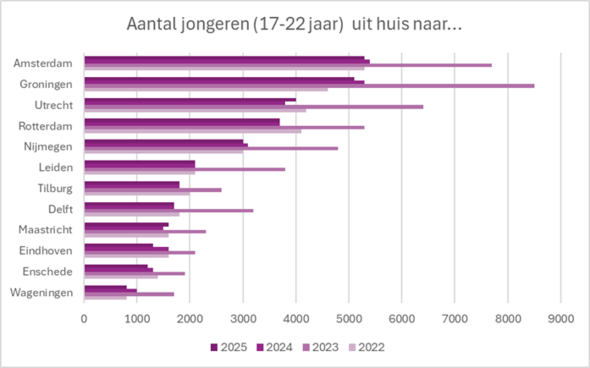
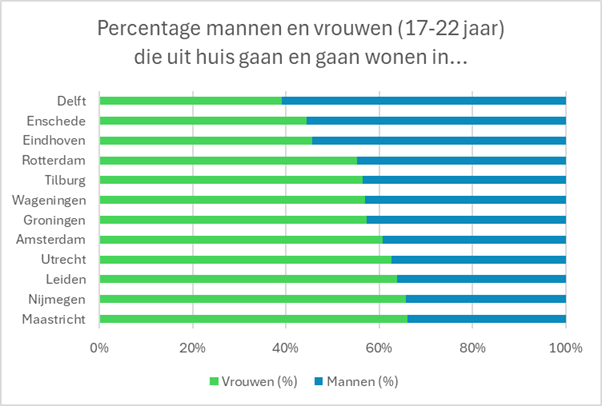
The cities with a technical university (Delft, Enschede, and Eindhoven) attract more men than women.
In Eindhoven, the gender ratio is relatively balanced: 54.3 percent men compared with 45.7 percent women. Delft attracts the largest share of men, at 60.8 percent, compared with 39.2 percent women.
In contrast, a proportionally higher number of women are moving to all other university towns, especially Maastricht and Nijmegen.
Home region
The statisticians also mapped where the young people moving to each city, come from (see CBS for an interactive map with figures for each city).
Most cities primarily attract young people from their own region. Dutch students in Eindhoven mainly come from the three southern provinces and the southern Randstad.
Groningen attracts few young people from Limburg, while conversely, few young people from the northern part of the country travel to Maastricht. And relatively few young people from either region leave home to live in Amsterdam.
But there are exceptions. Centrally located Utrecht attracts young people from all parts of the country, and Enschede also draws young people from across the Netherlands. Wageningen stands out: for that city, the distance from the family home appears to make relatively little difference.
This article was translated using AI-assisted tools and reviewed by an editor.
Discussion