- People
- 23/01/2026

Research beckons: Maarten Merkx steps down as dean
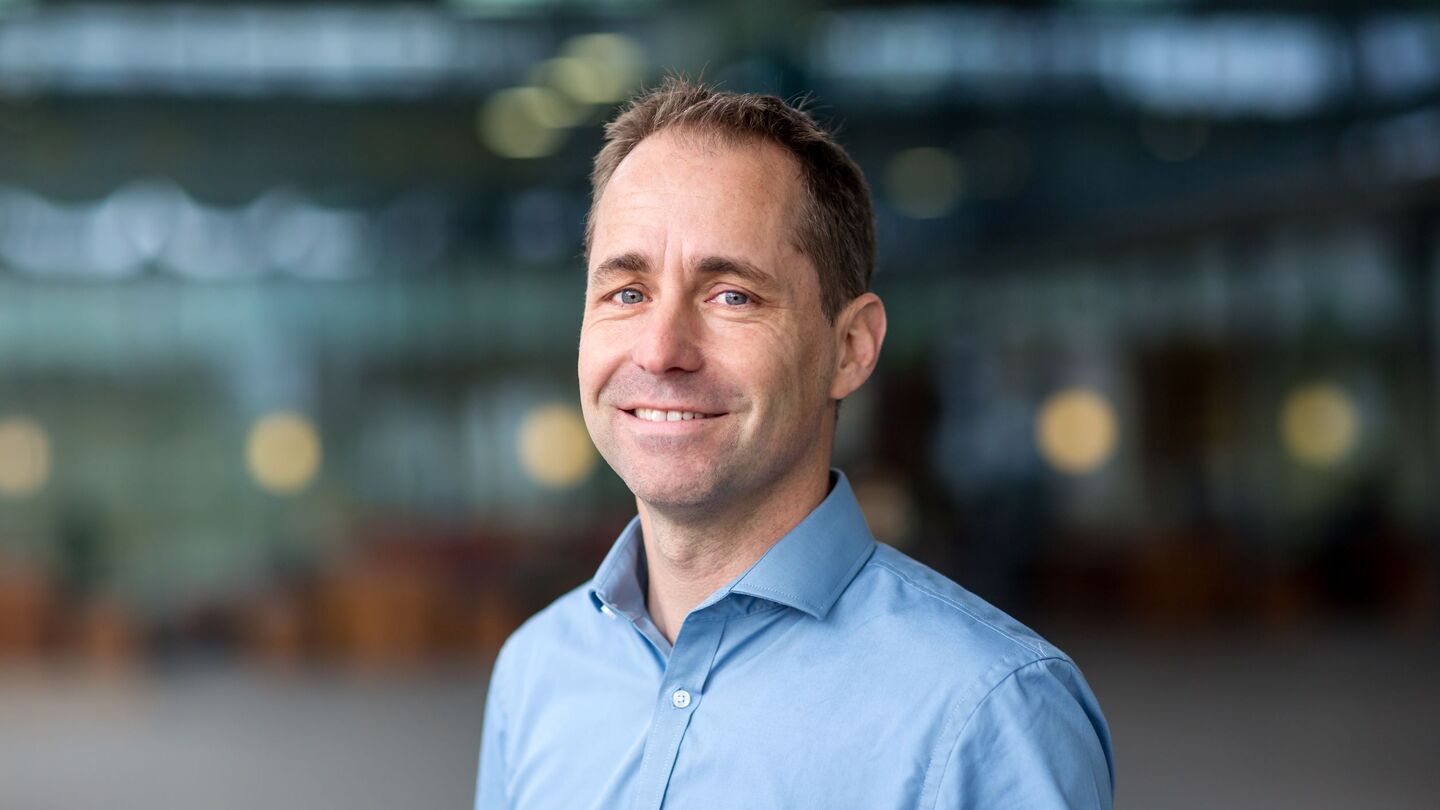
For over six years, Maarten Merkx has enjoyed serving as dean of Biomedical Engineering. Still, he will soon be stepping down from the role, although he could have continued until at least 2027. Research is calling. “There is so much happening in my field right now, and I’m really looking forward to devote more time to my research group.”
According to Merkx, the plan had always been to step down halfway through his second term. “When I became dean in 2019, I initially intended to do it for one term, a period of four years,” he explains. At the time, Merkx decided to keep his research group and continue teaching alongside his deanship—something he knew would require more time again in the long run.
“When I was asked to do a second term, I said yes, but I also indicated that I wanted to do it for about two more years,” he says. Formally, he was appointed for four years, until 2027, but in practice the agreement was that after two years he would return fully to his research and teaching.
Protein engineering
According to Merkx, the timing could not be better. “In my field, protein engineering, developments are moving incredibly fast right now. The application of AI is causing a revolution in the design of new proteins.”
His research group focuses on designing proteins that can function as biosensors: smart molecules that can very specifically detect the presence of a particular substance or, for example, a pathogen. Such biosensors can be used for rapid and accurate diagnostics, among other things.
To illustrate the importance of this work, Merkx refers to the COVID-19 pandemic. “During COVID, you generally had two types of tests to determine whether you had the virus. The PCR test was very reliable, but it took a lot of time and money. The at-home test was fast and easy, but less sensitive,” he explains.
“Using protein engineering, we are working on tests that are just as easy, fast, and inexpensive as at-home tests, but much more sensitive—and therefore more reliable.”
His group has since developed such tests for, among other things, sexually transmitted infections (STIs), COVID-19, and malaria. PhD candidate Harm van der Veer is currently testing the malaria test in Uganda, where the disease is widespread.
AI opens doors
The proteins designed for these types of tests are almost always based on existing proteins found in nature. “We take a protein with certain properties and adapt it for our applications,” Merkx explains.
“Take luciferase, for example—an enzyme that naturally occurs in deep-sea shrimp and produces light. We have modified that protein so that in our tests it emits a light signal when the virus in question is present. By using different colors, we can even detect multiple viruses or bacteria at the same time.”
Redesigning existing proteins has been done for quite some time, but developing entirely new proteins long remained a major challenge. “The function of a protein is determined by its three-dimensional structure, and that structure is the result of the amino acid sequence,” says Merkx.
Although this relationship has been known for decades, in practice it was extremely difficult to directly design the right sequence based on a desired structure or function. This often came down to a lot of trial and error, he explains. “You would design a large set of variants, make them in the lab, and hope that a few of them more or less did what you wanted.”
Models now are so good that you can say, ‘I want a protein that binds to a receptor protein on cancer cells'
With the rise of AI, that process has fundamentally changed. By training models on large amounts of protein data, predictions can now be made much more precisely. “Instead of hundreds of random designs, we now get a limited number of sequences, many of which immediately have a realistic chance of success,” Merkx says.
The first successful AI models for predicting protein structures emerged about five years ago, but developments are moving fast. “For about a year now, they’ve been so good that you can say, for example, ‘I want a protein that binds to a receptor protein on cancer cells.’ In medical diagnostics, that’s obviously incredibly valuable.”
Nobel Prize
The rise of AI in protein engineering is generating broad interest both within and beyond the field. In 2024, the Nobel Prize in Chemistry was awarded to three researchers for their work on AI-driven methods to predict protein structures and design new proteins.
Work to be done
With all these new developments and possibilities within reach, Merkx is now happily passing the dean’s baton to focus fully on his research again. “And I also teach,” he adds. “Of course, I need to make sure that I update my master’s course in protein engineering to reflect these new developments.”
He does not expect the transition back to research and teaching to be difficult. “I think that will be fine—I never really stopped doing this. I may need some time to get used to losing the rhythm of the deanship. That role comes with a certain dynamic that largely determines your day. When leading a research group, there is more freedom.”
Looking back
Looking back on his six and a half years as dean, Merkx mainly feels satisfied. “I look back on it with a great sense of fulfillment. I learned a lot during this period,” he says. The deanship allowed him to see the university “in all its complexity” and required different skills than working as a professor.
Still, he says, the role ultimately remains very much about people. The COVID period at the start of his first term accelerated that learning process, forcing him to make decisions more quickly and to trust his instincts.
Asked what he is most proud of, Merkx remains down-to-earth. “That’s for others to decide. The main thing is that I think I didn’t make a mess of it.” He points to the consistently high level of research and education in the department, and notes that fundamental work is increasingly finding its way into start-ups and clinical applications.
“I’m especially proud of the people who made all of this possible. I tried to give them as much room as possible to do what they’re good at.”
Maarten Merkx will remain dean of the Department of Biomedical Engineering (BmE) until the end of April. As of May 1, he will be succeeded by Jan van Hest.
This article was translated using AI-assisted tools and reviewed by an editor.
Discussion