
- The University
- 10/02/2026
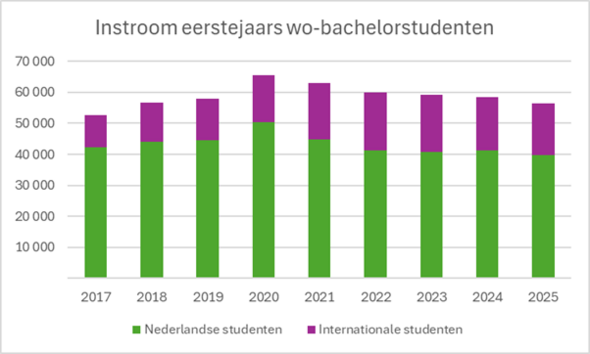
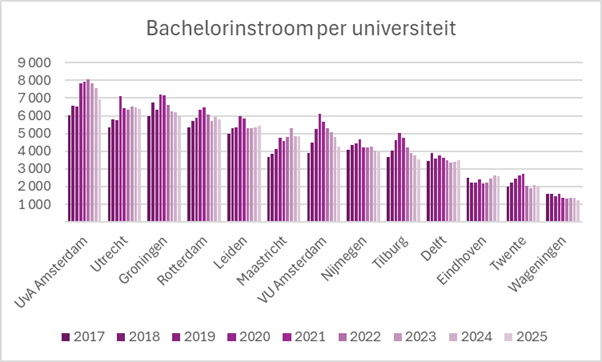
Around 56,000 bachelor’s students started at a Dutch university in 2025. That is 3.4 percent fewer than last year. For the fifth year in a row, the number of first-year students has decreased. Both Dutch (3.3 percent) and international intake (3.6 percent) have declined.
TU/e: fewer Dutch first-year students
2596 first-year students began a program at TU/e this academic year, compared to 2652 a year earlier—a decrease of 2.1 percent. The decline is in the intake of Dutch students, as international applications actually increased, with 99 additional first-year students from abroad. Source: UNL
Dutch students
Only the bachelor’s programs in law saw an increase in the number of Dutch first-year students. In the “behavior & society” sector, numbers remained the same. In all other sectors, however, the numbers declined.
According to the universities’ association UNL, this is because fewer VWO students have started a degree program; there were fewer VWO students taking final exams, and they also passed less often. Moreover, they appear to be taking a gap year more frequently.
International students
International intake also declined, by 3.6 percent. Students from other European countries (EEA countries) in particular are choosing a bachelor’s program in the Netherlands less often.
The now outgoing Schoof administration had planned to cut back on these students. A new law was intended to reduce the number of internationals. Measures included a “language test” for English-taught programs. But the new coalition is scrapping this plan.
Remarkably, the shortage sectors of engineering and healthcare are attracting more internationals—especially engineering. Nearly one in five international students who started a bachelor’s program in the Netherlands in 2025 chose an engineering program.
Technical universities
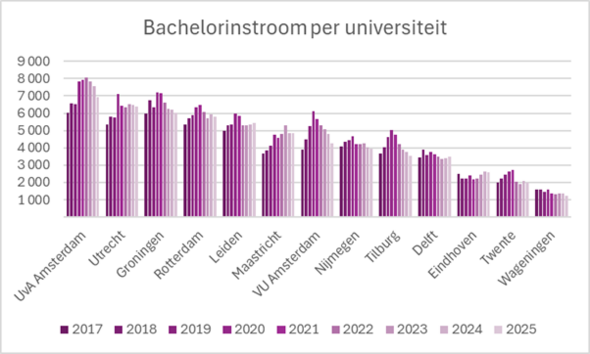
Delft, Eindhoven, and Wageningen were the only universities in 2025 to attract more international students than in 2024. In Wageningen’s case, this concerns one student. However, the universities of Eindhoven and Wageningen attracted fewer students from within the Netherlands, meaning their overall intake still declined.
Despite fewer international students coming to Leiden, the university still saw more first-year students starting: the number of new Dutch bachelor’s students rose by almost six percent.
The University of Amsterdam remains the largest university in the Netherlands but welcomed more than six hundred fewer first-year students this year than in 2024. At Vrije Universiteit, the decrease was around five hundred.
Decline
In total, 332,000 bachelor’s and master’s students are enrolled at a Dutch university, including about 91,000 internationals. Last year, the total number was 338,000.
UNL is concerned about the decline. “Without an inviting talent strategy, we undermine our science, (societal) innovation, and our economy,” says chair Caspar van den Berg.
Top talent
The coalition parties have indeed included such a talent strategy in their new agreement. “Universities and universities of applied sciences will be given more targeted opportunities to attract international top talent and retain domestic talent,” write D66, CDA, and VVD.
At the same time, the coalition parties consider it important to “maintain control” over the arrival of international students and want to make “binding administrative agreements” about this with educational institutions.
This article was translated using AI-assisted tools and reviewed by an editor.
Discussion