
- Research
- 15/12/2025
Winner Talking Science 2025: repairing the hole in your knee
From toilet brushes and earthquakes to ice crystals and damaged knees: during Talking Science 2025, twelve TU/e researchers proved that complex science can be told as a compelling story—in just three minutes. With no slides and no formulas, creativity and clarity took center stage. Which pitches convinced the jury the most?
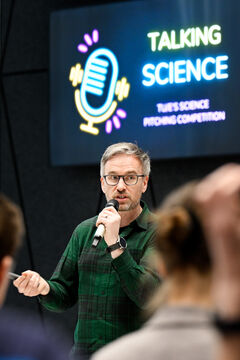
About a hundred people are gathered on Friday afternoon in the Defense Room in Atlas for Talking Science, TU/e’s fast-paced science-pitching competition. Now in its third edition, the event has brought twelve TU/e researchers—EngD candidates, PhD candidates, and postdocs—to the stage, each with one challenge: explain their research creatively and convincingly in just three minutes. No slides, no graphs, no equations. Just storytelling.
Science communicator (and superhero enthusiast) Barry Fitzgerald once again has taken on the role of moderator. As in previous years, Fitzgerald coached the participants beforehand, helping them convey their message more effectively. “I love to share these stories,” he says before kicking off the afternoon.
The jury panel features ED journalist Mascha Prins, Calum Ryan (researcher and winner of Talking Science 2024), Margriet van der Heijden (full professor of science communication), and Barbara Malheiros (project manager at the Research Support Office). As always, they are tasked with selecting the first and second prize winners, while the audience will choose their own favorite.
Adding to the tension: none of the contestants know in advance when they will be called to the stage. Only moments before their pitch do they discover their place in the lineup—heightening nerves and excitement as the competition gets underway.
3D world representation
Yasaman Kashefbahrami is the first to take the floor with her intriguing research on real-time 3D world construction. She opens with a surprising question to the audience: “Who here has been in an earthquake?” She admits that she had—and that it was a terrifying experience. The damage in her case was less severe than she feared, but the event made her realize how important it is to be prepared for worst-case scenarios.
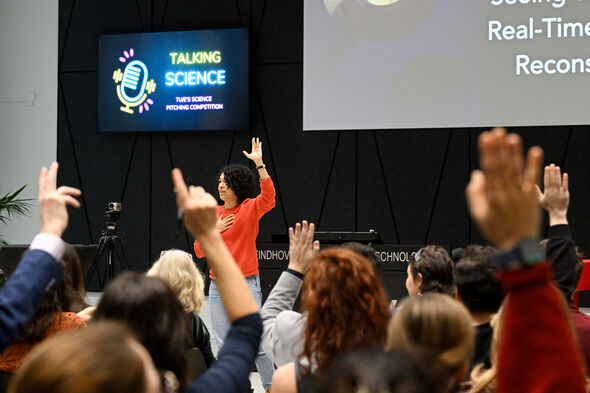
That insight now drives her research on creating 3D maps: digital models of the world that capture the size and position of people and objects, helping us understand our surroundings more precisely and in real time. “That would help rescuers understand where people might be trapped and evacuate them safely and quickly,” she explains.
From a toilet brush to a pandemic
The contestants follow one another at high speed, each presenting a completely different research area—yet in such engaging and accessible ways, using low-threshold metaphors, that you almost stop thinking in terms of departments or research groups. Instead, the pitches make you think in terms of possible solutions to real-life problems.
Among them is Lotte Weedaege, who explains how models of human mobility play an important role in predicting how a virus spreads during a pandemic.
Jennifer van den Berg takes a more personal approach, sharing how her own vulnerability became her superpower. As a postdoc researching psychological safety, she emphasizes its importance. “We can only open up and show our vulnerability when we feel psychologically safe, without fear of being dismissed or judged—and it has been proven to be vital for organizations to perform and thrive.”
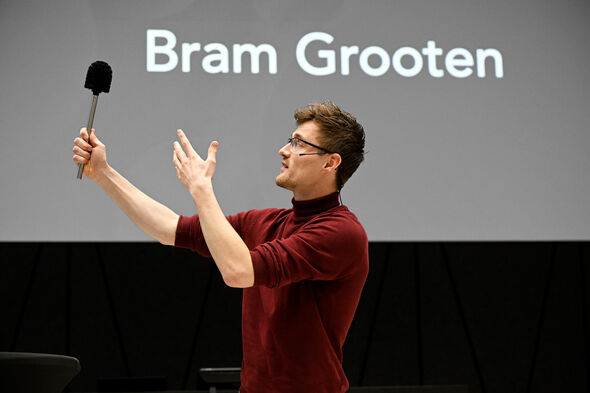
Bram Grooten also intrigues the audience, walking on stage holding a toilet brush. His dream is to see robots take over all household chores in the future—especially cleaning toilets, which he dislikes the most. To make that possible, robots need to learn not to get distracted by their surroundings.
Grooten is developing technology that allows robots to “see” only what is relevant for their task, hiding or blurring the rest of the visual information so they can stay focused.
Inspired by fish
Although many of the pitches were impressive, only three contestants can walk away with a prize.
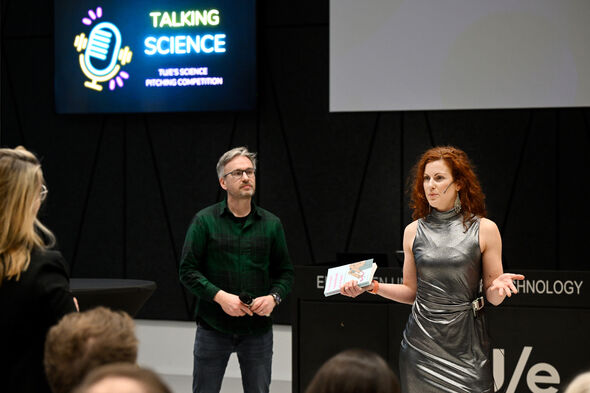
The audience prize and a 500-euro cheque go to Daniëlle van den Broek (in the main photo on the left), who studies the behavior of ice. When temperatures drop, ice crystals form and continue to grow, eventually causing damage.
Van den Broek investigates how to keep ice stable and prevent this harm, drawing inspiration from nature—such as fish that survive in icy water without injury. She is designing smart “ice stickers” that can stop ice growth, helping protect plants, donor organs, and even food from ice-crystal damage.
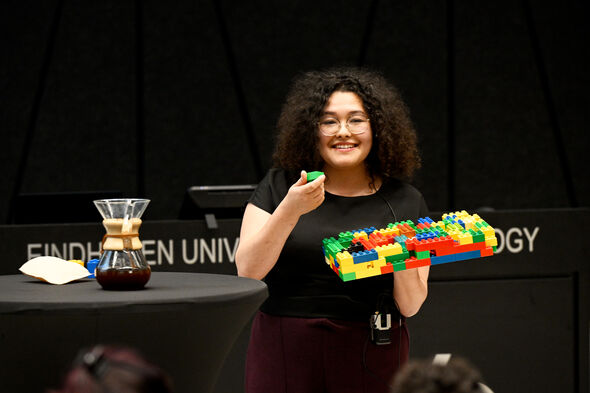
The jury awards PhD researcher Jadwiga Poniatowska the second prize and a cheque for 500 euros for her pitch on giving membrane materials a second life. Many of these membranes are made of plastics and become waste once they are damaged.
Poniatowska is developing solutions—using a mix of chemistry and smart design—to make membrane materials recyclable and repairable, and therefore more sustainable.
A hole in your knee
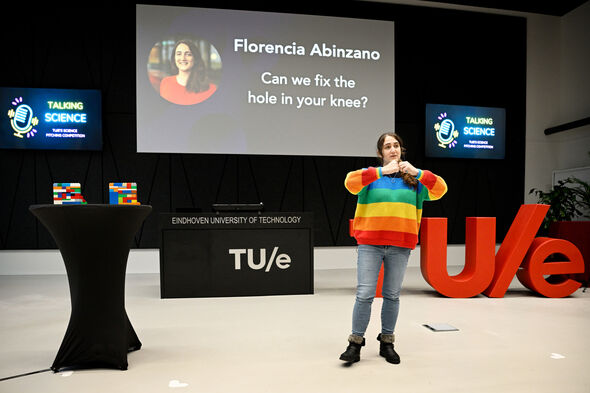
The overall jury winner, receiving a cheque for 750 euros, is Florencia Abinzano with her pitch titled Can we fix the hole in your knee? In her winning presentation, the postdoc researcher at Biomedical Engineering explains how damaged cartilage in the knee causes unbearable pain and why it is so difficult to replace the tissue with new, healthy cartilage.
She is exploring ways to encourage cartilage cells to refill the injured area with durable, long-lasting tissue, so knees can keep functioning for many years.
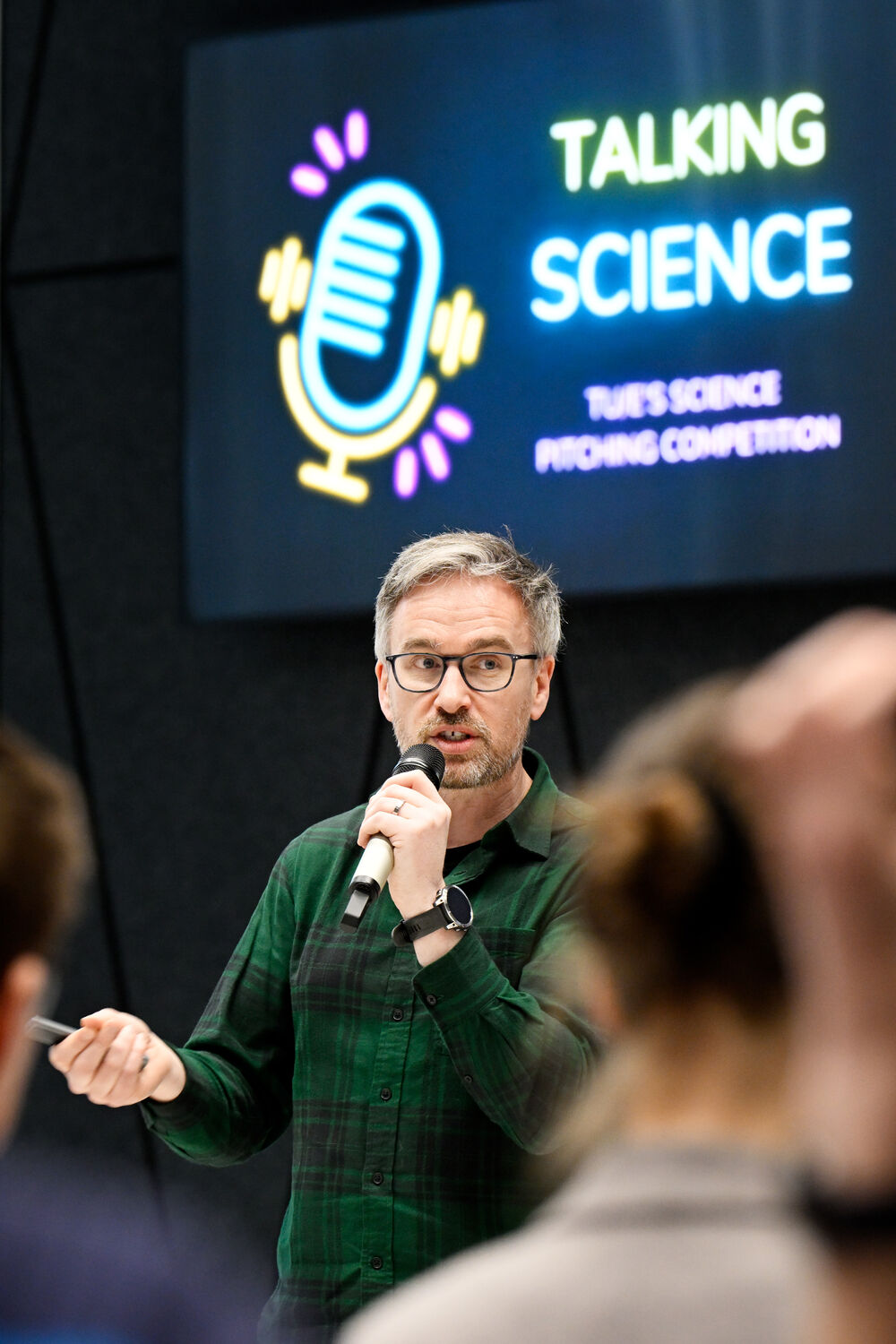


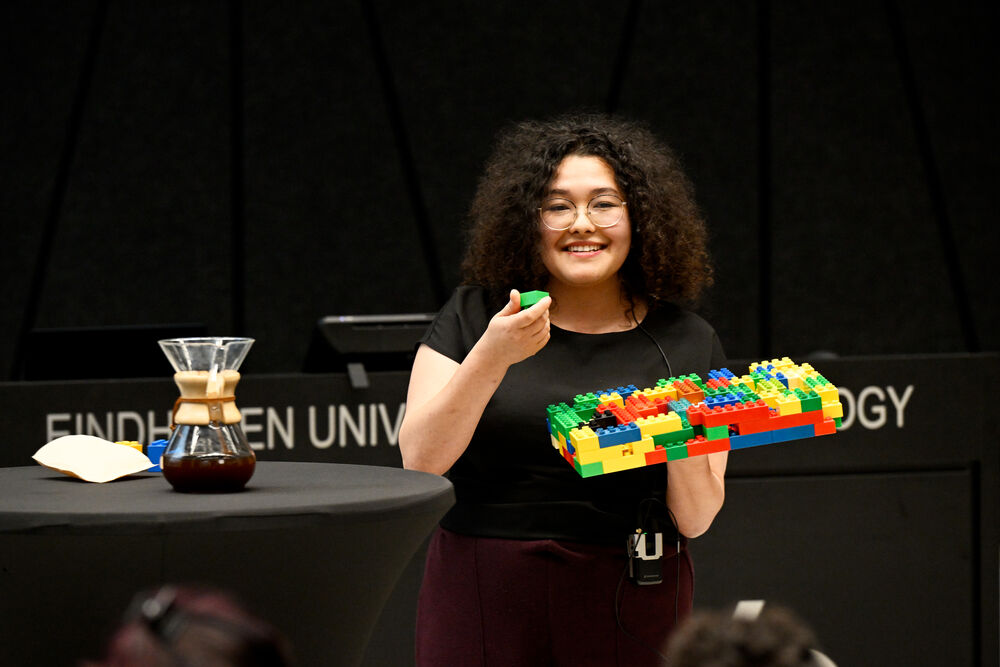

Although Abinzano’s pitch has made the greatest impression on the jury, she herself would have voted for Bram Grooten’s presentation. “I think Bram did really well. His message was extremely clear, so it will stay with everyone.”
While she is a little surprised by her victory, she is also extremely happy. She considers the award a great encouragement to continue her work with even greater enthusiasm. “My dream is to keep people moving—walking, dancing, whatever they want,” Abinzano says.
This article was translated using AI-assisted tools and reviewed by an editor.
Discussion