
- Research
- 12/03/2026
KIVI Congress at TU/e: building a stronger Europe
What will the Europe of tomorrow look like—and what role will engineers play in shaping it? That question was at the heart of KIVI's Engineer’s Day, held at TU/e on Wednesday. “Europe must be the drawing, not the background,” argued Rector Magnificus Silvia Lenaerts. There was also royal attendance: Princesses Beatrix and Mabel presented two awards.
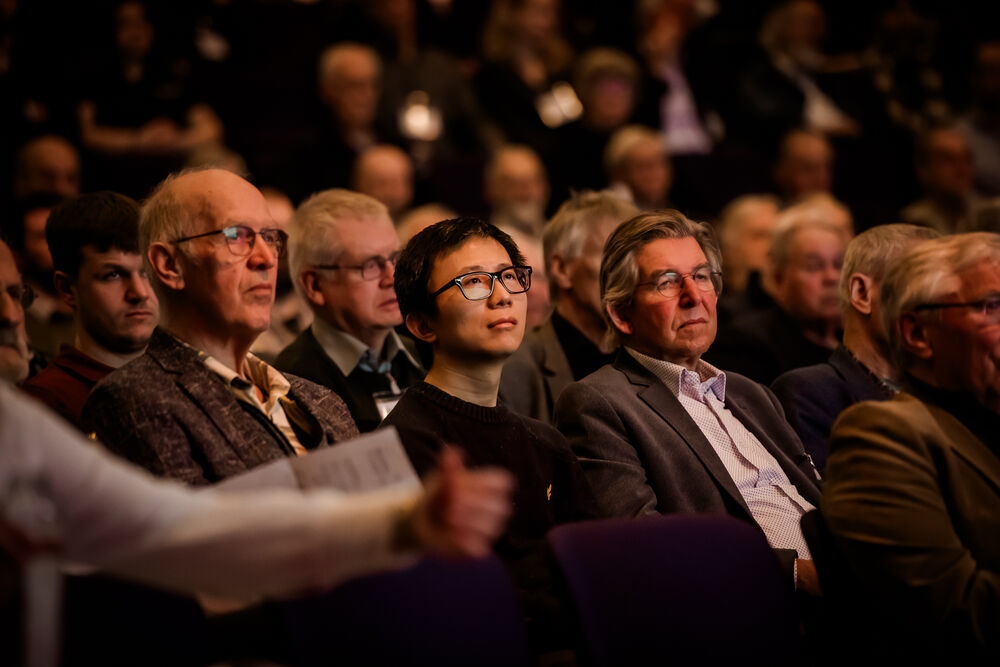
A few hundred engineers, researchers, and students gathered on Wednesday morning in the Blauwe Zaal of the Auditorium for Engineer’s Day. The annual congress of the Royal Netherlands Society of Engineers (KIVI) brings engineers from across the country together and features two awards: the Prins Friso Engineer of the Year Award and the KIVI Engineering Student Team Award for talented student teams.

But this year, a broader question resonated throughout the event: how can engineers contribute to a stronger Europe?
Moderator Celina van den Bank, a civil engineer and TU/e alumna, opened the program and immediately explained why the theme is so timely. In a world full of transformations and geopolitical shifts, the question is more urgent than ever: how do we shape the Europe of tomorrow? The conference therefore focused on engineering challenges in mobility, digitalization, defense, and energy.
Two power women
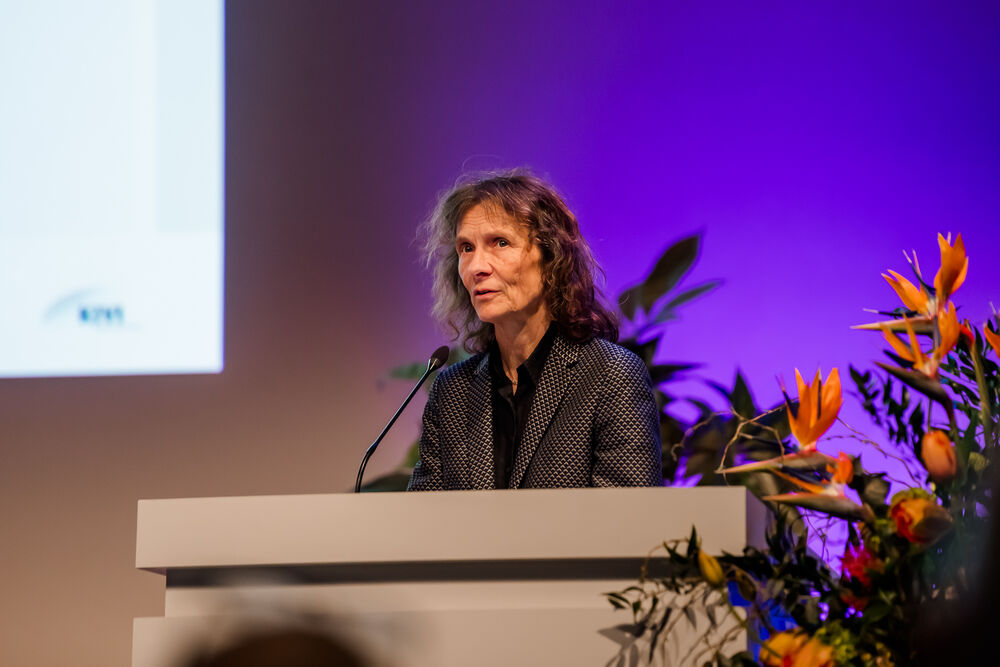
After this introduction, Van den Bank handed the floor to two “power women who have achieved something remarkable”: TU/e Rector Magnificus Silvia Lenaerts, the university’s first female rector, and KIVI President Diana van den Heuvel.
Lenaerts began with a metaphor that nodded to the conference theme Blueprint for a Stronger Europe. She explained that the word “blueprint” comes from cyanotype, an old technique in which a technical drawing was placed on light-sensitive paper. When exposed to sunlight, the background turned deep blue while the lines of the drawing remained white. “Exactly the opposite of how we print today,” she said.
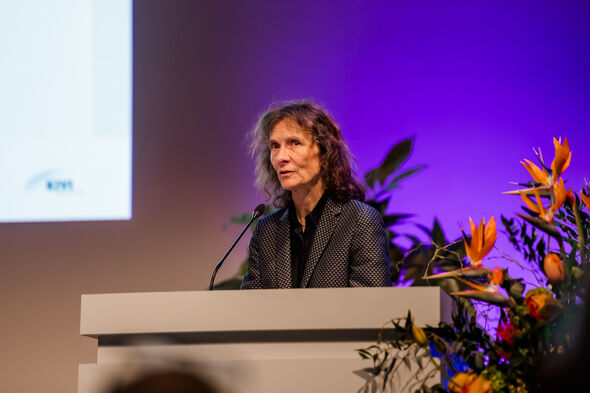
The question, she argued, is whether the Europe of the future will be the background or the drawing. “Too often, we are the background—and that needs to change.”
Striving for indispensability
Lenaerts then focused on the role of technology in today’s geopolitical landscape. Technology, she said, is no longer neutral. Who controls our data? Who oversees our energy networks? These are no longer purely technical questions—they are questions of sovereignty.
This new reality, she argued, also demands a different role for engineers. “They need to see the bigger picture and understand what is at stake.”
Full technological independence for Europe is, according to Lenaerts, an illusion. “What we should strive for instead is indispensability.” She cited ASML as an example: without the chip machines from the Veldhoven-based company, the global chip industry would grind to a halt.
The key, she said, lies in greater collaboration within Europe. “We need to look beyond our borders and seek more connection. Only then can Europe become the drawing, instead of the background.”
Scaling up
KIVI President Diana van den Heuvel also addressed the central question: how do we strengthen Europe in a world that is changing faster than ever?
“From conflicts in Ukraine to tensions in Iran—we see how quickly reality can shift. Our system relies on data and infrastructure. We need to strengthen our independence and make our entire chain more resilient.”
According to Van den Heuvel, the knowledge is already there, but the key is speed and efficiency in applying it on a large scale. “We must dare to accelerate, scale up, and make choices.”
She closed with a clear message to the audience: “You are at the drawing board of a stronger and more resilient Europe. Build smarter, build for the future.”
Taking control of our destiny
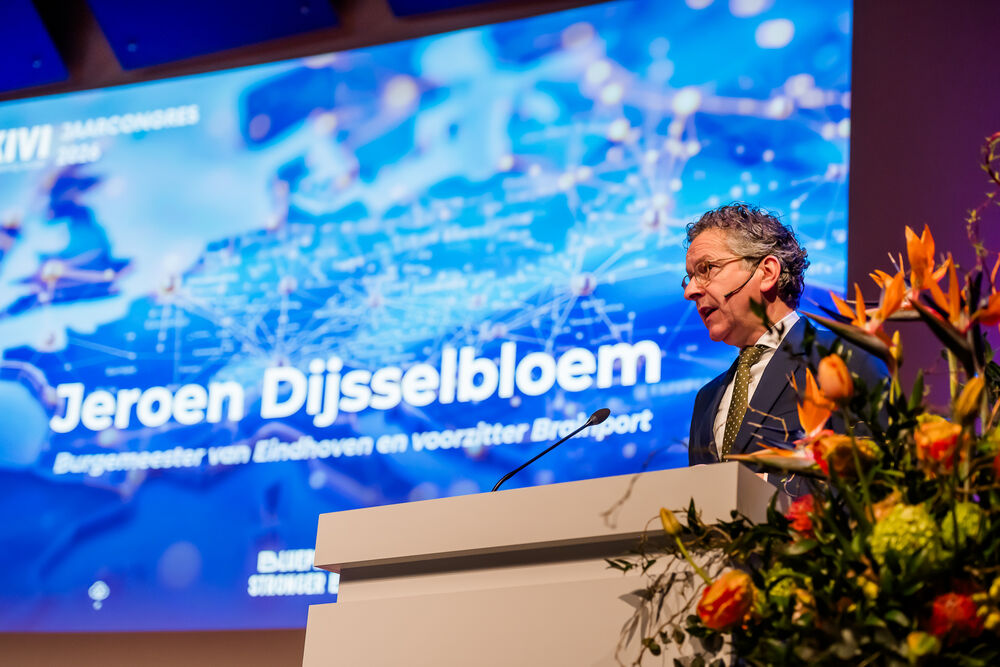
Next, Jeroen Dijsselbloem addressed the audience. The former member of the Dutch House of Representatives, former Minister of Finance, and since 2022 Mayor of Eindhoven also emphasized that the future relies heavily on technology. “Geopolitics and technology have become completely intertwined,” he said.
While China holds a dominant position in raw materials, production, and technology, U.S. companies control the major digital platforms. The question, Dijsselbloem argued, is how Europe can remain relevant in this power landscape. “If you’re not at the table, you’re on the menu,” he quoted former ASML CEO Peter Wennink. “Do we still have our fate in our own hands? That’s the core question.”
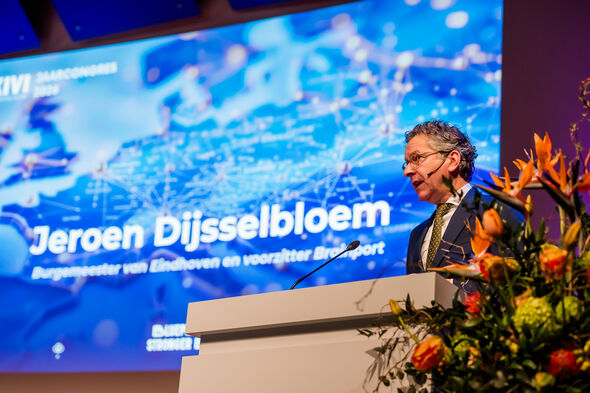
Dijsselbloem stressed the importance of scaling up. American companies succeed with technology developed here, he noted. “We have gold in our hands, but we need to get better at bringing it to market quickly and scaling it.”
At the same time, that growth brings challenges. Eindhoven faces a severe housing crisis. “I won’t sugarcoat it,” the mayor admitted. But shutting off growth, he said, is not an option. “Then companies will expand elsewhere, in the U.S. or Asia.”
“It’s fantastic to have a global player like ASML in the region and to let it continue growing here,” he continued. Yet that growth requires choices. Housing will therefore be a key theme in the upcoming municipal elections. According to Dijsselbloem, the question is not whether Eindhoven should grow, but how to manage that growth in balance.
Unmanned maritime systems
In the afternoon, parallel sessions were held around the four strategic themes: mobility, digitalization, defense, and energy. Under the defense theme, Bas Buchner from the Royal Netherlands Navy spoke about the Taskforce Maritime Uncrewed, which focuses on accelerating the development of unmanned maritime systems, such as drones that can operate above and below water.
“We need to build knowledge together and get to work quickly to make this happen, to be prepared for the future,” he said. The goal is for these systems, together with manned units, to ultimately form a system of systems, effectively collaborating to significantly enhance the navy’s operational power. This prepares the navy of the future for threats such as mines, drones, and missiles.
Semiconductors
During the digitalization session, Bart Smolders, scientific director of TU/e’s Casimir Institute, spoke about strategic opportunities in the semiconductor sector. According to Smolders, so-called heterogeneous integration will be crucial in the future: combining electronics with other technologies such as photonics, quantum, and spintronics.
“This approach can enable higher performance, energy efficiency, more compact systems, and new applications,” he explained. Although much research is still needed to integrate these technologies reliably and efficiently, Smolders sees major opportunities for the Netherlands and Europe, particularly for start-ups.
Courage
Across all sessions, a clear message emerged: it’s not just about the knowledge we have, but how we strategically use it. Whether Europe ultimately becomes the blueprint or the background depends on the choices made today. “Engineers play a key role in this,” Van den Heuvel said. “The question isn’t whether we have the technology—but whether we have the courage to use it.”
Martijn Otten and Project MARCH awarded
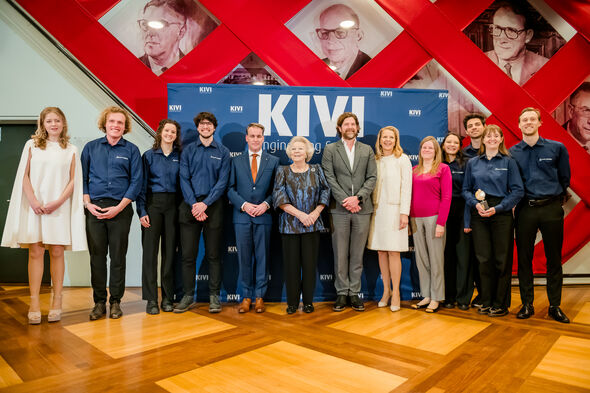


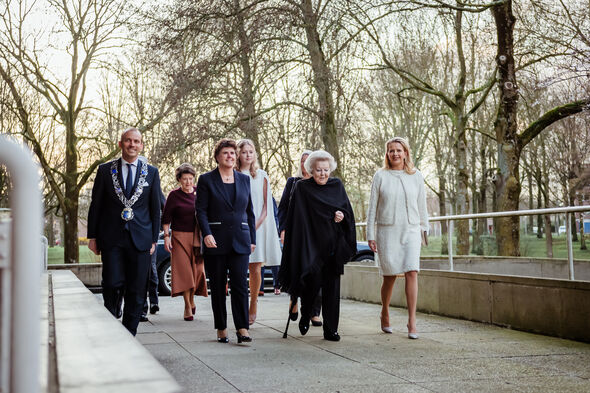
At the 12th Prins Friso Engineer of the Year Award ceremony, Martijn Otten was named Engineer of the Year 2026. The award was presented by KIVI President Diana van den Heuvel and Princess Mabel, in the presence of Princess Beatrix. Otten was recognized for his work on projects such as Aquadrones for high-risk missions, advanced production lines in Ukraine, and robotics systems. He succeeds Meike Nauta, who received the award last year.
On the same evening, TU Delft’s Project MARCH received the KIVI Engineering Student Team Award. The team develops open-source exoskeletons for people with spinal cord injuries. Thanks to these motorized robotic suits, people with paralysis can regain movement. The team was honored for its multidisciplinary approach and close collaboration with patients and rehabilitation experts. Other nominees included Formula Student Team Delft, which builds race cars, and EduQuation team from TU/e and Fontys, which explains quantum concepts through video games, virtual reality, and board games.
Discussion