
- Sports
- 19/03/2026
“A strong chance that Thêta will win the Varsity this year”
Brimming with confidence, student rowing association Thêta is heading to Houten on Sunday, March 29. There, the Eindhoven-based club will compete in the Varsity, the premier event for student rowers. On the Amsterdam-Rijnkanaal, the “Oude Vier” will go head-to-head with nineteen other associations.
“Every student involved in rowing has circled March 29, 2026, in red on their calendar,” says Kevin Jansen, president of student rowing association Thêta. That’s the day the Varsity takes place—the most important competition for student rowers—on the Amsterdam-Rijnkanaal Canal near Houten. The main event is called “De finale der Oude Vieren” and covers a distance of 3,200 meters. “March 29 marks the start of our rowing season—we really kick things off then. This race brings out the strongest sense of community within the association.”
Last Wednesday, the lineup for the Oude Vier was announced: Adam Street, Kaspar van Zelst, Olle van Bohemen, Jelle Teekens, and coxswain Noa Lindeman. “They’re working hard in preparation to achieve the best possible result for the association,” the president says.
A historic rowing celebration
Jansen beams as he talks about the Varsity. “Since the 1800s, students from Cambridge and Oxford have competed annually on the Thames. The Varsity is the Dutch equivalent. It used to be an event dominated by traditional student corps, but nowadays non-corps associations are also allowed to participate. These are referred to by the recognized corps as “knorren,” which stands for Kennen Niet Onze Regels (“Do Not Know Our Rules”). Thêta falls into that second category, as our association does not originate from a recognized corps.”
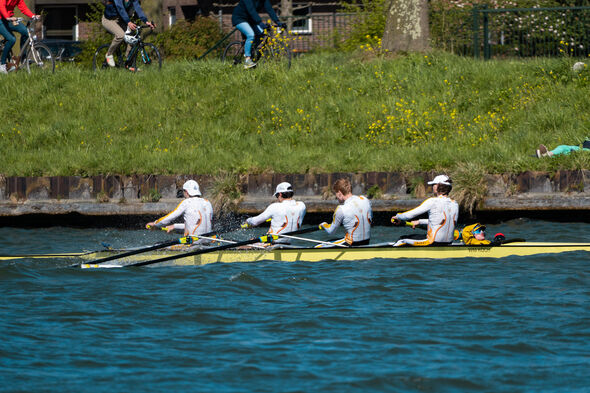
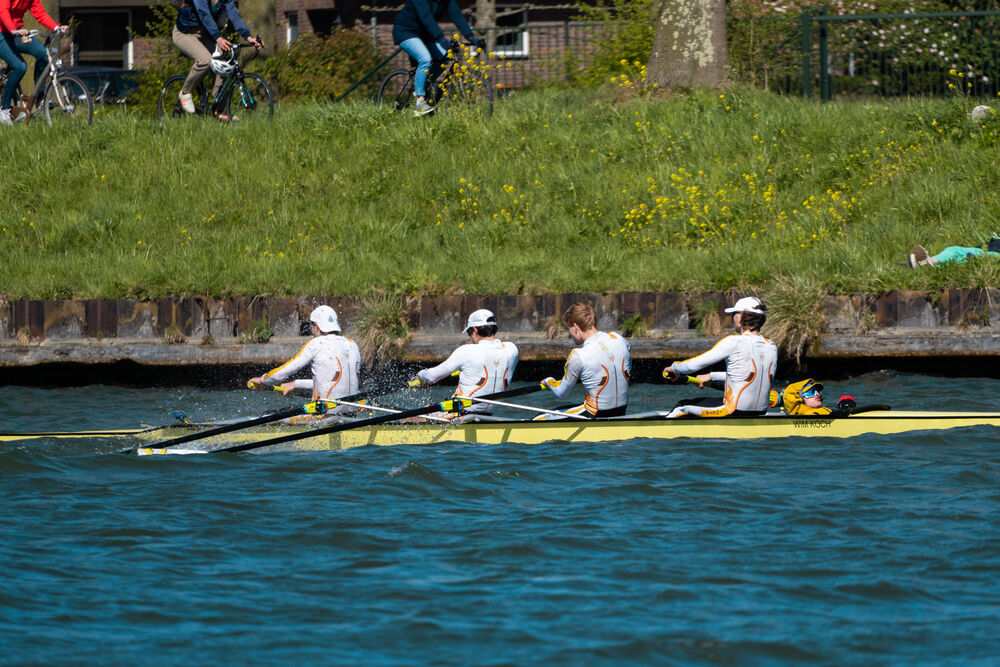
Thêta first participated in the Varsity in 2001. The Eindhoven team had strong prospects: with four Olympic rowers, a brand-new boat, and international training camps, success seemed almost guaranteed. Unfortunately, due in part to an injury to one of the rowers, they were unable to bring home the gold. Finishing just seconds behind the two fastest boats, Thêta placed third.
In 2002, Thêta secured second place. Then a twelve-year period followed without reaching the final, but since 2018, Thêta’s Oude Vier had been a consistent finalist in the Varsity—until last year.
“There are nineteen student rowing associations in the Netherlands. We’re among the four smallest. Making it to the final means you’re one of the top seven rowing clubs. So relatively speaking, we’re performing very well.” He quickly adds: “But pride doesn’t count—if you don’t win.”
Strong chances this year
This year, however, the entire association senses an opportunity for victory—and the coaches agree. One key factor is that the World Rowing Championships will be held in the Netherlands in 2026. According to Jansen, the Dutch rowing federation KNRB is focusing on that event.
“That means national team rowers won’t be competing in the Varsity this year. Clubs from Amsterdam and Utrecht have the most national team rowers.” Thêta has only two: honorary member Sander de Graaf and Vera Snijders. Since De Graaf is no longer a student, he is not eligible to compete in the Varsity, and Thêta has not entered a team in the Women’s Four category, in which Snijders could have participated. “So we’re not missing any national team rowers, while clubs from Amsterdam and Utrecht are.”
The preliminary races (over 2,000 meters) and the final all take place on the same day.
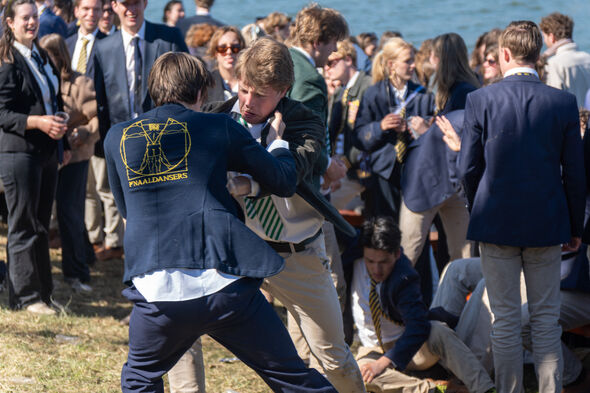
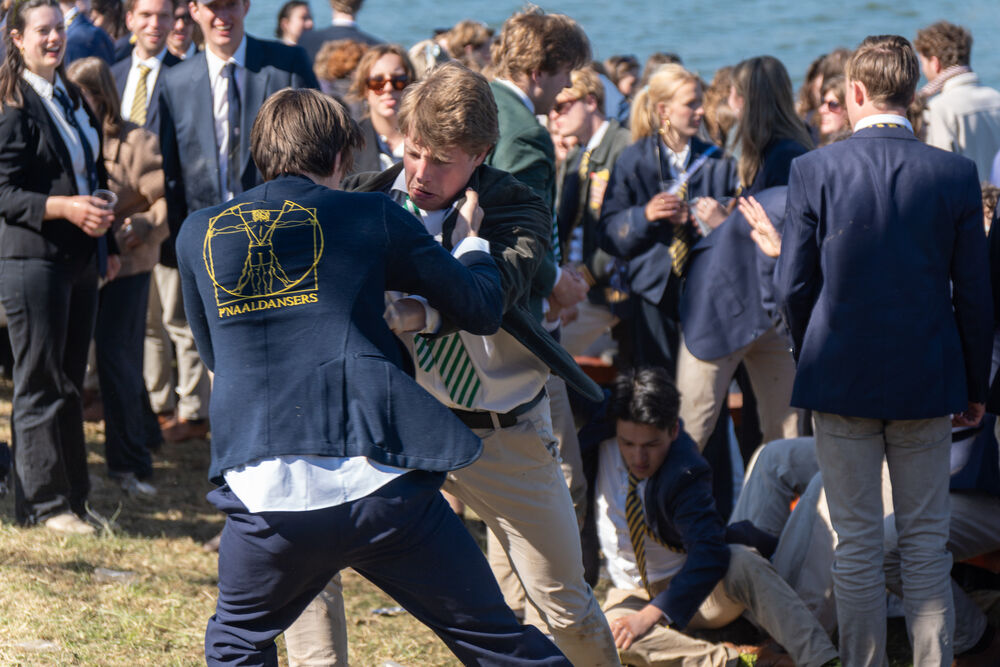
Competition isn’t limited to the water; along the canal banks, students engage in “brassen”—a traditional form of grappling—until one ends up with both shoulders on the ground. “You grab each other by the lapels and push and pull. It never turns into a real fight, because you don’t use your legs. Afterward, the winner consoles the loser with a beer.”
A traffic jam of container ships
The location of the spectacle is unique, Jansen emphasizes. “Normally, large container ships are constantly passing along the Amsterdam-Rijnkanaal all day. But during the Varsity, shipping traffic is halted for the student rowers, except for a break in the afternoon—aptly called the ‘shipping break.’”
The Varsity is steeped in tradition. Winners are congratulated in the water by naked men—who are considered not truly naked because they keep their ties on. “Naked, yet not bare,” as the rule goes. It is also tradition for the winning association to host a kroegjool—a celebratory party everyone looks forward to. “That would be one of the most meaningful celebrations for Thêta,” says the president. “Just as special as the Varsity itself.”
This article was translated using AI-assisted tools and reviewed by an editor.
Discussion