
- Campus
- 27/03/2026
A closer look at the art on the TU/e campus
The TU/e campus is filled with art, both inside the buildings and outdoors. For those who pass by it every day, it can easily fade into the background. That is why TU/e art curator Britte Sloothaak takes interested students and staff on art walks, helping them rediscover the gems scattered across campus. The first edition took place on Thursday.
Despite the chilly wind on Thursday afternoon—and at one point even a brief spell of hail—a group of around ten students and staff members gathers at the south entrance of Atlas. It marks the starting point of the so-called Campus Art Tour, organized by Studium Generale and Britte Sloothaak, curator of the TU/e art collection.
Creativity in a technical environment
But how did the university’s art collection come into being? TU/e was founded shortly after the Second World War, in 1956. From the very beginning, there was attention for the role of art on campus, Sloothaak explains. “Professors, but also Philips from the industrial sector, already emphasized that in such a rational and technically driven environment, there must be room for creativity and emotion.”
The TU/e collection consists exclusively of modern art, primarily postwar works that were characteristic of that period—in the context of the Dutch reconstruction, Sloothaak explains.
‘De Technische Student’, south entrance Atlas
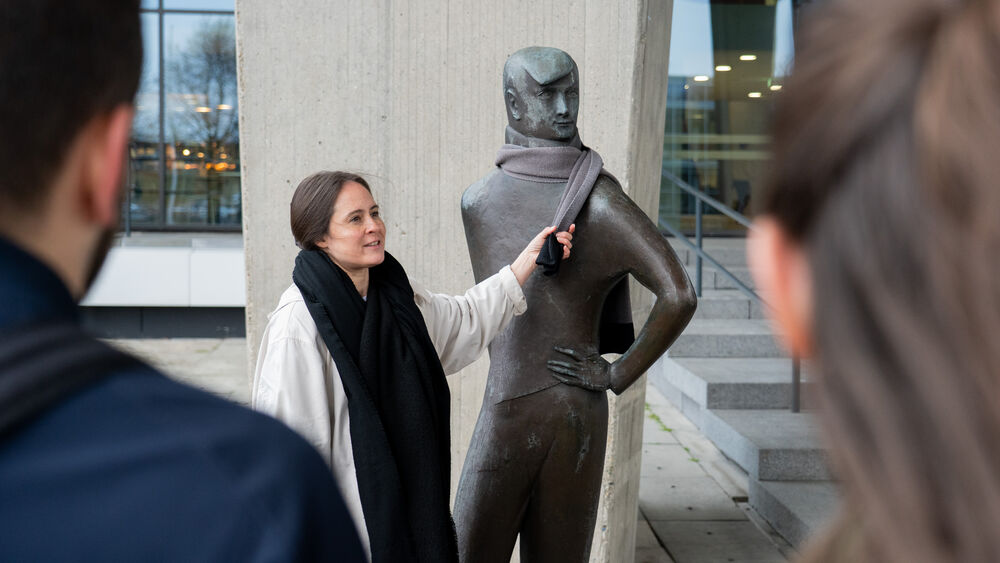
Within the hour scheduled for the Campus Art Tour, it is impossible to cover everything. That is why Sloothaak selects four works on or around the Koeveld—starting with ‘De Technische Student’. “I often call him the sassy student, because of his posture,” Sloothaak jokes.
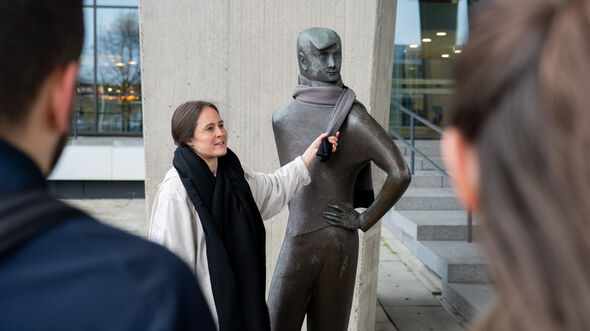
The work was created by Dutch artist Oswald Wenckebach. Initially, he focused mainly on painting and printmaking, but after meeting sculptor Jöhn Rädecker, he also developed an interest in sculpture. The bronze statue is part of a series in which Wenckebach portrayed everyday people.
The piece was acquired in 1963 by the firm Van Emden Choisy Roorda van Eysinga Smelt to mark the opening of the university’s main building, now Atlas. “The title of the work, ‘De Technische Student,’ does not specifically refer to a TU/e student. This title was assigned to the artwork during its acquisition in correspondence with Wenckebach’s widow,” Sloothaak explains.
‘Vliegend’, between Matrix and MetaForum
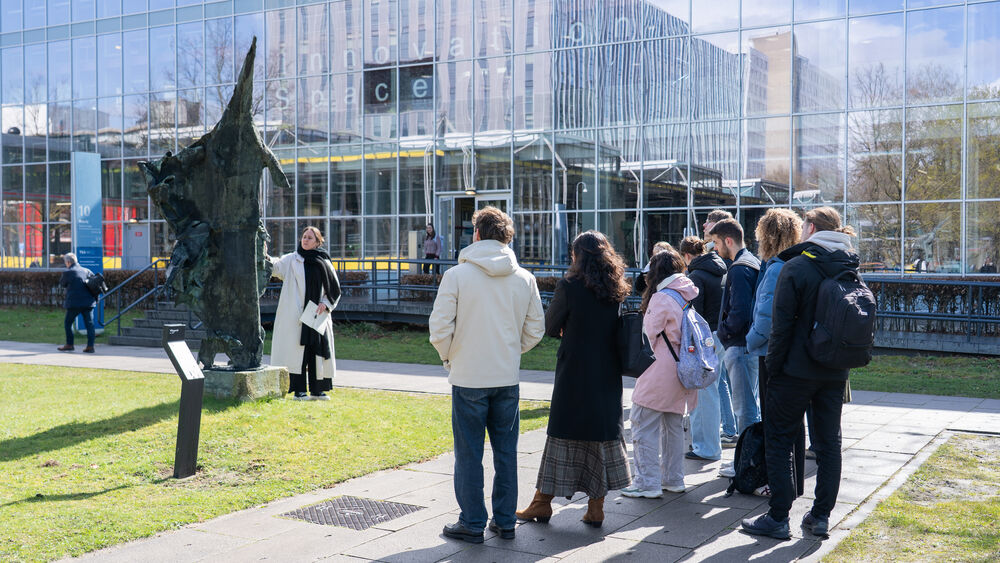
Like the previous piece, the second work on the tour—‘Vliegend’—is a solid bronze sculpture. This piece, too, was created by a Dutch artist, Wessel Couzijn, who was originally trained as a painter but later developed a passion for sculpture. The styles of the two works, however, are completely different.
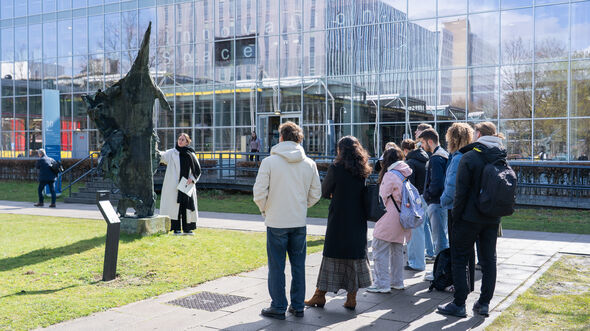
“As you can see, this sculpture is much less clean and stylistically restrained than the previous one,” Sloothaak tells the group. “Couzijn was very interested in expressing emotion and feeling. Just look at the pronounced shapes and the rough surface.”
According to Sloothaak, this is particularly interesting because Couzijn created realistic images in his paintings. The shift in style—from figurative on canvas to highly non-figurative in 3D—is much more pronounced than in Wenckebach’s transition from painting to sculpture.
‘Objet Mathématique’, Koeveld
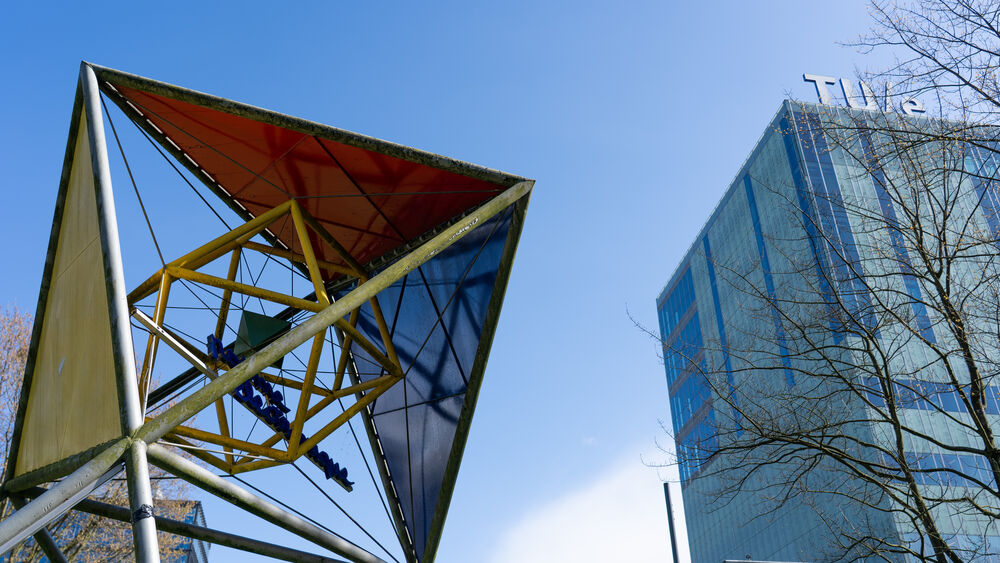
The third stop focuses on the nine-meter-high work ‘Objet Mathématique’, which was specially designed for the Philips Pavilion at the 1958 World Expo in Brussels.
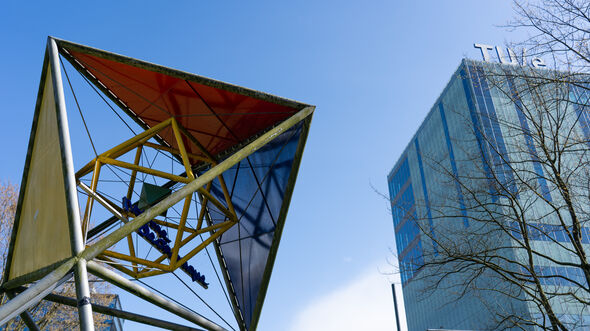
The design was created by French-Swiss Le Corbusier and executed by Greek Iannis Xenakis, both architects. Together with composer Edgar Varèse, they developed the architecture of the pavilion and an audiovisual installation presented inside it. “The pavilion was beautifully designed, but there was a problem: visitors couldn’t easily find the entrance,” Sloothaak explains. “This installation was therefore added to attract attention and clearly mark the entrance.”
At the top of the structure, the text ‘Poème électronique’—the name of the trio’s joint project in the pavilion—appears in LED lighting. Originally, the word ‘Philips’ was also displayed, but it has since been removed.
‘Vloerreliëfs’, between Vertigo and Matrix
For the final stop, Sloothaak takes the group to four concrete blocks near the parking lot next to Vertigo, titled ‘Vloerreliëfs’. Created by Dutch artist Ad Dekker, the blocks each consist of stacked circles, squares, or triangles.
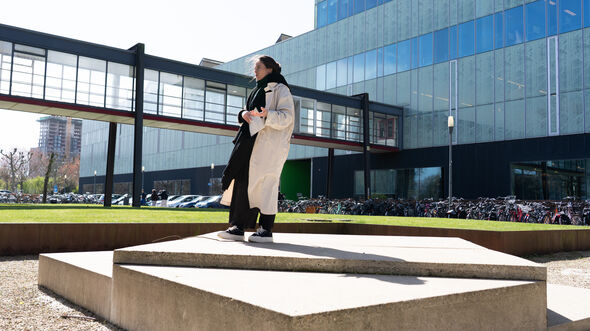
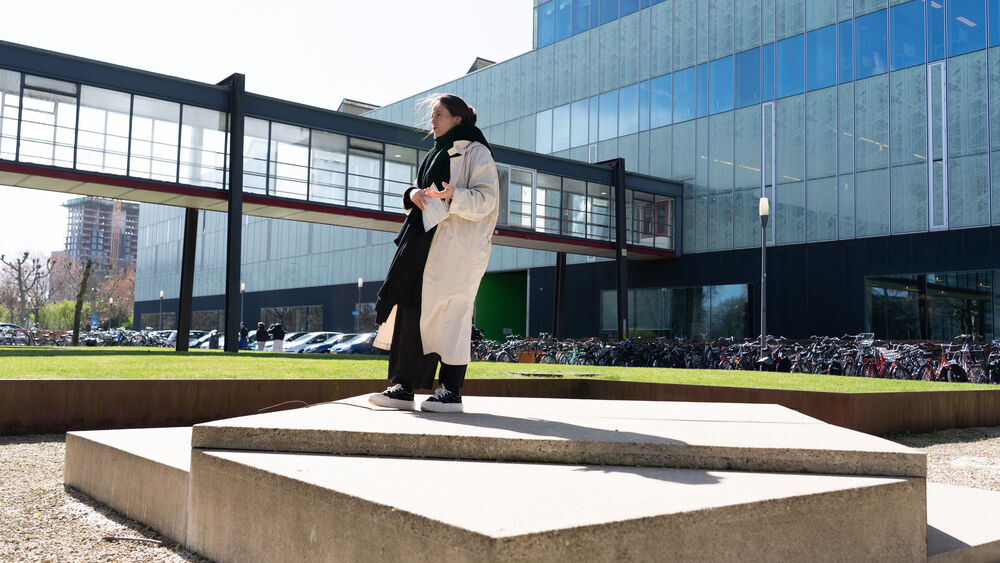
“It’s a modest work, but don’t be mistaken: it’s not simple,” Sloothaak emphasizes. “Dekker deliberately claimed space, worked with different shapes and heights, and stacked everything in a way that invites people to sit on it.” The gray, flat colors are a deliberate choice, she adds. “He believed color only distracts from what an artist can do.”
‘Vloerreliëfs’ was created in 1972 specifically for the construction of the former Rekencentrum building (now Neuron). Due to renovations, the work was relocated in 2002 to its current spot. It has recently been designated for the Municipal Monuments List.
When you see different things, you start thinking different things—and ultimately doing different things
Seeing, thinking, doing
The tour ends in the storage space of TU/e's Art and Heritage Committee. Here, Sloothaak concludes by explaining why art at a university is not only aesthetically valuable, but also essential. She herself worked for many years in major museums, but consciously made the move to TU/e a few years ago.
“At TU/e, we don’t acquire art to store it away, but to display it,” she says with pride. “The art is not kept behind glass or on a pedestal—it truly becomes part of the campus. You can sit on it or touch it. That’s completely fine. It allows you to look at art in a different way.”
She echoes the vision of TU/e’s founders, who emphasized the importance of creativity in a technical environment. “When you see different things, you start thinking different things—and ultimately doing different things.”
This article was translated using AI-assisted tools and reviewed by an editor.
Discussion