
- Campus
- 11/05/2026

Cursor investigates | May I park in a charging spot?
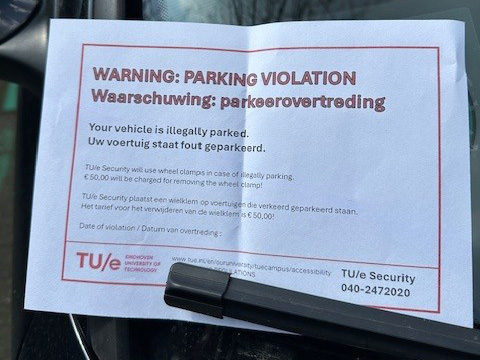
If you park your non-electric car in a charging spot on the TU/e campus, you may receive a warning or even a wheel clamp. According to TU/e parking management, you are then parked incorrectly. However, this rule is not explicitly stated on a sign on site or in the university's parking policy.
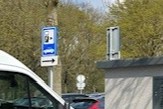
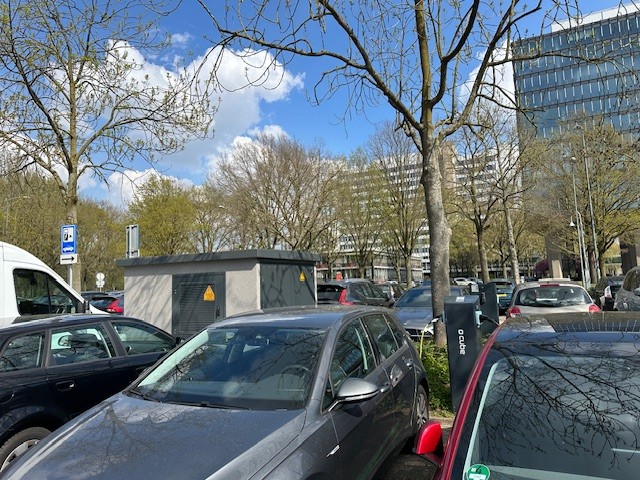
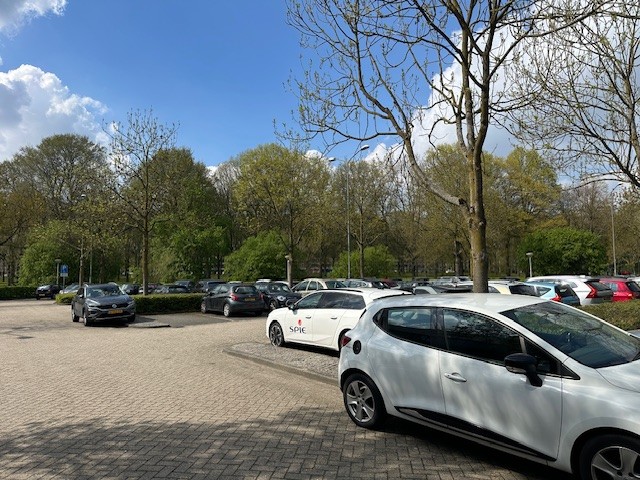
It's not a secret that TU/e is struggling with parking on campus. Especially on Tuesdays and Thursdays, and after nine o'clock in the morning, drivers circle around looking for a spot. The parking spaces that are still available if any, then are often charging spots for electric cars. Cars running on petrol, LPG, or diesel are also regularly parked there. However, there are no signs on campus indicating that these spots are exclusively intended for electric cars.
Illegal parkers
The university regularly issues written warnings to drivers parked in a charging spot with a non-electric car. This also recently happened to the author of this article, Cursor editor Bridget Spoor, who could no longer find a regular parking spot in the parking lot at the Auditorium, which has a relatively large number of charging spots.
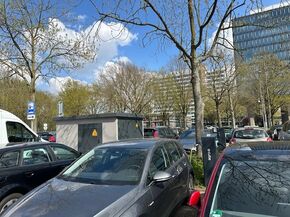
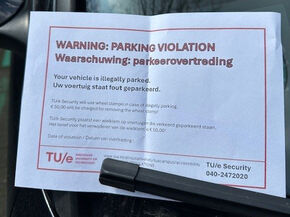
‘TU/e security places a wheel clamp on vehicles that are parked incorrectly and removal costs 50 euros,’ the note reads. In doing so, the university refers to the parking policy.
That policy only states that incorrect parking can be punished with a wheel clamp and that it is clear where parking is and is not allowed on campus. But how clear those rules are in practice is the question.
To assess what is and is not permitted, we must also look at the Road Traffic Act. After all, the TU/e refers to this in its answer to Cursor's questions.
Wheel clamp
In principle, the Road Traffic Act (WVW) does not apply to private property, unless that property is in practice publicly accessible. That is the case at the TU/e, despite the barriers. Any car with a parking ticket can open one of the barriers, and pedestrians and cyclists can pass via footpaths and cycle paths.
In short, the campus is private property that functions as a public area. In that case, TU/e is allowed to apply its own rules on the premises, and part of this may be: referring to the Road Traffic Act (WVW).
These own rules must be clear to users of the site, for example via signs or a reference to the parking policy. In practice, this does not seem to be equally clear, given the number of non-electric or non-charging cars at charging spots.
Parking = charging
For an electric charging spot, the rule according to the Road Traffic Act is: only park if you are actually charging, even if this is not indicated at the parking spaces. In practice, however, electric cars are also parked for extended periods, for example because no alternative spots are available after charging.
According to the Road Traffic Act, it is not permitted to park a non-electric car at a charging spot. Non-electric cars are only allowed to park outside of those times if a supplementary sign is displayed, for example indicating time windows. A violation can result in a fine.
Benefit of the doubt
The enforcement officer on duty determines whether only non-electric cars receive a warning or wheel clamp on campus, or also electric cars that are not (or no longer) charging.
The university applies the guideline that an electric car parked in a charging spot and charging, or that has recently charged, is given the benefit of the doubt. According to TU/e, petrol and diesel cars should not be parked in charging spots at all and may therefore receive a warning or wheel clamp.
Prohibition signs
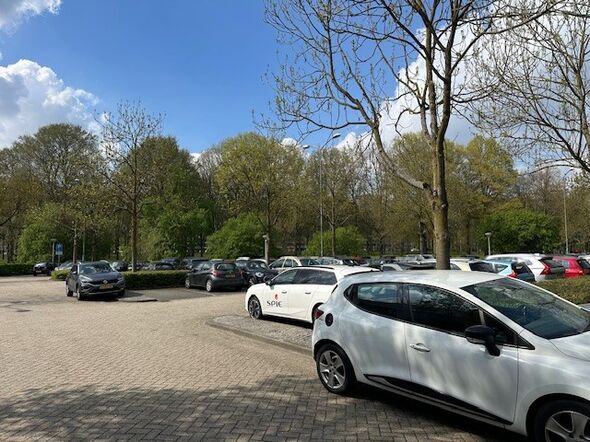
Regarding the claimed lack of clarity, Campus & Facilities communications advisor Margot Wolfert states that “the starting point of the parking policy is that the use of parking spaces must be clear and understandable. This means that signs indicate the purpose for which a parking space is intended. TU/e refers to the Road Traffic Act (WVW) and does not need to include all those rules in the policy again, only potential adjustments.”
“We want to prevent public space from being overloaded with exclusively prohibition signs; we are opting for a balance between indicating desired use and explicit prohibitions,” she adds.
According to the Road Traffic Act, a prohibition sign is therefore not necessary either: indicating that it concerns a charging spot is sufficient under the law to exclude other activities or vehicles.
2,348 parking spaces
TU/e has 2,348 parking spaces available, distributed across the (main) campus, the Vector grounds, and the spots on Celebeslaan that the university makes available for free parking. Of these, 42 parking spaces have been designated as charging spots for electric cars. Most of these charging spots are located near the Auditorium.
The university declined to answer the question of how many wheel clamps TU/e places annually. “We try to limit the use of wheel clamps as much as possible. This is a last resort and is only applied in specific situations. This use is not shared,” Wolfert says.
In conclusion, she notes that the university continues to look at the clarity of the parking policy. “A parking policy must evolve along with developments on the campus.” The Mobility working group is currently developing a draft for a new parking policy.
Update 12-05-2026, 09:13: A correction has been made to this article. It was stated that the parking policy document did not refer to the Road Traffic Act, but this is indeed the case in one place, under article 2.7.E.
Discussion