
- Campus
- 26/10/2026

Accessibility audit highlights barriers in the Auditorium
An inaccessible stage, heavy doors and missing tables for wheelchair users. Every few years, TU/e’s Accessibility Working Group examines how accessible the university’s buildings are. This time, the Auditorium is under review. The working group members set out with a wheelchair user and Royal Dutch Visio, an expertise center for people who are blind or have low vision.
“See you in five minutes,” jokes Julia Warmerdam, a TU/e master’s student in Biomedical Engineering. She is sitting in her wheelchair as she slowly descends on a stairlift. The lift takes a surprisingly long time to cover a height difference of just four steps.
During the audit, Warmerdam shares her experiences and points out issues she encounters at each location and with each facility. Royal Dutch Visio, an expertise center for people who are blind or have low vision, represents this group and identifies areas for potential improvement.
These user experiences help the Accessibility Working Group identify the barriers that need to be addressed to achieve its mission: a campus that is equally accessible to everyone.
An essential elevator
The 60-year-old Auditorium has four floors, all accessible by elevator. For wheelchair users, this is an essential facility. “I always make sure to leave early,” Warmerdam says. “In case it’s busy or an elevator breaks down and I have to take a detour.”
The first stop on the route is lecture hall 7 in the basement. Warmerdam enters the lecture hall through the double doors without any problems, but the Royal Dutch Visio advisors are more critical. The first-year student uses a narrow wheelchair.
People using a power wheelchair or mobility scooter may have more difficulty getting through. They would first have to open the second door. Like other doors leading to the walkways and lecture halls, it is heavy and therefore difficult to operate from a wheelchair.
There is space at the front of the lecture hall for a wheelchair or mobility scooter user to sit. The board is mounted at a suitable height, so Warmerdam does not have to tilt her head far back to see it. However, there are no tables where she can place her laptop.
The lack of these tables was also noted during a previous audit in 2019. However, no new tables have been installed yet.
Trash can
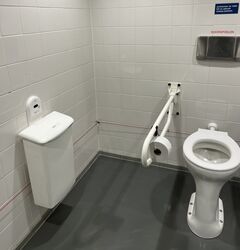
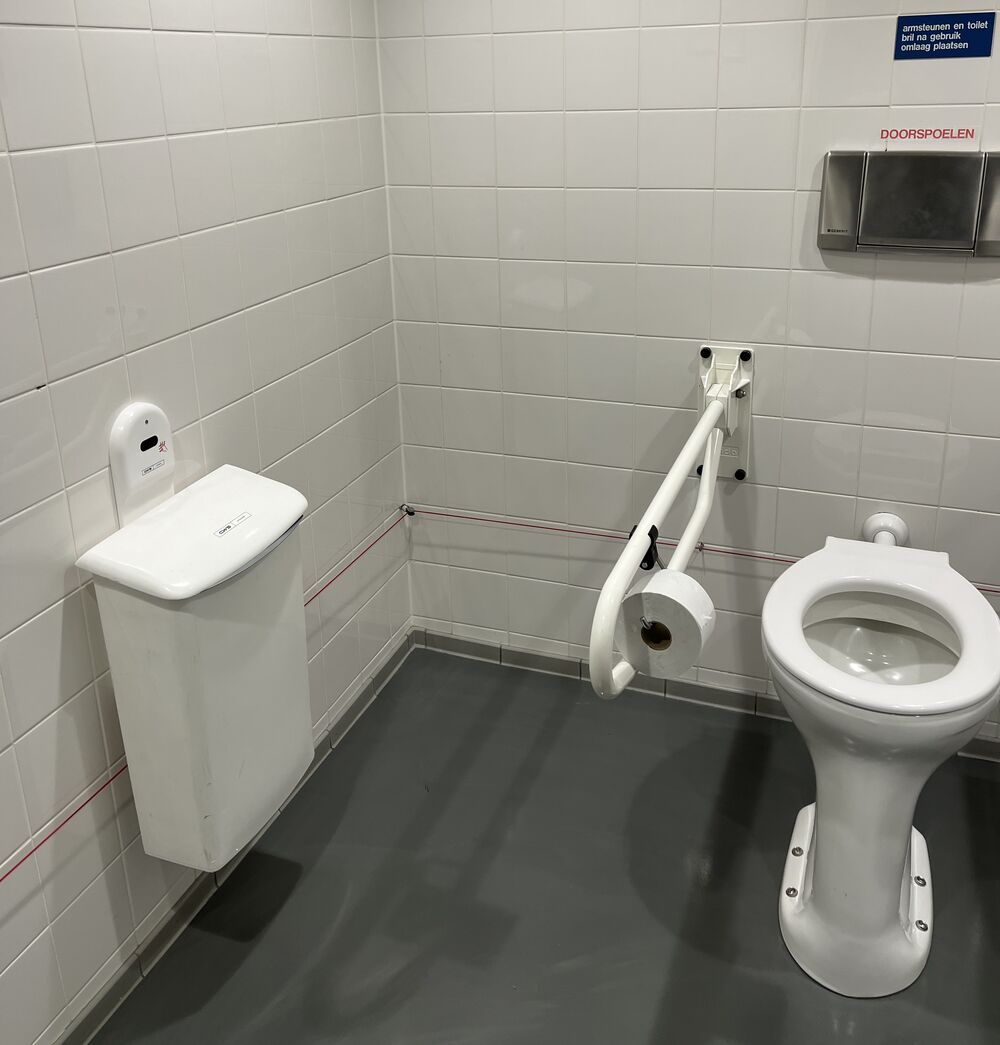
The restrooms also need improvement. Warmerdam cannot position her wheelchair parallel to the toilet, which would allow her to transfer from her chair onto the toilet. A trash can is in the way.
The fold-up grab bars also have problems: they are stiff to move, one does not stay in the raised position, and both feel unstable. In another accessible restroom, the grab bars are more stable and the trash can is less obstructive.
Roy Kleise, one of the Royal Dutch Visio advisors, also considers the restroom from a different perspective. “If you have low vision, you can’t see white against white.” He says some fixtures should therefore be a different color. “That really applies to all the items in a restroom, such as the toilet seat, the soap dispenser and the grab bars.”
Coffee machine
Even getting a quick coffee or tea from a vending machine can be difficult for people who are blind or have low vision at TU/e. The options on the touchscreen are difficult or impossible for them to see.
The final stop is the Blauwe Zaal. This large hall is used for lectures, as well as events such as graduation ceremonies and talks. The hall is accessible to wheelchair users, and designated wheelchair spaces are available.
However, the stage in the hall is not accessible to wheelchair users. As Warmerdam sits in front of the stage, she realizes that, under the current circumstances, she probably would not be able to receive her diploma on stage.
Action plan
Based on the audit, Royal Dutch Visio will prepare a report outlining its findings and recommendations for improving accessibility at TU/e. The organization will combine Warmerdam’s experiences with its own expertise in visual accessibility.
The areas for improvement will be included in an action plan, distinguishing between measures that can be implemented in the short term and changes that will take longer. For example, an incorrect sign indicating an accessible restroom can easily be removed, while widening doors requires more time and money.
The Accessibility Working Group will review the recommendations and determine which measures can be implemented. It is not yet known when the work will begin.
Is accessibility in TU/e buildings relevant to you? The Accessibility Working Group would like to hear from members of their target group. If you would like to share your experiences, please contact Vione van Leeuwen.
This article was translated using AI-assisted tools and reviewed by an editor.
Discussion