
- Employee
- 12/02/2026

Since the introduction of the Top Income Standards Act in 2013, (semi-)public institutions, including universities of applied sciences and universities, have no longer been allowed to pay exorbitant salaries to their Executive Board. The maximum income is determined annually. In 2024, the threshold was 233,000 euros.
Other employees, such as professors, are allowed to earn more than this threshold. However, the educational institution is then required to disclose their salary publicly, without naming individuals.
Numbers down
An analysis of figures from DUO shows that the number of top earners in higher education has fallen significantly in recent years. According to the oldest available figures, there were still 112 non-board members with a salary above the standard in 2016. In 2020, this had dropped to 64, and four years later to 39.
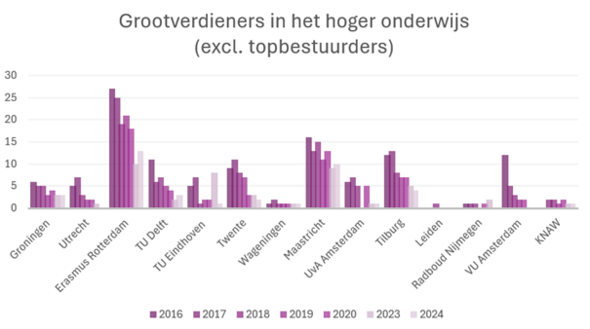
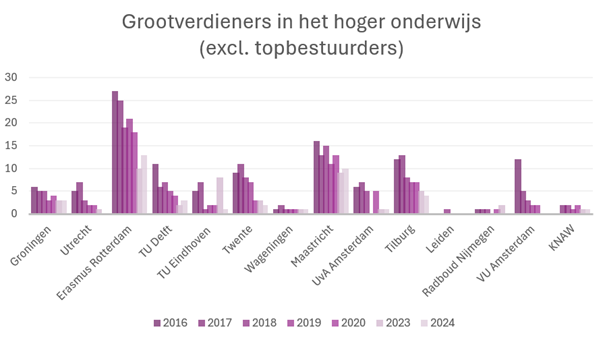
The highest salaries are mainly found at Erasmus University Rotterdam. According to a spokesperson, the university complies with the collective labor agreement, but additional payments are sometimes added to the salary, such as a “labor market allowance” and “compensation” for pension contributions. Some employees are also paid for unused vacation days.
But the number has also decreased at Erasmus University. In 2016, 27 professors and deans there had a top salary; by 2024, that number had more than halved.
At the Royal Netherlands Academy of Arts and Sciences, only one top earner remains. This concerns a director of one of the scientific institutes, who earned more than 250,000 euros in 2024.
Further reporting on top earners at TU/e will follow later this year, once the university’s accountant has verified the 2025 figures.
Highest salary
The highest salary went to a professor in Tilburg. This person earned more than 340,000 euros, partly due to their “special contribution to science,” according to an explanation.
From 2016 onward, the number of top earners has declined by an average of ten people per year. If this trend continues, by around 2027 there will no longer be any professors, deans, or directors earning more than the minister.
Why this decline is occurring is not entirely clear: after all, these employees are allowed to earn more, and in the past this happened frequently. Now that administrators’ salaries have been capped, there appears to be a cultural shift in which older professors with top salaries are succeeded after retirement by, as education union AOb calls them, “people with more normal pay.”
This article was translated using AI-assisted tools and reviewed by an editor.
Discussion