
- The University
- 18/06/2026

Dutch universities slip in global QS rankings
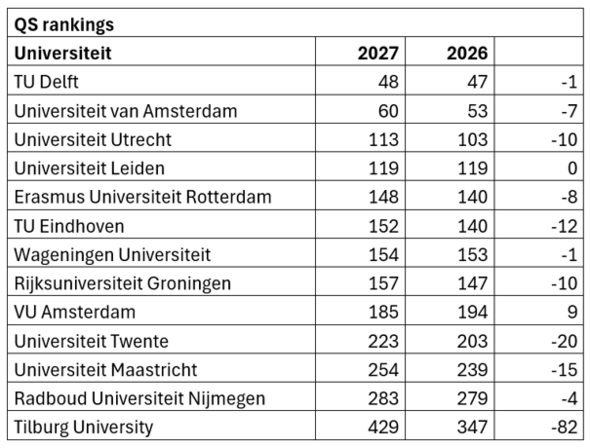
Eleven of the Netherlands’ thirteen universities have lost ground in the latest global rankings by research firm QS. TU/e is among them, dropping twelve places. The Netherlands continues to perform relatively well overall, but universities in other countries are advancing more quickly.
The QS World University Rankings 2027 were published today. The American institution MIT once again holds the number one position, a spot it has occupied for fifteen years. Imperial College London and Stanford University share second place.
The top ten remains dominated by British and American universities. The only exceptions are Switzerland’s ETH Zurich and the National University of Singapore, which rank eighth and tenth, respectively.
Ten years ago, twelve Dutch universities were ranked among the world’s top 200. Today, only nine remain in that group. TU Delft continues to lead among Dutch universities but has slipped one place to number 48. TU/e has dropped twelve places, falling from 140th to 152nd.
Making progress
Most other Dutch universities have also fallen in the rankings, with the exception of Leiden University, which maintained its position, and Vrije Universiteit Amsterdam, which improved slightly this year.
That said, the Netherlands continues to perform relatively well. According to the ranking’s creators, universities in other countries are simply making progress more quickly than Dutch institutions, causing the latter to move down the list despite their own performance.
Reputation
The QS rankings take several factors into account, including a university’s reputation among academics, the proportion of international students and faculty members, and graduates’ performance in the labor market. Sustainability has also been included in recent years, with topics such as climate and social equality playing a role.
The academic reputation of Dutch universities, already strong, improved further this year. By contrast, their reputation among employers declined, as did citation scores for scientific publications and levels of internationalization among staff and students.
Criticism
These types of rankings are regularly criticized. How can a single score adequately represent an entire university, with all its staff members and students? And how significant are the differences between institutions in reality?
Take citation scores, for example, a measure of the influence of scientific publications. Research on earthquakes in Groningen is unlikely to attract much attention outside the Netherlands. But does that make it any less valuable? In addition, some institutions are said to use questionable strategies to improve their positions in the rankings.
As a result, there are frequent calls to disregard such rankings altogether. At the same time, others argue that these comparisons do provide insight into the position of Dutch universities in the global academic landscape.
‘Debatable’
The Universities of the Netherlands (UNL) is critical of rankings, which it says “wrongly claim to be able to summarize a university’s performance in the broadest sense in a single number.”
This article was translated using AI-assisted tools and reviewed by an editor.
Discussion