
- The University
- 16/06/2026

Neurodiversity at TU/e: "Always room for improvement"
On the occasion of Neurodiversity Pride Day, extra attention is being paid on campus today to students who are, in one way or another, “wired differently.” Raising the flag is a symbolic moment, but throughout the year, the university mainly focuses on providing practical support.
When does TU/e consider a student neurodivergent? The university does not actually have a specific definition for that, says Anneke Sikkema. As a policy advisor at Education and Student Affairs (ESA), she works on additional support for students who need it. “We talk about all students with support needs, and that can also include neurodivergent students.”
This includes students with ADHD, autism, and giftedness, among others, “but formally also students with dyslexia and dyscalculia. Essentially, it refers to anyone who is, in a sense, ‘wired differently,’ causing them to process information in a different way.”
Improving support
In 2020, TU/e signed the United Nations Convention on the Rights of Persons with Disabilities, expressing its commitment to being an inclusive educational institution. In the same year, the university introduced a new policy for studying with additional support, accompanied by a five-year implementation plan. According to Sikkema, many elements of that plan have been realized. A peer support platform was launched on Teams, communication was improved so that students better understand where to seek help, and MetaForum now has a low-stimulation exam room.
The improvement plan was officially completed last year, but efforts to improve support have not stopped. “We decided to keep the working group in place,” says Sikkema, “because there is always room for improvement.”
Not everyone at TU/e automatically qualifies for additional support; students need proof, such as an official diagnosis. “Unfortunately,” says Sikkema, because this can sometimes be difficult. Obtaining a diagnosis can take months or even years.
“In addition, we see that some students need support even when there is not yet a formal diagnosis.” It is unclear whether this requirement will change in the short term.
Exam room
For students who do qualify, additional accommodations are primarily available during exams. They may receive extra time, use text-to-speech software or a sit-stand desk, or take their exams in a low-stimulation environment. At present, more than 130 students are authorized to use this separate exam room.
Awareness of neurodivergent students is also growing within education, although, according to Sikkema, implementing major changes is not easy.
“Education is highly diverse, and every instructor has their own teaching style. Students are also very diverse, which makes it difficult to design education in a way that works for everyone.”
As inclusive as possible
“I understand that it can be quite challenging for instructors to meet the individual needs of students and that not everything is possible. However, I do expect that in the coming years we will increasingly look at how to make education as inclusive as possible.”
And that is already happening. There are initiatives within TU/e aimed at improving support in education so that it better meets the needs of neurodivergent students. For example, neurodiversity is addressed in HR’s TEACH program as well as in the University Teaching Qualification (UTQ) program.
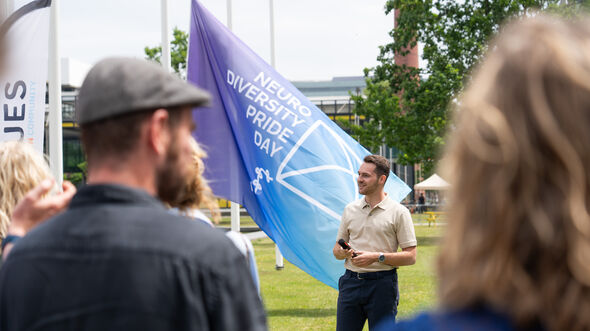
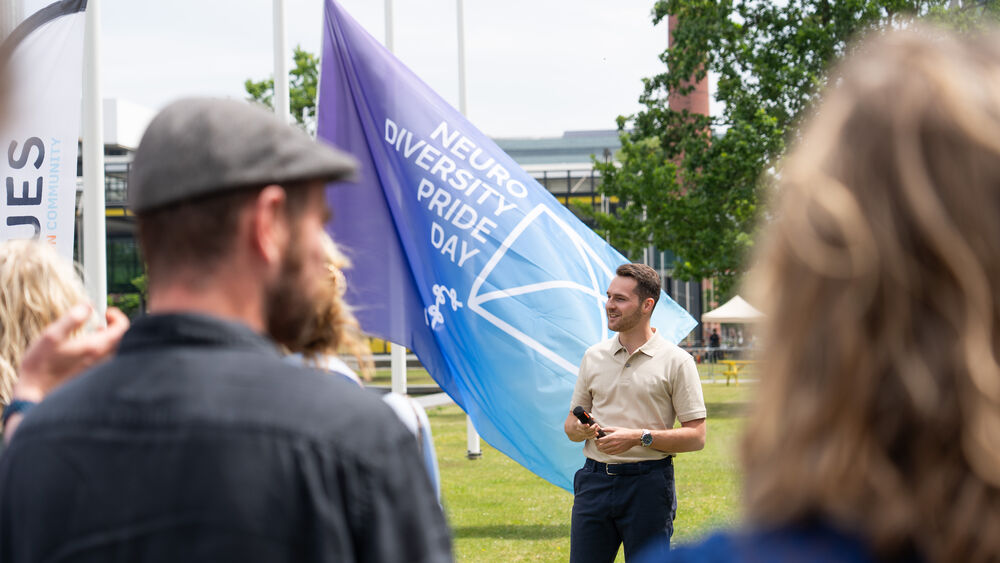
Students have also established the Donatues Foundation to raise awareness of giftedness and neurodiversity and to provide a central place for students who could use support in these areas. Last year they organized the celebration of the Neurodiversity Pride Day for the first time and also this year they have organized several activities for the occasion, including raising a special flag (see photo above).
Lived experiences
Sikkema would also like to involve the students who actually need the support themselves. To achieve this, she created a student advisory committee made up of students with lived experience, which meets every quarter to discuss possible improvements.
“Students who would like to play an active role in this can contact me.”
Partly based on input from this group, a variety of new facilities have been introduced in recent years, including the purchase of power nap pods and the creation of the Lighthouse peer support platform.
Reasonable and fair
But how far should a university go in providing additional support? It is a gray area and an ongoing search, Sikkema says. “Legally, we are required to provide good education and support for students with disabilities or chronic illnesses, but that support must be reasonable and fair.” She grimaces slightly at those last words, because who decides what is reasonable and fair?
There is currently no institution-wide document that clearly defines the university’s duty of care. According to Sikkema, TU/e would like to provide greater clarity on this issue. It is also receiving attention at the national level.
Equality
“The goal is ultimately to move toward a more inclusive form of education and assessment,” says Sikkema. As she also writes in the improvement plan (see text box), this would reduce the need for individual accommodations and increase equality among students.
When asked whether enough is being done for neurodivergent students at TU/e, Sikkema responds: “There is attention for it, but there’s always room for improvement.”
This article was translated using AI-assisted tools and reviewed by an editor.
Discussion