
- The University
- 13/03/2026

TU/e was surprised by anti-abortion protest
The demonstrators from TFP Student Action Europe who protested against abortion on campus on Thursday afternoon had permission from the mayor to do so. However, TU/e had not been informed and was surprised by the protest. Bystanders took matters into their own hands and did not give the demonstrators a chance to spread their message.
“Why aren’t you stepping in?” That is a question university security guards regularly receive during the protest by TFP Student Action Europe, a group that is also known in the Netherlands as Civitas Christiana. The guards, along with several police officers, keep a close eye on the protest but do not take action because the demonstration has been authorized by the municipality, they explain.
The university had not been informed and was therefore surprised by the protest, says spokesperson Ivo Jongsma. Even if the university wanted to stop it, it would not be allowed to, because the campus is public space. The Public Assemblies Act therefore applies. Only the police are permitted to intervene, and only if there are valid grounds to do so. The officers present on Thursday afternoon do not appear to see such grounds.
Hate speech
Counterprotester and PhD candidate Daisy O’Neill disagrees. She was the first to stand in front of the demonstrators with her sweater, covering the anti-abortion slogan on their banner. “I do feminist research, so I can’t just stay in my ivory tower.”
Although O’Neill is very grateful for the support she receives from a growing number of people, she finds it unfortunate that this counterprotest is necessary. “We have more important things to do. On paper, the university does a lot for women, but by allowing this, women feel unsafe here.”
She does not consider what the men from the activist group are doing to be demonstrating, but rather spreading hate. “Calling me a murderer and a whore because I want autonomy over my own body is not what I would call demonstrating.”
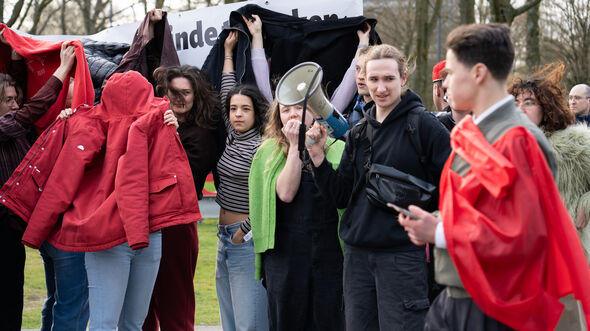
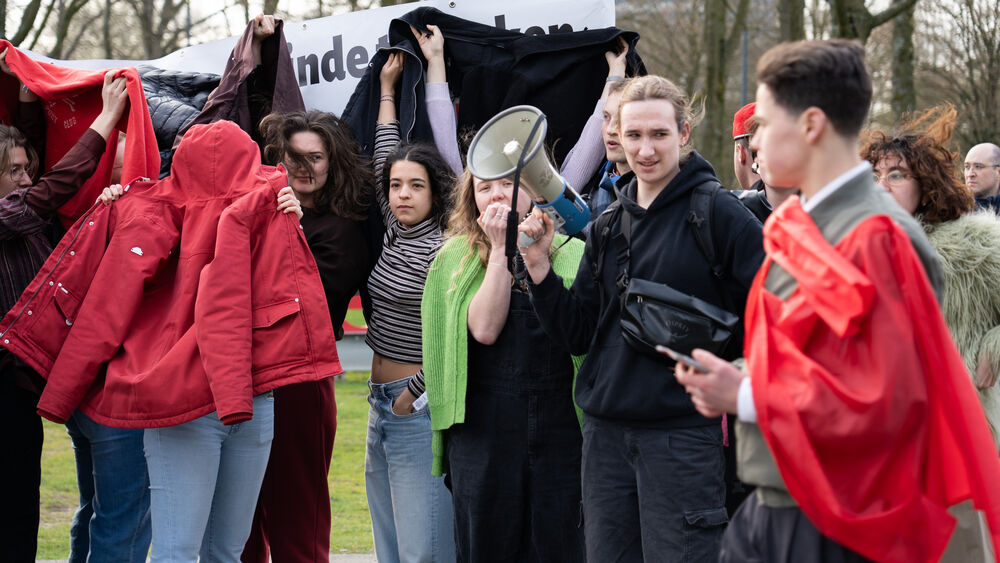
Student Koen van den Berk, who only arrives later when the demonstrators are already at Luna, also does not receive a friendly welcome. “I wanted to start a conversation with one of the demonstrators, but then another guy came up to me and firmly asked, ‘How does it feel defending the killing of babies?’”
Van den Berk did not give up, however, and eventually started a conversation with the other demonstrators. Talking amid all the commotion was not easy, but according to him they still managed to have a fairly substantive exchange about when life begins – at the conception or later. “Unfortunately, the discussion couldn’t go much further, because the group left.”
Freedom of expression
Aside from the short conversation between Van den Berk and the demonstrator, who had also briefly spoken to a female counter-protester, there is little room for dialogue. Both groups mainly try to shout each other down.
Seppe van Loo, who acts as spokesperson for the activist group TFP Student Action Europe, believes the counterprotest restricts his right to freedom of expression. “They are preventing us from making our voices heard. I would like to debate them, but they’re not open to it.” Behind him, a loudspeaker carried by one of his fellow demonstrators blares: “You survived abortion. Where’s your tolerance. Hypocrites.”
According to Van Loo, the pro-life movement is gaining momentum. “We want to contribute to that.” Earlier in the day, the activist group had also visited the university in Nijmegen, and it has previously demonstrated in The Hague and Utrecht. In September last year, the group protested in Leiden. Following that protest, MP Sarah Dobbe of the Socialist Party asked parliamentary questions about the demonstration.
Misinformation
Dobbe’s questions mainly concerned the misinformation the group was said to be spreading. Flyers that the demonstrators also attempted to distribute in Eindhoven claimed, among other things, that abortion is unsafe and increases the risk of breast cancer, referring to a study from the nineties.
‘That is not correct,’ then-State Secretary for Youth, Prevention and Sport Judith Tielen said in her response to the parliamentary questions. ‘The Dutch Society of Abortion Doctors has confirmed to me that the information in the leaflet does not correspond in any way with the current medical and scientific consensus,’ she wrote.
The State Secretary also called it concerning and undesirable that incorrect health information about abortion is being spread. By the end of 2026, at her request, Fiom and Rutgers were expected to present evaluated interventions and communication strategies to counter the spread of misinformation.
Not stopping
By the end of the demonstration, counter-protester O’Neill does not intend to leave it at that. She plans to speak with the university about the demonstration and hopes to prevent something like this from happening again, although the university itself has limited influence over such situations. When the demonstrators leave at the end of the afternoon, she climbs onto a raised platform to thank everyone. “We shouldn’t stop here. The university should have a say in what happens on campus. Hopefully we can make our voices heard.”
Response TU/e
The Executive Board finds it bitter that people would come to demonstrate against a right that is so fundamental and such a major achievement of women’s emancipation, spokesperson Ivo Jongsma said. According to him, the demonstration does not align with the university’s core values. “We therefore understand that members of our community took offense at this demonstration and that our community responded with a countervoice. However, we cannot and do not want to ban demonstrations like this.” Demonstrators are allowed space on campus, within the agreed rules, even if the university does not identify with the message being expressed, Jongsma added. The university has also posted the response on intranet.
Discussion