- Student
- 28/10/2026

“Since AI came along, I stopped asking for help”
AI as a study tool: does it help students better understand the material?
For some students, generative AI is the ideal private tutor: available day and night, never irritated, and always willing to explain a difficult concept. But handing over the hard thinking also comes with risks.
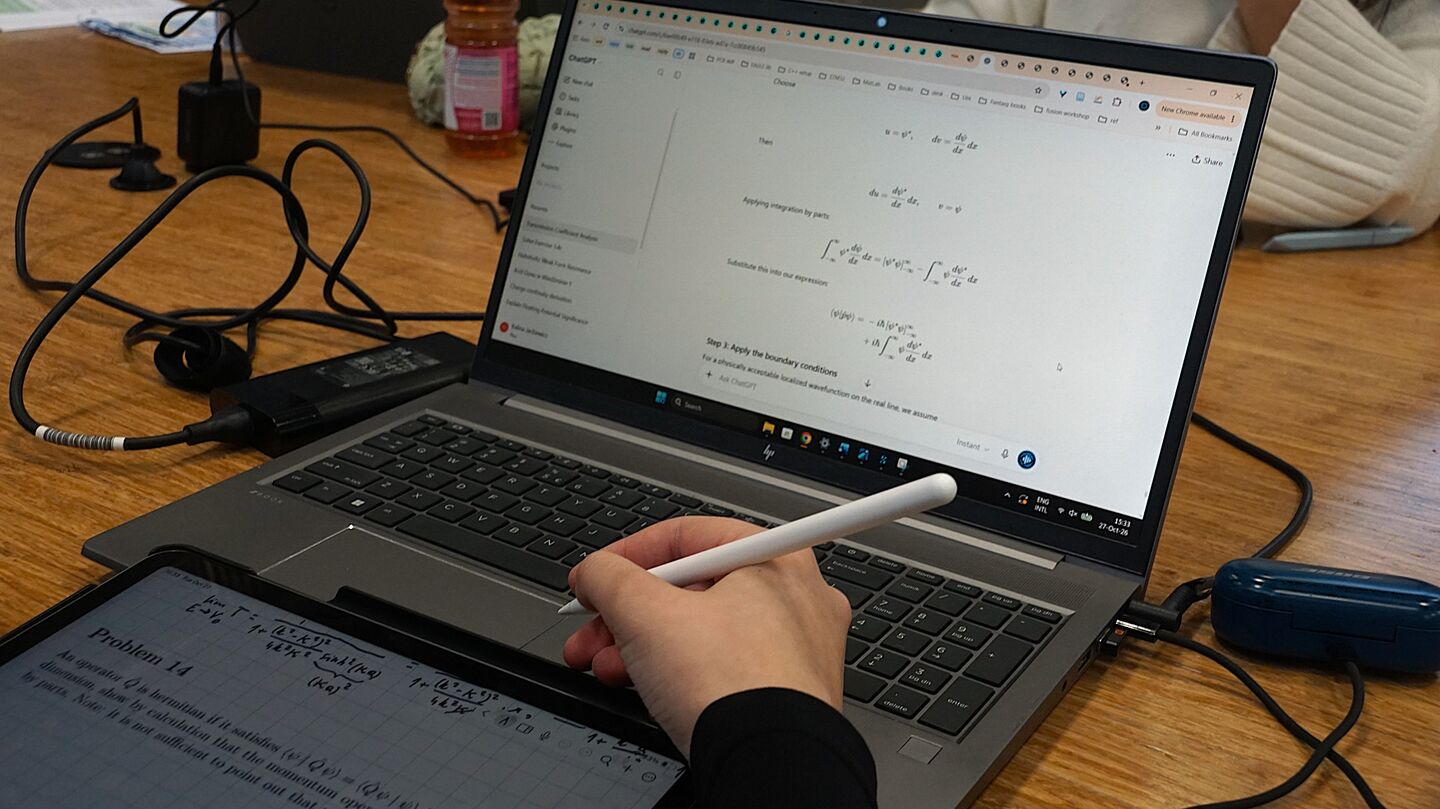
With a single prompt, an AI chatbot becomes a personal study assistant. Within seconds, it can provide additional explanations, generate practice questions, and help you solve assignments step by step. Generative artificial intelligence (GenAI) has the potential to become a powerful study tool. But whether students actually learn more from it depends on how they use the technology.
For example, the tool can help students understand difficult concepts more quickly. However, when AI takes over the thinking, students risk developing a less thorough understanding of the material and becoming less able to apply it independently. Intensive AI use can also come at the expense of social interaction, as students consult and collaborate with one another less often.
Cursor asked 18 TU/e students about their views on and experiences with using AI for their studies. Cursor then presented several findings to Rianne Conijn. As an assistant professor in the Department of Industrial Engineering and Innovation Sciences, she researches how students can use AI in ways that support learning.
The responses from the 18 students do not constitute a representative sample, but they do offer a glimpse into how TU/e students use and experience AI in their studies.
Additional explanations
Several students say AI helps them understand difficult concepts and assignments more quickly. They can ask ChatGPT, Claude, or Copilot as many questions as they want and get additional explanations without having to turn to a professor.
For someone who finds it hard to ask for help, it has been a godsend for me
Anas, a Computer Science student, calls AI the most effective study tool he has ever used. “For someone who finds it hard to ask for help, it has been a godsend for me.”
Conijn has heard similar experiences from students. In her Behavioral Research Methods and Ethics course, students were allowed to use a specialized AI tool that answered questions exclusively based on the course materials available on the Canvas learning platform.
“They liked having things explained in a different way, especially when they felt embarrassed about not understanding something or were nervous about asking questions,” Conijn says. Students also said they appreciated that the AI tool was available day and night. But that constant availability also has a downside.
The social aspect
“We know that social interaction is an important factor in learning. Even just seeing that your fellow students sometimes struggle too can make a difference,” Conijn says. When you turn to AI for help exclusively, that contact disappears. Conijn says this is detrimental. “We see that people who studied together generally persevere longer, are happier, and achieve better results.”
When AI came out I completely stopped talking and asking for help from my friends and instructors
Tugan, a master's student in Data Science and Artificial Intelligence, prefers to study alone. “When AI came out I completely stopped talking and asking for help from my friends and instructors. I used to go to instructors’ office hours, but now I always ask AI to help me with my studies.” Still, he feels that he is not really learning when he asks AI for explanations.
Self-regulated learning
Planning what to study, checking your understanding as you study, and reflecting on your approach afterward are all important components of self-regulated learning, according to Conijn. Checking your own understanding is particularly important. Students should not simply absorb information; they also need to assess whether they genuinely understand the material and can apply it.
Conijn says it is important to experience “desirable difficulties” while learning. These are challenges that deliberately slow down the learning process in the short term but ultimately lead to greater learning gains over time.
I regret using AI. AI does all the work, so you don’t learn anything yourself
When AI simplifies a difficult assignment and shows the solution, students may feel that they have mastered the material. But when a similar question appears on an exam, they may find that they cannot solve it independently.
Several of the students interviewed seem to have encountered this problem. Emirhan, an Electrical Engineering student, says he no longer uses AI to solve assignments. “I regret using it to work through the questions step by step. The AI basically does all the work, so you don’t learn anything yourself. It cost me a lot of extra exam retakes.”
It definitely affects your learning curve if you aren’t an active participant in the conversation
Anas tries to use AI mindfully because he notices that he learns less when he lets AI do the work for him. He emphasizes the importance of staying actively involved in the conversation with an AI tool. “It definitely affects your learning process if you don’t actively participate in the conversation.”
Dependence
Seventeen of the eighteen students interviewed consider becoming dependent on AI or learning less as a result of using it to be among the risks of AI use. In their view, this risk arises primarily when AI takes over the difficult thinking.
According to Conijn, there is not yet conclusive evidence that students are actually becoming dependent on AI. Establishing whether this is the case requires research over a longer period. “What we do see is a kind of deskilling (the loss of skills, ed.). If you let AI do a lot of things for you, you don’t learn how to do them yourself.” When students repeatedly delegate certain tasks to AI, they may fail to develop the skills needed to perform those tasks independently.
Learning to work with AI
Conijn does not believe students should stop using AI for their studies. “If you are learning as a result, that is a gain in itself,” she says. “On the other hand, we know that some ways of interacting with AI are not particularly beneficial from an educational perspective.”
We are living in this new era where we have to learn how to work with AI and not forbid it
Students have different opinions on whether AI supports or hinders learning. On one point, however, most seem to agree: AI will continue to play a role in education. The question, then, is how students and instructors can use the technology effectively.
Rinske, a Data Science student, puts it this way: “We live in a new era in which we need to learn to work with AI rather than ban it.”
This article was translated using AI-assisted tools and reviewed by an editor.
Discussion