- People
- 17/08/2026

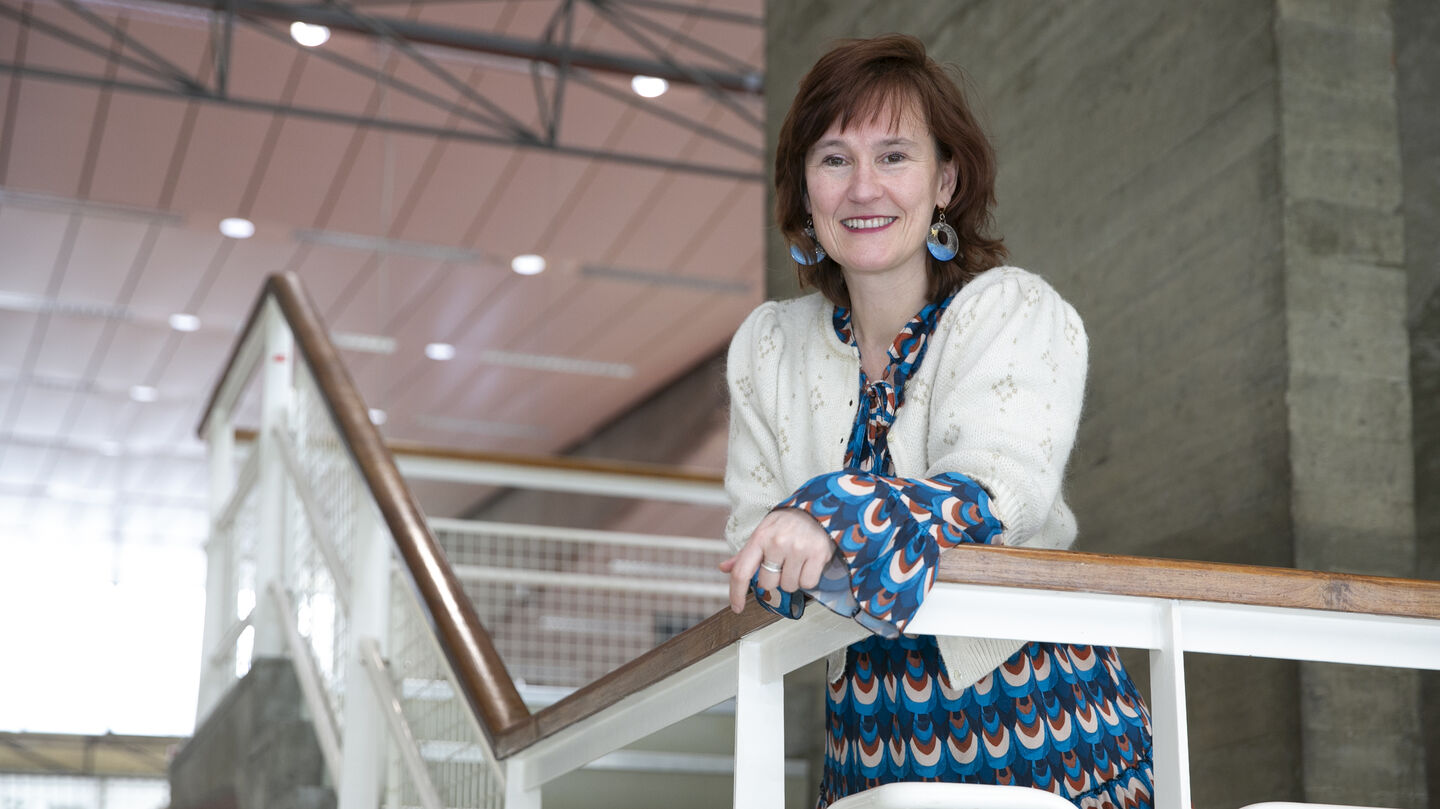
After a year, Olga Coolen feels completely at home at SG
After almost a year as director of Studium Generale, Olga Coolen is increasingly getting the feeling that she has truly made her way into the “capillaries” of TU/e. Looking back on her first year, she talks about what surprised her, what she learned, and what she now values so much about SG.
On November 1, Olga Coolen enthusiastically took over as director of Studium Generale from former director Lucas Asselbergs. Before that, she worked at various museums and publishing houses, most recently spending more than 13 years as director of the Philips Museum in downtown Eindhoven.
Moving from the broad perspective of a museum to programming specifically for students was a leap into the unknown, she says. And yet, that is exactly what she values so much now. “That’s where I really feel the mission: being there for students and making our programs accessible to them.”
One-offs
One important difference between working for museums and for SG is the many “one-offs,” Coolen says. “At the museum, I was used to standardizing things or creating an exhibition that would then remain on display for two years,” she explains. “At SG, we work on an enormous number of programs at the same time. And almost all of them are short-term or one-off.”
That also means that a highly successful lecture, workshop, or exhibition does not simply return to the agenda: “We keep coming up with something new.”
Working at SG took some getting used to because of this, but she now really enjoys the approach. “It makes everything feel a little more current,” she explains. “We look at what’s going on in the world and among our audience, and try to respond to that in our programming.”
For students
The audience at TU/e was also different for Coolen: students. “It was new for me to focus so specifically on students,” she says. “In the bachelor’s program, we are even a fixed part of the curriculum, through the mandatory ITEC credits that students can earn by attending our programs.”
To fully immerse herself in the student perspective, she did everything she could during her first year to get to know her new audience as well as possible. “I tried to talk to as many students as possible,” she says. “Our student employees at SG, of course, but also through other channels. For example, members of the cultural associations at TU/e and, naturally, the many visitors to our programs.”
Broadening horizons
The fact that TU/e is not just about students, but specifically about technical students, makes no difference to Coolen. There is a perception that cultural programs at technical universities generally receive less enthusiastic responses. “I actually enjoy helping students broaden their interests.”
“Deepening your knowledge of your own interests is becoming easier nowadays, partly because of social media,” she says. She herself is passionate about dance and, alongside her work at SG, teaches dance improvisation classes in Eindhoven. “As a result, my entire social media feed is full of experimental dance videos. That way, you very quickly get more and more depth.”
Broadening your horizon, she says, is much harder. “SG makes that broadening more accessible.” In her view, it does not matter whether or not students consider themselves culturally inclined. She particularly enjoys it when students say after a program that, for example, they had never been to a classical music concert or an art walk before, and were pleasantly surprised by the experience. “That’s when it really feels like we’ve achieved what we set out to do: putting together cultural programs that give our students an accessible way to experience them.”
What stayed with her
To get to know SG and its audience well, Coolen attended almost every program during her first year. “That allowed me to connect with students, see what was going on, and experience what worked well and what was less successful.” One of the programs that stayed with her the most was ‘The Forever Wars’ about the Middle East.
“We really wanted to address the subject, but at the same time, it was very sensitive. Because how do you approach it? Who do you give a voice to? And which perspective do you choose?” In the end, the program combined a historical lecture, a personal story from Iranian students, and a discussion with the audience.
“The lecture was very factual and as objective as possible, intended to help people better understand the context,” Coolen explains. The personal experiences of Iranian students provided an emotional complement. “They also performed an Iranian piece of music live, with images of the war in the background. That was very powerful.” The discussion that followed gave the audience an opportunity to ask in-depth questions. “We received very positive feedback from visitors. Many said the program had helped them understand the complexity of the situation.”
Now it feels right
Now, almost a year after taking up the position and with many exciting things on the horizon, Coolen feels completely at home at SG. That feeling was reaffirmed just before the summer break, when the team came together for an end-of-year gathering, partly at her home. It was a moment to look back together on the past academic year. “It always takes some time to find your footing when you start something new,” she says. “But that was really the moment when I felt: now it all feels right.”
This article was translated using AI-assisted tools and reviewed by an editor.
Discussion