
- The University
- 17/06/2026

Cursor explains | How TU/e plans to assess collaborations
The TU/e has launched a broad plan to assess all academic collaborations. The individual researcher and the Committee for Responsible Collaborations play a key role in this process. The most sensitive collaborations will also be discussed in a Moral Deliberation panel. Cursor takes you step by step through what this new process will look like.
With this new plan, TU/e introduces a standardized method for evaluating all academic collaborations. This does not only involve ethical considerations, but also other risks, such as knowledge security and cybersecurity. The new approach was prompted by ongoing debates about sensitive collaborations, both within and outside the university, as well as a growing need for clear ethical guidelines from the academic community.
The university explicitly does not choose a fixed ethical framework that can be used as a universal yardstick for all sensitive collaborations. Instead, each sensitive case will be assessed individually. By systematically documenting all decisions, ethical frameworks are expected to emerge gradually as a cumulative result of earlier considerations. The underlying idea is that these frameworks can evolve with changing societal values.
The researcher
All academic collaborations will soon follow the same basic process. To streamline applications, the university distinguishes between three risk levels in the new system: low, medium, and high. The exact criteria are still being developed, but they will include previously identified ethical concerns, knowledge security, legal restrictions, as well as national and international sanctions and limitations.
In addition, TU/e distinguishes between two types of collaborations: individual collaborations and agreement-based collaborations (ABCs), which require a signature from either the department board or the Executive Board. Applicants will determine their category using a mandatory online tool.
Individual collaborations include both researchers jointly writing a scientific paper and collaborations between research groups or principal investigators, often including the exchange of PhD candidates.
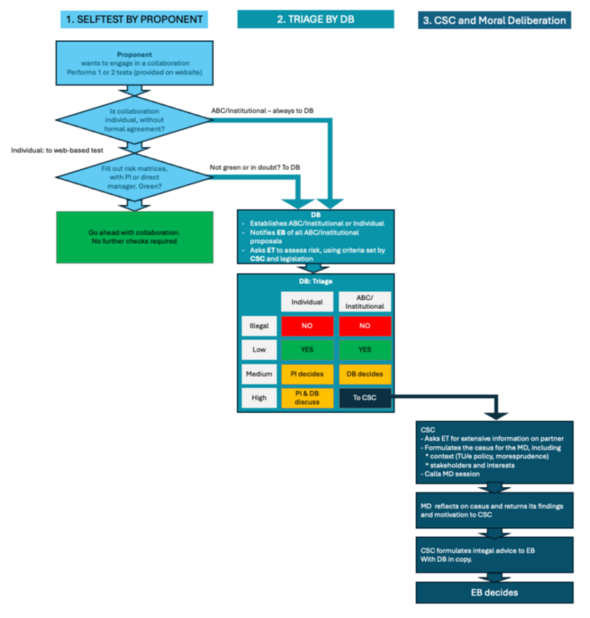
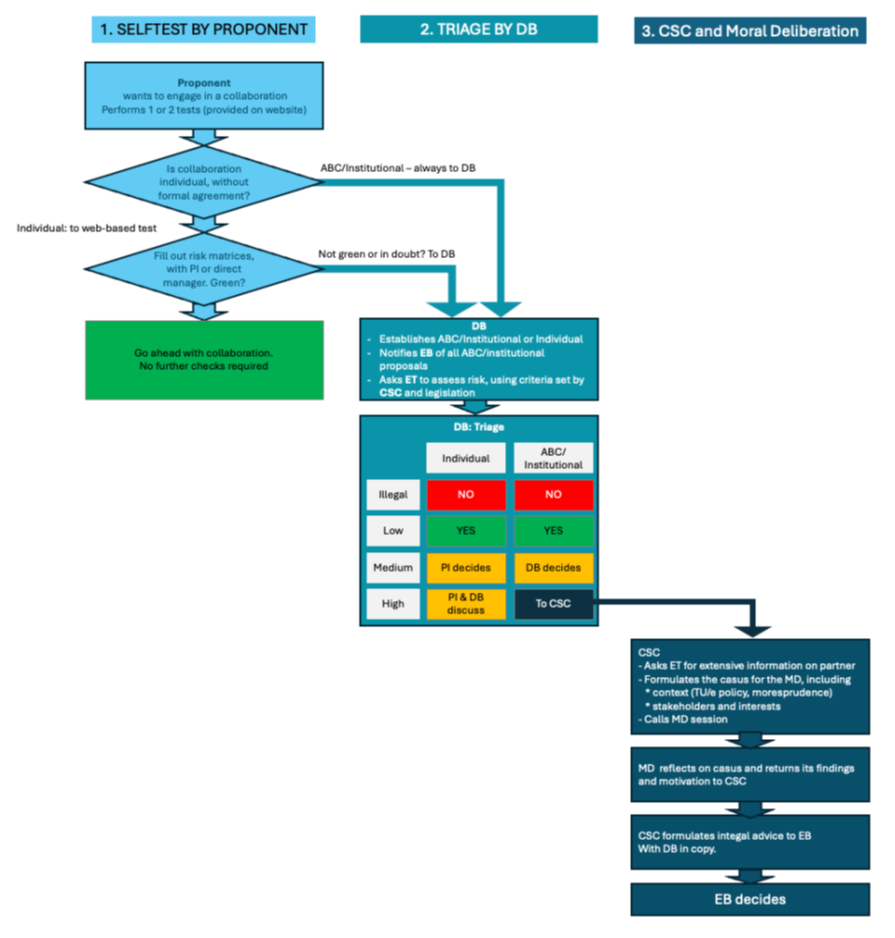
If a collaboration is assessed as low risk, it will be approved immediately. The researcher determines through the tool that it is an individual collaboration with no relevant risk factors, after which they sign off on the project as the responsible party.
The department board
Individual collaborations with an elevated risk profile, as well as all ABCs, are referred to the department board. In the case of individual collaborations, the board decides together with the applicant(s) whether the collaboration may proceed. For ABCs with low or medium risk, the department board makes the decision without the involvement of the applicant(s).
The board may also consult an expert team for a risk analysis. This team will be embedded in the existing Knowledge Security Team and will build a dossier to enable more efficient assessment of future applications.
The committee
Only the most high-risk ABCs will be forwarded to the Committee for Responsible Collaborations. These may involve collaborations with other universities, institutes, countries, regions, or industry partners. The committee will consist of representatives from the TU/e community. In addition, subcommittees will be formed with experts from specific fields, for example defense. The exact size of the committee has not yet been determined.
The committee conducts an in-depth analysis of risks, ethical dilemmas, and the university’s interests. It does not issue a final verdict on whether a collaboration may proceed, but it can provide both solicited and unsolicited advice to the Executive Board regarding collaborations and the university’s position on societal issues. It can also consult external experts, organize dialogue sessions, and submit cases to the Moral Deliberation panel.
Moral Deliberation
Based on all available information, the Moral Deliberation discusses each case according to a fixed step-by-step procedure. The goal is not to reach an immediate judgment, but to explore different perspectives, make underlying values explicit, and develop a well-considered course of action. The panel therefore does not produce a simple yes-or-no decision, but instead formulates conditions under which a collaboration may or may not proceed.
A pool of approximately one hundred TU/e students and staff members will be assembled for this panel. For each case, a group of ten to fifteen participants will be selected from this pool.
The outcome of the Moral Deliberation is added to the committee’s analysis and is then submitted to the Executive Board, which makes the final decision.
Discussion