
- People
- 09/04/2026
Behind the Scenes | Fares Abuelhassan, teaching assistant
From technicians to schedulers, and from IT specialists to catering staff—it takes many hands to keep TU/e running smoothly. But who are the people behind the scenes? Cursor puts them in the spotlight. This time: Fares Abuelhassan, teaching assistant for a wide range of courses.
For Fares Abuelhassan, the role of teaching assistant (TA) has become a familiar part of his time as a student. As early as his second year of his bachelor’s program, the Applied Physics student secured his first position as a TA. Since then, he’s gotten a taste for it and now assists a professor in a different course almost every quartile.
He is now in the final year of his master’s program, which means he will soon be saying goodbye to TU/e—and with that, to his TA side jobs as well. Still, he hasn’t decided whether he will leave teaching behind entirely. Over the years, he has come to really appreciate it. “Maybe I’ll find a combination between working in industry and teaching. Who knows.”
What time do you clock in?
“The earliest I usually start is around 10:45 a.m. That’s after a lecture that ends at 10:30, followed by a homework session for that same course. I’ve actually never had to start earlier than that.”
What does your job involve?
“Teaching assistant is a pretty broad role. Every course has professors who teach it, but they often need support—and they ask senior students like me to help.”
“Your tasks as a TA range from creating practice assignments to grading work, but most often we’re asked to supervise guided self-study sessions.”
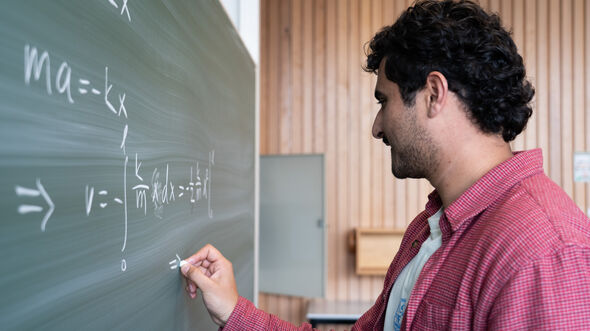
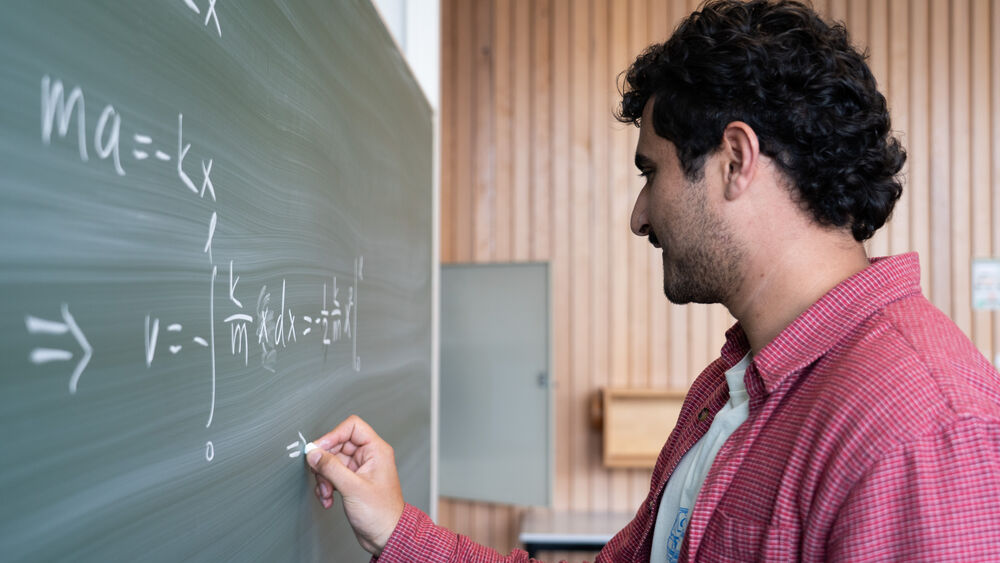
“That means right after the professor’s lecture, you sit down with a group of up to forty students who will be working on homework for that course. Together with other TAs, you walk around answering students’ questions, and I often also explain things to the whole group on the board. Those homework sessions are what I enjoy most as a TA.”
Do you get more responsibility if you’ve been a TA for the same course multiple times?
“Yes, definitely. In some courses, like Calculus, there are even formal rules about that. For example, if it’s your second time as a TA there, you’re also allowed to teach students from other versions of the course—Calculus has three variants.”
“But I notice it in courses without fixed rules as well. The more often you’re a TA somewhere, the stronger your connection with the professor becomes, and the more responsibility you’re given. I also notice that my input is taken more seriously in those courses.”
How did you get into this job?
“My very first TA position was for Calculus, when I was in my second year. I saw a vacancy at Euflex, and it immediately seemed like a lot of fun.”
“After that first experience as a TA, I started emailing other professors in my program to ask if they needed TAs for upcoming courses. That’s really how things got started.”
“I’ve kept that up ever since. Before each new quartile, I send out emails again. And professors also ask you to come back if you’ve been a TA for their courses before.”
What do you enjoy most about your job?
“For me, the human interaction is definitely number one. Education is quite a social field, and I really enjoy that.”
“I also find it interesting and educational to get a sense of the organizational side of teaching a course. And it’s fascinating to see the course material from a different perspective. You look at it differently when you’re there as a TA supporting the course, rather than as a student trying to pass it.”
And what do you enjoy least?
“I often notice that as a course progresses, fewer and fewer students show up. That’s unfortunate to see, but there’s not much you can do about it.”
“I also get humbled sometimes by students’ questions. They ask me something—because, well, I’m the TA—and I genuinely don’t know the answer, and then the whole group is looking at you. On the one hand, that’s uncomfortable, but on the other, I’m always honest about not knowing and I follow up later. That also shows students that it was a good question.”
What time do you clock out?
“Most of the work is with students—like supervising homework sessions—so those hours always fall within fixed class times. The latest I usually clock out for those is around 17:15.”
“But sometimes I get other assignments that aren’t tied to a specific time, like grading homework or setting up a module. I usually do those at home, often on weekends.”
What do you do after you clock out?
“It sometimes feels a bit unusual to say, but I’m a birdwatcher. I used to do it with my grandmother, but since I turned sixteen, I’ve started taking it more seriously.”
“I’m part of a bird working group. We do weekly counts and organize excursions. That way, we keep track of how nature is doing—and especially the birds, of course, since the Netherlands is really a bird country.”
“I’ll also soon be starting as a field researcher counting bats. A friend of mine has a device that converts bat sounds into something humans can hear. That intrigued me, so I looked into it further and came across a vacancy to count bats. Unlike birdwatching, that’s paid—but honestly, I would have done it for free as well.”
“Hobbies and side jobs like that, out in nature, are ideal alongside a technical study. It helps keep things balanced.”
This article was translated using AI-assisted tools and reviewed by an editor.
Discussion