
- Student
- 25/03/2026

Who dares to step onto the stage to face their fears?
“It only really becomes a problem if you’re never afraid of anything,” says psychiatrist Neeltje Batelaan. She gave the lecture Facing Fears for Studium Generale about the usefulness and characteristics of fear. Co-organiser TINT wrapped up the event with a Fear Challenge: participants stepped onto the stage of the Blauwe Zaal to look their own fears straight in the eye.
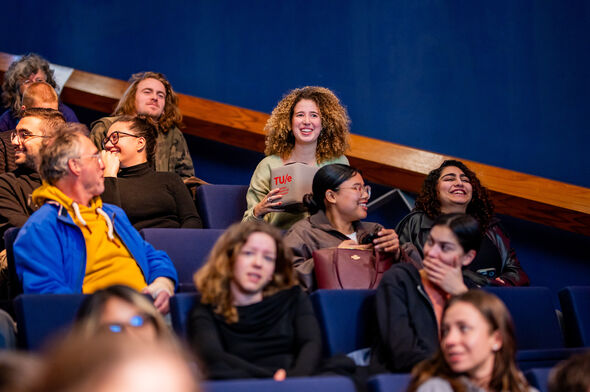
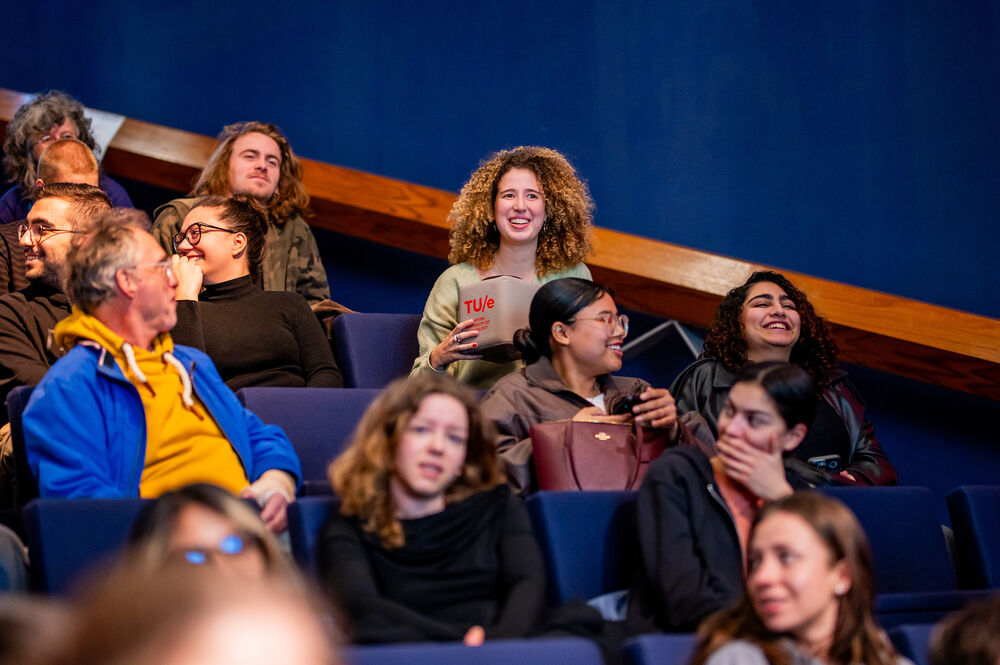
The Blauwe Zaal was sold out on Tuesday evening, but not completely full. Perhaps some of those who registered didn’t dare to come? Psychiatrist Neeltje Batelaan, also a professor of anxiety disorders at Amsterdam UMC, explains what fear is, what you can do about it yourself, how to help someone with anxiety, and answers questions from the audience.
“Fifteen percent of the adult Dutch population has an anxiety disorder, which means that there may be around forty people here tonight who are affected.”
What is fear?
Fear is useful, she emphasizes. It is a biological response to dangerous situations. Fear starts in your brain: adrenaline is released, your muscles tense up, your heart rate and breathing increase, and you are ready to flee.
“But sometimes your brain becomes overactive in certain situations or thoughts, and fear becomes problematic. In this room, there are undoubtedly people who are afraid that I might call on them and therefore avoid eye contact. Others may be unable to focus on my talk because they are thinking about burglars in their home or someone stealing their bike. Still others may be afraid of the bacteria on their seat and can only think about when they can wash it,” Batelaan explains. “But this is not visible. And it’s not talked about much.”
What can you do about it?
If you are afraid, it is always good to ask yourself whether your fear is realistic. “You can change your thoughts, and that changes everything that follows. This is something you can apply using cognitive behavioral therapy.” She gives examples of social anxiety and physical anxiety.
“If you’re too nervous to give a presentation, you might think, ‘I’m going to fail, and if I fail, no one will want to be around me anymore.’ Try to form alternative thoughts. Remind yourself that you prepared well. And after the presentation—whether it went well or poorly—reflect on your fear. After a bad presentation, ask yourself whether everyone has really abandoned you.”
Someone who immediately assumes the worst when a friend is seven minutes late (they’ve had an accident and might even be dead) should look for alternative explanations. “They missed the bus, ran into someone they know, forgot their bag and went back to get it… there are many explanations.” The anxiety expert knows that people with anxiety disorders consistently overestimate two things: the likelihood that something bad will happen and how bad it will be.
Someone who walks up a flight of stairs, feels their heart pounding, and then thinks a heart attack will follow may have a physical anxiety disorder. If they stop walking, they notice their heart rate slows down. This can lead to avoiding stairs altogether. “The thought that climbing stairs is dangerous makes you vulnerable to long-term anxiety,” the psychiatrist warns. “If a fear is not realistic, don’t act on it. Keep walking calmly and consciously realize that you are not having a heart attack.”
How can you help someone else?
Sharing your fears can be a relief. Recognizing that someone else is afraid of the same things can be comforting. Still, Batelaan knows that people often find it difficult to talk about fear due to shame. That is why she especially recommends listening carefully.
“Imagine you have to give a presentation together and the other person is too afraid. Don’t just take over, but discuss the fear and say you want to help—for the long term. Let the other person also do part of the presentation and talk about it again afterward. Did it go badly? And does that really mean no one wants to be around you anymore?”
The final—of many—questions concerns the current world order. “What can you do if you are afraid of a third world war?” Batelaan does not have a simple answer.
“It’s difficult,” she says. “You want to stay informed, but reading everything about global politics is impossible and doesn’t help. Accept that there is uncertainty. It feels unpleasant, but it is reality. Accidents happen, people get sick, there is uncertainty.”
Stage fright
To close, TINT presents a practical challenge to face stage fright. Life coach Margit van Tuijl guides everyone in the audience to take small steps. “Raise your hand if you find it scary to stand in front of a group.” To those raising their hands: “Stand on the steps. Feel your body—what is happening in your arms and legs?” She continues: “Come onto the stage.”
That she eventually gets 27 people on stage makes sense to one participant. “When you do something together, you’re less nervous.” And then: “Who dares to answer a question?” This time, many students do.
Want to know more?
Psychiatrist Neeltje Batelaan offers the following recommendations:
- Laat ze maar denken, by Rob Faltin (in Dutch). “In Laat ze maar denken, you learn to manage your nerves and discover that rejection is less serious than you might think.”
- Self-help books by Boom Publishers (in Dutch), including their “Top 5 self-help books” selection.
- The Imp of the Mind, by Lee Baer. “Exploring the silent epidemic of obsessive bad thoughts.”
The Dutch-language lecture Altijd angstig, which she gave in 2025 for Studium Generale Utrecht, can be watched online.
Batelaan also contributes to the podcast series Met volle angst vooruit by the Anxiety, Compulsion and Phobia Foundation and is currently writing her own English-language book.
Discussion