
- Campus
- 23/09/2026

A pavilion that moves with the sun
A striking new installation has recently appeared on the field behind the Luna building: SOMBRA. The pavilion was designed as an ode to the sun and will be on display on the TU/e campus for the coming months. But SOMBRA is more than an eye-catching structure: it is designed to adapt to changing sunlight.
Anyone walking across campus may already have noticed it: the pavilion that has been standing on the field behind the Luna building since last Friday is quite an eye-catcher. Its name is SOMBRA—derived from the words for sun (sol) and shade (ombra).

From Venice to the TU/e-campus
SOMBRA was initiated by Metadecor, Airshade Technologies and Alumet and developed in collaboration with several partners, including TU/e. Among those involved is Bas Overvelde, full professor at the TU/e’s Department of Mechanical Engineering, who contributed his expertise in soft robotics to the project.
The pavilion was showcased at the Venice Architecture Biennale last summer and has now made its way to the TU/e campus, where it is expected to stay for at least six months. “It’s not going to be a permanent installation on campus, since the idea is to showcase it in different places”, says Papachristou.
Solstices
“The design is very dynamic,” Papachristou explains. “There are soft robotics elements in the arches. Small triangular panels are attached to them, and these contain air pockets.”
The six arches are positioned according to the movement of the sun, with the upper and lower arches corresponding to the position of the sun during the summer and winter solstices. The panels are hinged, allowing them to open and close depending on the amount of sunlight.
When the sun heats up the structure, the air inside small canisters hidden in the arches expands. This creates pressure, pushing air into a small airbag connected to one of the panels. As the airbag fills, it contracts like a muscle, activating a mechanism that pulls the panel closed.
Ode to the sun
“So when there is a lot of direct sunlight, you get more shade, making it more comfortable for people sitting underneath,” Papachristou says. “And when there isn’t a lot of sun, the panels open again, so you have a clear view through the pavilion.”
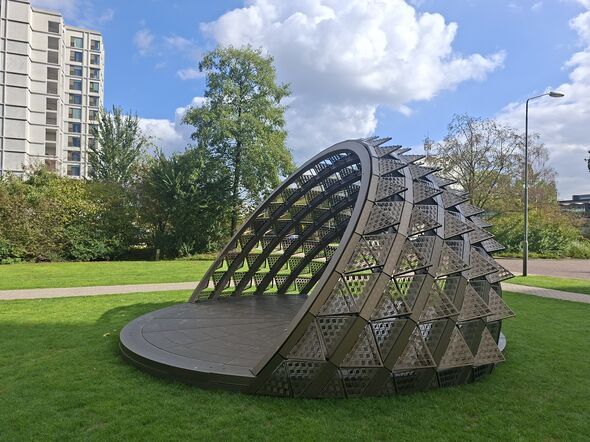

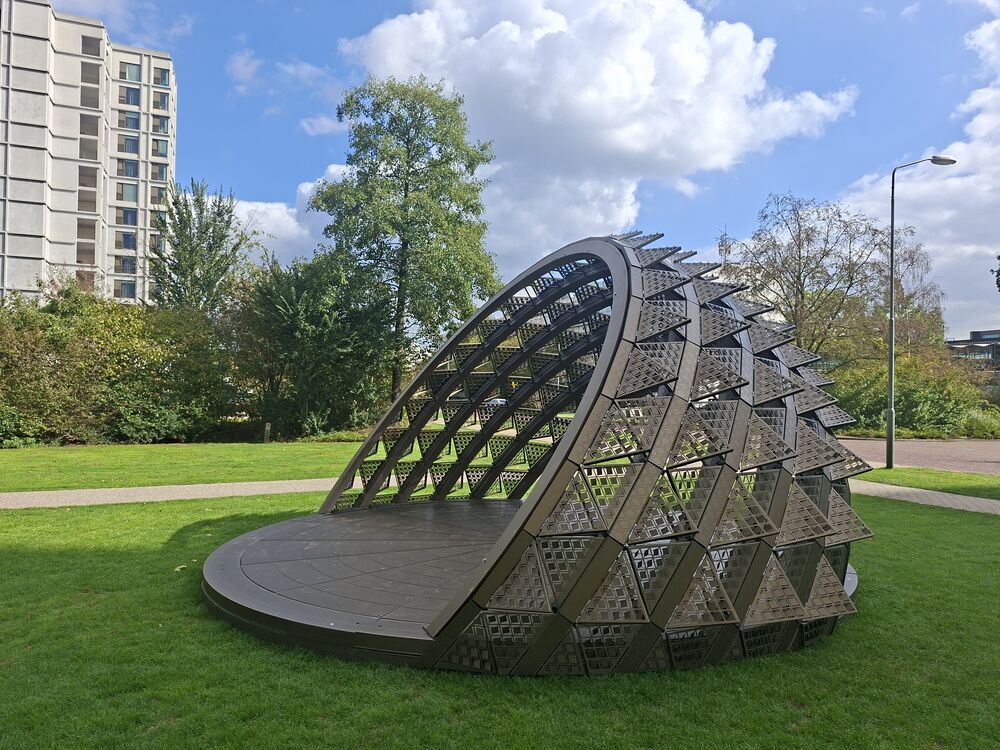
What makes it special is that the whole system works through natural physical processes. “The pavilion has no connection to the internet, electricity or any electronic devices—it simply moves with the sun.”
As the sunlight becomes stronger or weaker, the panels respond accordingly, almost as if the pavilion were breathing. “It is designed as a kind of ode to the sun,” Papachristou says. Throughout the day, as the sunlight changes, SOMBRA changes with it.
A place to meet
“We would love for the pavilion to become a place where people can meet, have lunch and spend some time,” Papachristou says. “We also hope it can be a conversation starter—a way to get people thinking about how innovation can help us reshape our surroundings to better serve our needs.”
That idea fits closely with the work of the Smart Campus & Living Labs program. “Our role is to showcase innovations and ideas that are developed on campus, but also to encourage students to think about how we can make our campus better. SOMBRA is one example of what we do.”
For Papachristou, that means looking at the campus differently and questioning things that might otherwise seem self-evident. “Why is the elevator so slow? Why are the lecture halls always so full? Why aren’t there enough places to find shade when it’s sunny? We want to encourage conversations around these questions and turn them into innovations on campus,” she says.
This article was translated using AI-assisted tools and reviewed by an editor
Discussion