
- Student
- 25/08/2026

Biggest challenge still lies ahead for Stella Juva in Kenya
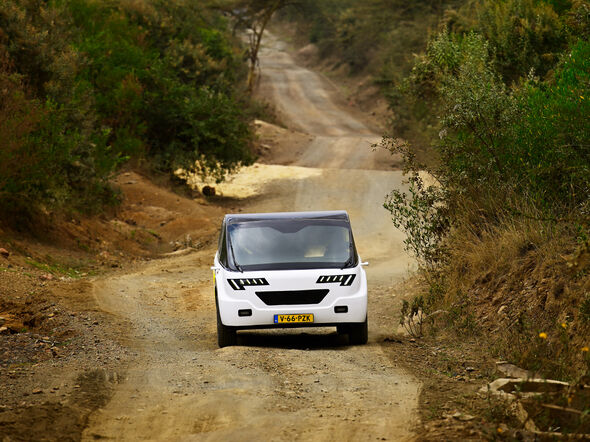
The first results from Solar Team Eindhoven’s solar-powered ambulance speak for themselves. Stella Juva generates more energy than it consumes. TU/e students have now traveled 700 kilometers in Kenya with the vehicle, which was specifically designed to provide medical care in hard-to-reach areas.
Twenty-three students from Solar Team Eindhoven traveled to Kenya on August 14 to test Stella Juva in practice. The ambulance is equipped with solar panels on its roof. The energy they generate powers the motor and supplies electricity to the medical equipment. This allows the vehicle to provide healthcare in difficult-to-reach and remote areas.
The students have already covered around 700 kilometers and are very pleased with the initial test results. “When we are stationary, the car generates more energy than all the medical equipment inside it uses at the same time,” says team manager Mathijs van Gerven. “This allows healthcare workers to provide continuous medical care.”
Selfies
The trip began in the capital Nairobi, at Amref Health Africa, the Solar Team’s partner organization. This largest healthcare organization in Africa works in more than 35 countries to promote sustainable access to healthcare. The team presented Stella Juva there to, among others, the Kenyan Minister of Energy and various media outlets.
“The next day, when we stopped somewhere to recharge, someone immediately recognized us because they had heard about us on the radio,” Van Gerven says. “Kenyans like to strike up a conversation and ask what kind of crazy car we are driving around in. People take lots of selfies and photos. They are very enthusiastic.”

Impact
The first major drive was a trip of more than 100 kilometers from the capital to Lake Naivasha. For the students, it was an excellent introduction to the chaotic Kenyan traffic.
For the biggest off-road challenge so far, the team drove to a remote field location for pregnant women. A 40-kilometer journey over unpaved terrain took them to Mosiro. “That was very impressive for the team,” Van Gerven says. “It is a very poor area. Access to healthcare cannot be taken for granted. It is exactly the kind of place where our solar-powered ambulance can make an impact.”
Potential
The vehicle is specifically equipped for pregnancy diagnostics in remote areas. The medical equipment on board was partly developed based on the requirements of Amref Health Africa itself.
The team showed local healthcare workers and midwives how the equipment works and how they can use it in practice, in order to gather their feedback and responses. Van Gerven: “Healthcare workers see a lot of potential because you can reach places that are normally inaccessible due to a lack of fuel or infrastructure.”

Final destination
The day before yesterday, the team completed a 184-kilometer drive from the city of Narok in southwestern Kenya. The route took them along the highway and through the busy outskirts of Nairobi. The team is currently spending another day in Kajiado to rest and work on the car.
From there, the journey continues to the final destination: Mount Kilimanjaro. It is the final and biggest challenge for Stella Juva: a demanding journey of more than 200 kilometers.
“The terrain is a good example of a location where our car could provide medical care,” Van Gerven says. “It is a fitting end point for our journey through Kenya and for us as a team: after spending a year building it, we have managed to get it all the way to Kilimanjaro.”
Reality
The adventure in Kenya will then be over. The team will still meet with industry partners and policymakers. According to Van Gerven, the message is clear.
“Thanks to the successful tests, we know that Stella Juva can make an impact. We hope to inspire them to turn this vehicle and this technology into a reality. If 23 students can achieve this in one year, just imagine what industry could achieve.”
There will be no time for the students to rest, however, according to the team manager: “Next week, we will all be back in the lecture halls.”


Discussion