
- Research
- 23/06/2026

3 TU/e top scientists awarded ERC grants worth millions
The European Research Council has awarded 22 Advanced Grants of up to 2.5 million euros to leading researchers at Dutch knowledge institutions. Three of those grants have gone to TU/e scientists Remco van der Hofstad, Bert Koopmans, and Willem Mulder.
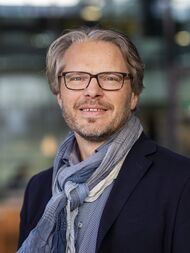
The European Research Council's (ERC) Advanced Grants are intended for top scientists. Three TU/e researchers have received one: Remco van der Hofstad from the Department of Mathematics and Computer Science, Bert Koopmans from the Department of Applied Physics and Science Education, and Willem Mulder from the Department of Biomedical Engineering.


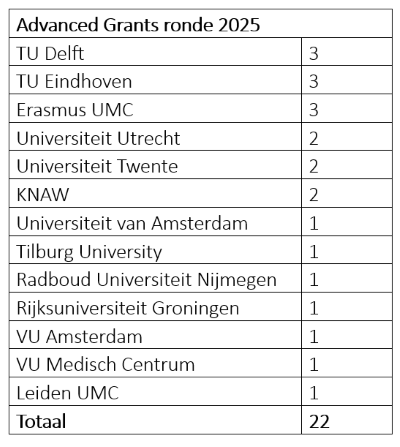
TU Delft and Erasmus University also secured three ERC Advanced Grants each. Other Dutch universities received fewer grants or none at all (see table below).
Success rate
In this funding round, the European Research Council (ERC) distributed a total of 840 million euros. That is more than 100 million euros higher than last year. As a result, a record number of grants was awarded. Nevertheless, the success rate remained relatively low.
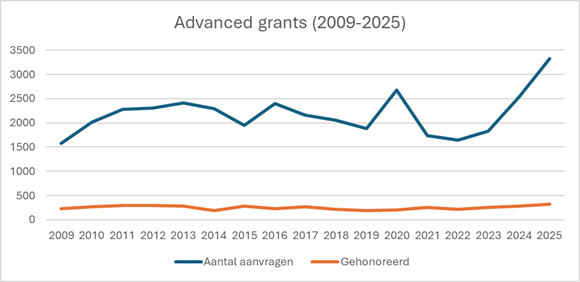
This is due to the growing number of applications. This year, 3,329 proposals were submitted, more than 30 percent more than last year. Of those, 319 were funded. This puts the success rate at 9.6 percent. Last year, it stood at 11 percent, and the year before at nearly 14 percent.
Competition
Competition for these European grants is therefore intense. According to the ERC, the rising number of applications is creating challenges: there are not enough reviewers available to assess proposals thoroughly. To reduce the workload, the council proposed stricter rules earlier this year to limit the number of applications, but the plan was dropped after receiving substantial criticism.
The United Kingdom received by far the highest number of grants this time (62), followed by Germany with 46 and Switzerland with 32. The Netherlands ranks sixth with 22 grants. That is slightly lower than last year, when the country ranked fourth with 24 grants.
United States
In total, thirteen leading researchers currently based outside Europe have received a grant: nine from the United States, two from Australia, and two from Canada. The funding allows them to establish a laboratory or research team at a European research institution.
Seven of them are making use of additional funding made available by the ERC for researchers from outside Europe, aimed at attracting more international top talent. The budget was increased after President Donald Trump launched an attack on academic freedom in the United States.
Women
A total of 81 female top researchers received an Advanced Grant, compared with 237 men. As a result, only one-quarter of the laureates are women. One recipient identified as non-binary.
The ERC also awards Starting Grants (up to 1.5 million euros) and Consolidator Grants (2 million euros). In those funding programs, the share of female grant recipients is generally somewhat higher.



Discussion