
- Research
- 24/06/2026

On the TU/e campus, Tuesday centered around Research Day 2026, the annual event celebrating research, innovation, and academic excellence. Students, staff, alumni, and guests gathered in the Auditorium, where academic and science prizes were awarded. This year’s theme was “Curiosity Connects.”
The edition coincided with the kickoff of the university’s 70th anniversary lustrum, which earlier in the day took place in Eindhoven. Professors in academic gowns visited schools by bicycle and later joined a city procession.
Honorary doctorate for smart networks
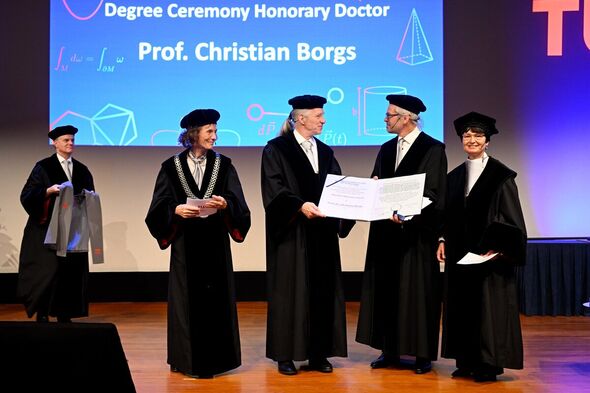
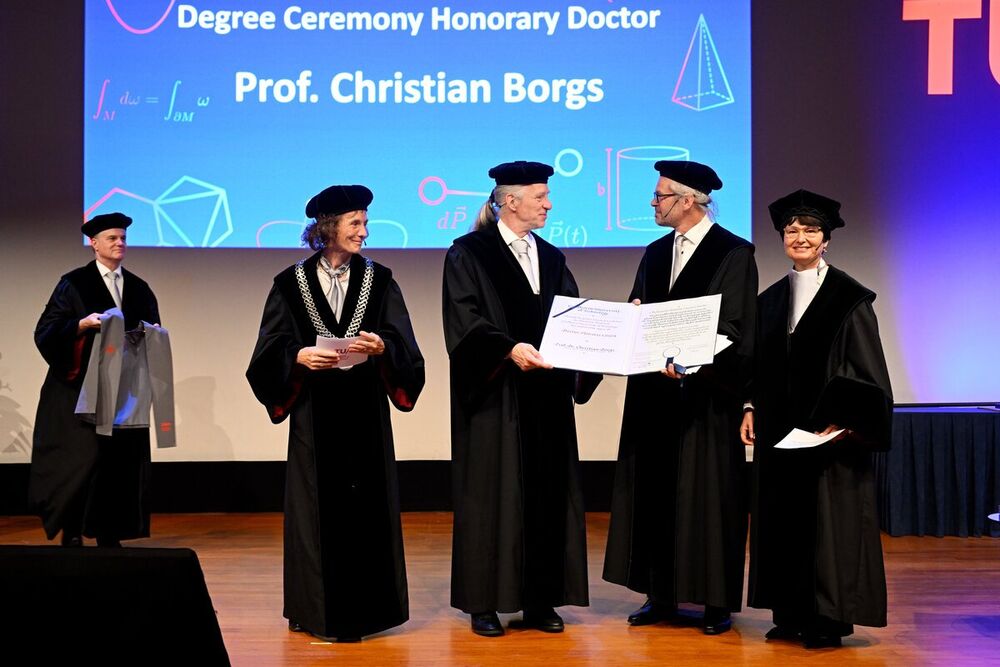
After returning from the city celebrations, the professors took their seats in the Blauwe Zaal under the guidance of the beadle, and the program began. Rector Magnificus Silvia Lenaerts opened the day by awarding an honorary doctorate to Christian Borgs, Professor of Computer Science at the Berkeley AI Research Group in California. Borgs is an internationally leading researcher at the intersection of mathematics, statistical physics, theoretical computer science, and AI for science.
“TU/e honors him, among other things, for his leading role in connecting academia with industry,” Lenaerts said. Borgs received the honorary doctorate from Edwin van den Heuvel, dean of the Department of Mathematics and Computer Science, who had nominated him for the distinction.
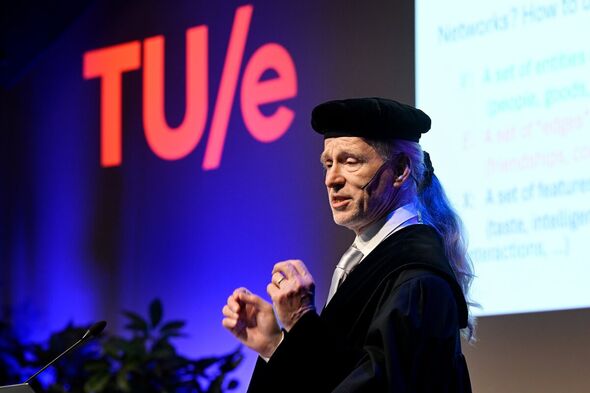
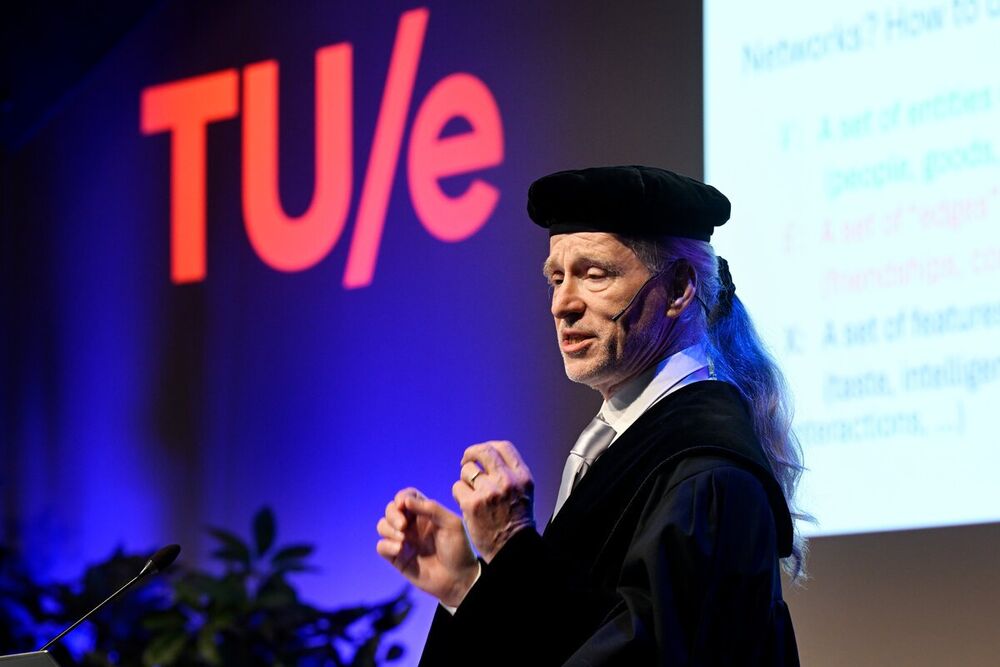
In his honorary lecture, Borgs—who works on the “mathematics of networks”—explained that networks are everywhere around us, from the World Wide Web to social and infrastructure systems.
With the methods he develops, complex networks can be better understood. This helps analyze and predict processes in such systems, such as the spread of viruses or the functioning of recommendation systems used by platforms like YouTube and Netflix, which model users and content as networks of interactions to suggest content.
Detecting tuberculosis
Professor Bert Meijer then took the stage for the next part of the program: the presentation of academic and scientific awards to talented and leading TU/e researchers. “Those who go home without a prize today will surely be disappointed. But being nominated by your colleagues is at least as important as winning, and a great honor,” he told the nominees in the front rows.
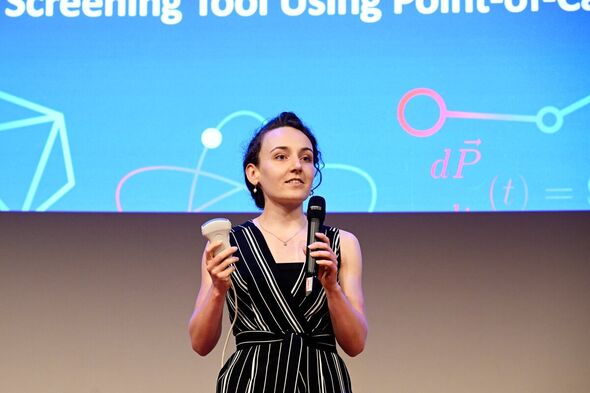
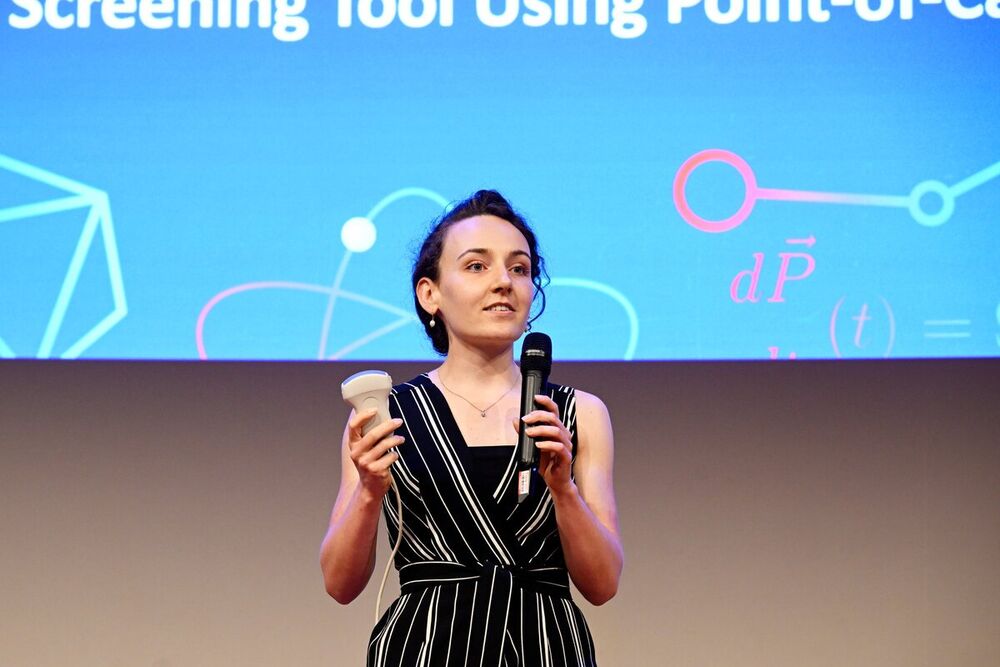
The prize for Best EngD Thesis, including a €5,000 award, went to Elze Swinkels. She developed an AI-supported screening method for early detection of tuberculosis in low- and middle-income countries, using portable ultrasound and a mobile application. This allows tuberculosis—still responsible for the deaths of around 3,500 people worldwide every day—to be detected and treated earlier. The technology is “scalable, portable, and affordable,” Swinkels said.
Derek van Tilborg also received an award and a prize for Best PhD Thesis for his innovative application of machine learning in chemistry, particularly in drug development. “There are thousands of molecules you can use for different applications. AI models can help reduce the possibilities to a selection that can then be further investigated,” he said.
As efficient as the brain
Next were the scientific awards, starting with the Young Researcher Award, which went to Minha Lee from the Department of Industrial Design. According to the jury—composed of the Rector Magnificus and the deans of all departments—Lee conducts groundbreaking research at the intersection of artificial intelligence and ethical questions.
“We know that AI has memory, but when it comes to emotions we usually consider them something uniquely human. But what if AI also has emotions, just like it has memory, but in a different way than humans? Could AI, for example, have compassion?” she asked the audience, presenting one of the central questions of her research.
Federico Corradi from the Department of Electrical Engineering received the Groundbreaking Research Award. His research focuses on so-called neuromorphic neural networks, which operate in a way similar to the brain: highly parallel, energy-efficient, and performing computations only when needed. This contributes to the development of a new generation of artificial intelligence.
“It’s good to hear that my brain is apparently very efficient,” Meijer joked during the award ceremony. Corradi also received a €15,000 research grant.
Delivering excellence
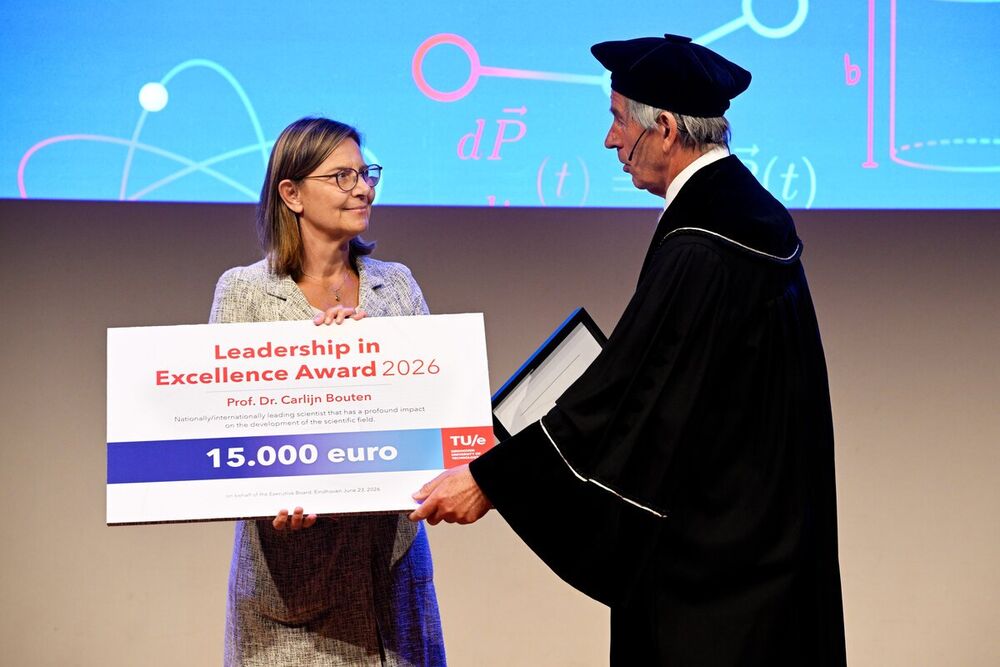
The Leadership in Excellence Award is presented annually to an established researcher for an outstanding scientific contribution in their field. This year, the award went to Carlijn Bouten, Professor of Cell-Matrix Interactions in Cardiovascular Regeneration at the Department of Biomedical Engineering.
“Bouten has an exceptional and impressive career, with a track record full of grants and national and international recognition. She is a versatile researcher capable of thinking outside the box,” Bert Meijer quoted from the jury report.
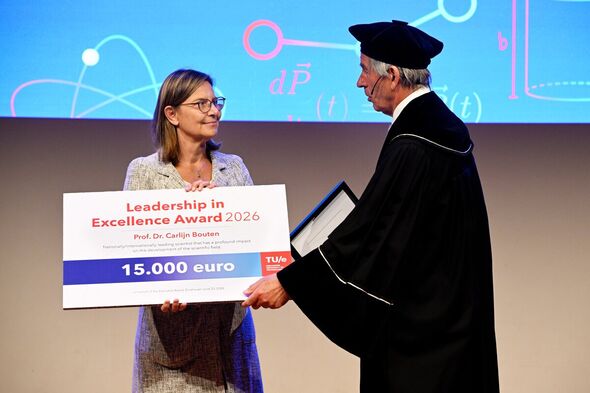
On stage, she emphasized her gratitude for the opportunities she has received at the university. “I was not pushed, but given the space to succeed. I had the privilege to excel.”
She also referred to a DHL van she recently saw with the slogan “Excellence, simply delivered.” “Customers pay for a service, so they expect excellence. That is also what we need in science: excellence in technology, simply delivered,” she said.
This article was translated using AI-assisted tools and reviewed by an editor
Discussion