
- Research
- 19/10/2026

Vegetables and weed grow themselves — here or on Mars
Wieger Wamelink, an ecologist at Wageningen University, speaks enthusiastically about his futuristic grow box, which he’s showcasing at Dutch Design Week (DDW). “I also call myself a space builder,” he says with a grin. “This autonomous grow box isn’t just being developed to make life easier here on Earth, but also to be used on Mars and the Moon.”
As part of 4TU Design United, Wamelink is presenting an autonomous growth chamber at Dutch Design Week (DDW). In collaboration with Eindhoven University of Technology (TU/e), he has developed a method that allows crops—such as vegetables or bamboo—to grow without any human labor. You simply plant the seeds, close the door, and the chamber takes care of the rest.
4TU Design United is a partnership between the four technical universities in the Netherlands (Eindhoven, Twente, Delft, and Wageningen) focused on design research. It operates at the intersection of scientific research, rapidly evolving emerging technologies, and the shifting needs and aspirations of our future society. Several of the collective’s projects are on display during DDW at the Klokgebouw.
Futuristic
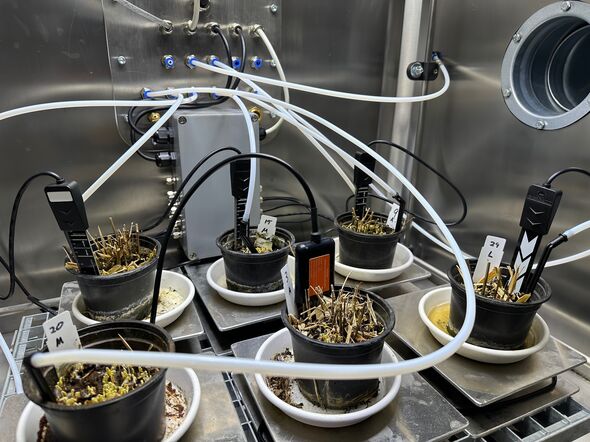
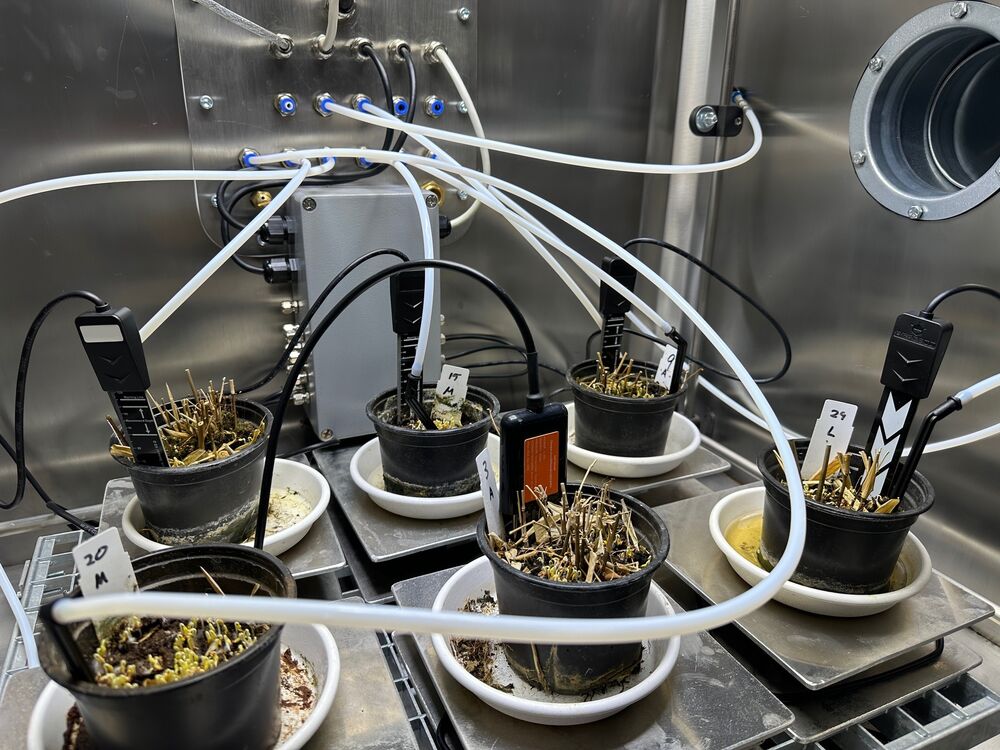
In the (distant) future, this growth chamber is intended to provide fresh food in places like Mars or the Moon — environments where fresh vegetables and fruit are typically not on the menu. “Perhaps that will change in the future. To prepare for this, we have simulated the soil found on the Moon and Mars. Furthermore, this technology could prove useful for countries with desert regions, where cultivating crops in extremely dry soil is a major challenge.” To verify that the chamber functions correctly, the team has also included a ‘control soil’ sample.
Gases
Gas exchange takes place inside the cabinet. For this, Wamelink had to enlist the help of Eindhoven University of Technology (TU Eindhoven). “I didn’t have the necessary expertise, but it’s a crucial aspect. Air enters on the left and exits on the right. It’s a delicate process—plants produce oxygen, which must be removed; otherwise, the cabinet could essentially turn into a bomb.” Normally, the door remains closed, which would trap all that oxygen; for the sake of the exhibition, however, it has been left open.
“The oxygen is now being extracted using gas-flow techniques developed in Eindhoven (by the Department of Mechanical Engineering, ed.). This requires extreme precision, as oxygen levels at the top of the cabinet differ from those at the bottom. Furthermore, as plants grow, they also alter the gas composition.”
Automated
The cabinet manages light, temperature, water, nutrients, carbon dioxide, and humidity—all without human intervention. This reduces both the labor required and the risk of error, while also demonstrating a system that could potentially function on other planets.
“This is quite unique; growth chambers developed to date still require someone to open the door. We — he works as part of a larger team—hope to soon build an entire ‘dome’ of these growth chambers in Wageningen.” If that proves successful, the next steps include a dome in the desert, followed eventually by installations on the Moon and Mars—the ultimate test, millions of kilometers away.
Weed
On the left side of the cabinet, some garden cress is currently germinating. But, as Wamelink assures, you could grow virtually anything in it. “Potatoes, for instance, or even bamboo, which could be used to make clothing or furniture. The possibilities are endless.” Some students might now be seeing dollar signs when they think of a fully autonomous grow box: could you grow weed in it, too? “Yes, you could. I know that students abroad once experimented with that, and it worked.” So, a fresh joint on Mars or the Moon might well be among the possibilities in the future.
Discussion