
- Research
- 02/09/2026

New foundation aims to extend the life of acoustics software
Much academic acoustics software risks being lost once a researcher leaves or a grant-funded project ends. The new Open Acoustics Foundation, established by TU/e’s Building Acoustics research group, aims to change that. The foundation brings researchers, students and companies together to extend the life of software tools.
Sound has a major impact on our living environment. Noisy offices and classrooms with poor acoustics can cause stress and affect cognitive performance. Universities therefore develop advanced methods and software to predict acoustics, but these do not always have a long life.
By supporting open-source projects and building communities around them, the founders of the Open Acoustics Foundation hope to ensure that acoustics software is maintained for longer and used by larger groups of users.
Complicated
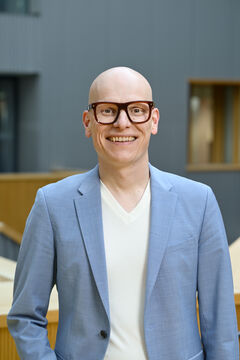
“In practice, methods slowly die out when their developer leaves the university,” explains Professor of Building Acoustics and co-founder of the foundation Maarten Hornikx. “Or they remain available only as complicated code on GitHub, which eventually becomes unusable without support.”
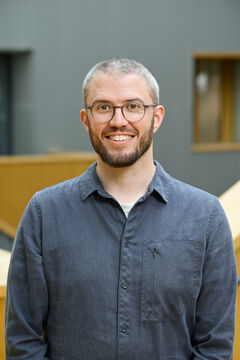
Sitting next to him is Marco Berzborn, a university researcher in the Building Acoustics research group and co-founder of the foundation. He adds: “I just received an email from an acoustics consultant who wanted to use software developed by our research group. ‘Yes, but it’s on GitHub. I’m looking for something executable,’ he said.”
The choice to establish an independent foundation was therefore deliberate, the founders say. When a research project and its associated funding end, there is often little money available to maintain existing software. A non-profit foundation should therefore provide a more stable basis and make it easier to attract external sponsors than would be possible as a TU/e research group.
CHORAS
The foundation’s first supported project is CHORAS. The platform brings together different acoustic simulation methods, which originate from various universities. It works in the web browser. Users can import a 3D model of a space and then calculate how sound propagates, depending on factors including sound sources, receivers and the materials used. They can also hear what, for example, a voice or musical instrument sounds like in the space.
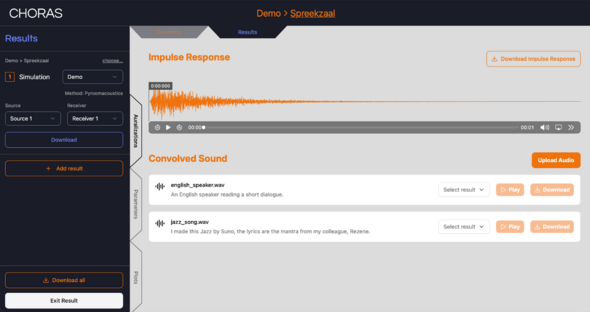


CHORAS started about 2.5 years ago as an NWO project. During the project, the founders say it became clear that researchers and companies were collaborating very little on software development.
“Consultants use commercial programs, while researchers develop new methods, but there is no direct connection between those two worlds,” says Hornikx. “Everyone has their own priorities, so collaboration tends to fall by the wayside. Within the foundation, we want to actively encourage working together.”
Building a community
To encourage collaboration, the foundation organizes meetings. It has already held two workshops for acoustics software developers. In November, a user day will follow, where researchers, students and people from industry can test the software and provide feedback.
According to Berzborn, such a community creates more opportunities. “It makes it easy to compare methods with each other in a fair and transparent way, something that previously rarely happened because of a lack of time, even though it is essential for scientific research.”
Gap
CHORAS is also already being used in education. Bachelor students Architecture, Urbanism and Building Sciences select an existing space on campus or in their dorm, test the acoustics using Bluetooth speakers, recreate the space in 3D, and design acoustic improvements using the software.
Berzborn: “If students have trouble installing open-source software, you’ve usually already lost half of them. At the same time, commercial acoustics software is too expensive. So CHORAS fills the gap for students between unaffordable commercial software licenses and user-unfriendly, open-source software.”
Independent of TU/e
The foundation has now officially been registered with the Dutch Chamber of Commerce. The founders hope to bring more open-source projects under the foundation within five years. “At the moment, we are on the foundation’s board, but we are also the creators of CHORAS. If we have several independent projects, the foundation’s neutral role will become clearer,” Hornikx says.
The official international launch of the Open Acoustics Foundation will take place in September during Forum Acusticum in Austria. The foundation will have a booth there alongside commercial software companies and materials manufacturers. Hornikx sees this as an important first step: “It’s a great opportunity to engage with the global acoustics community.”
The founders of CHORAS pictured in the main photo, from left to right: Silvin Willemsen, Marco Berzborn, Cédric Van Hoorickx, Maarten Hornikx and Bram Botterman.
This article was translated using AI-assisted toold and reviewed by an editor
Discussion