
- The University
- 01/09/2026
TU/e Opening Academic Year dedicated to strengthening Europe
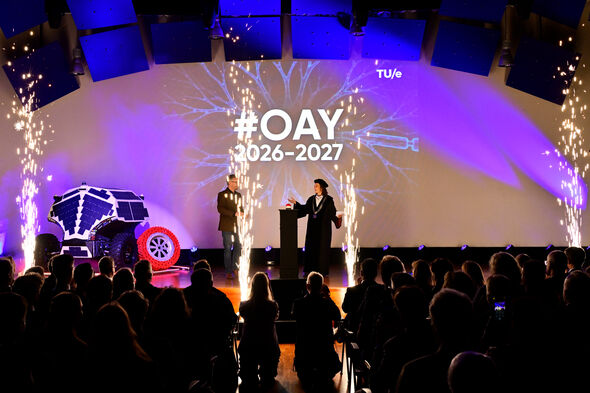
Rector Silvia Lenaerts opened the TU/e 2026-2027 academic year yesterday with the traditional push of a button and fireworks in the Blauwe Zaal. Yet, at times, the ceremony resembled the opening of the political working year: once again, a minister acted as keynote speaker, and never before has there been so much focus on the university’s role for the Netherlands and Europe.
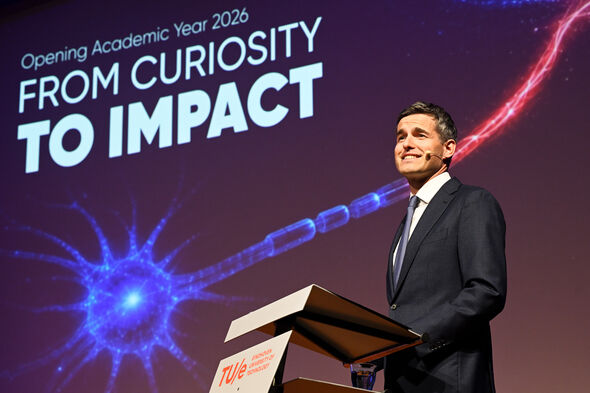
TU/e pulled out all the stops for the Opening Academic Year (OAY), with Minister of Foreign Affairs Tom Berendsen as keynote speaker. Initially, Minister Stientje van Veldhoven (Climate and Green Growth) was also announced as a speaker during the opening, but she turned out to be unable to attend.
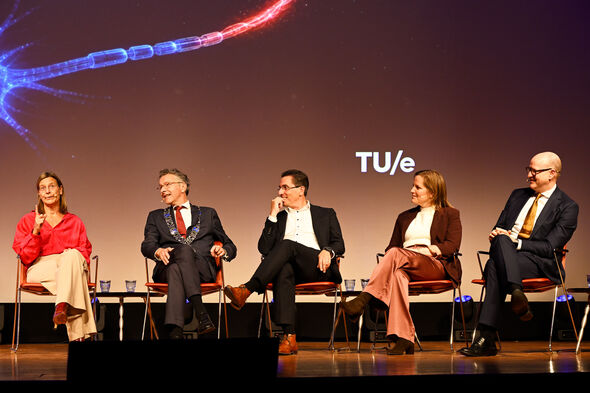
However, the approximately 150 visitors can listen to a panel discussion featuring MEP Bart Groothuis, ASML Chief Technology Officer (CTO) Marco Pieters, Siemac CEO Maartje van Schagen, Mayor of Eindhoven Jeroen Dijsselbloem, and Professor of Biomedical Engineering Carlijn Bouten. In addition, student team Polar presents its new Gen 2 car on stage. This year’s theme:From curiosity to impact.
Brainport
MEP Groothuis sees a simple solution for dealing with a Europe often labeled ‘weak’. “If everyone within Europe just starts working like they do in Brainport, things will turn out fine,” he says with a laugh, referring to the cooperation between various parties in the region. It illustrates the sentiment heard from many speakers this afternoon: the praise of Brainport.
Berendsen is also full of praise for it. “It is not just an economic model, but also a culture: having trust in each other and celebrating each other’s successes together. Successes that can only be achieved through cooperation.”
But outside Brainport the cooperation could be improved, Mayor Dijsselbloem believes. He would like to see national politicians step more out of the shadow of their own parties and dare to make decisions for the national interest.
Improving security
In his keynote, Minister Berendsen focuses primarily on the importance of strengthening the EU. The world has changed dramatically in just a few years. “We are dealing with Russian aggression, Chinese competition, and a less predictable America. Improving European security is therefore one of our greatest tasks.”
And that strengthening requires the necessary investments, but also innovation. This is where Berendsen sees a role for the TU/e. “Without innovation, there is no security. Security that is necessary for maintaining our prosperity and protecting our values.”
In his speech, the CDA minister particularly praises the (prospective) students. He emphasizes how important their knowledge, skills, and creativity are for the future of the Netherlands and Europe. “You are the leaders of tomorrow.”
When asked whether he is leaving enough room for the independent scientific development of young talent, he nods with conviction. “I underscore the importance of their results, but those results are achieved precisely when they use their free creativity. They must continue to challenge the status quo.”
Politics
Once again, a keynote by a minister, just like last year when former minister Ruben Brekelmans (Defense) took charge. Why not a scientist as the keynote speaker during the opening of the academic year, Cursor also asks press spokesperson Frans Raaijmakers.
He indicates that OAY has always been an event aimed at the outside world. “In the room, alongside students and staff, there are also many partners from the region. Everything comes together here, so an external keynote speaker is a logical choice.”
Rector Lenaerts concludes OAY with a speech and a concrete appeal to TU/e staff: take a critical look at your agenda. “Which items on it really contribute to making this university better?”
Everyone can go home and think about that, because five seconds later the rector proudly presses the red button and declares the 2026-2027 academic year open.


Alternative opening
Every year, an Alternative Opening of the Academic Year, the AOAY, also takes place in the Netherlands. This is a protest gathering featuring lectures, discussions, and a march, among other things, organized by trade unions and action groups against cuts in higher education. This year, it took place in Groningen, and TU/e professor Remco Tuinier was there.
Tuinier did not feel entirely comfortable with the political approach of the opening of the academic year at TU/e. “It is about making an impact and serving society. That is important too, but I miss genuine attention to the core of our work: education, research, and the independence of scientists.”
In Groningen, Tuinier enjoyed the critical lectures. “Take the investments the government is making in defense to tackle societal challenges. But why not invest in education (as well)? The rule of law is under pressure; in such circumstances, you should be strengthening universities.”
The topic of the democratization of universities was also on the agenda. “Speaker Dirk Jan Scheffers (from WO in actie and the Rijksuniversiteit Groningen) stated that Dutch universities are organized in a very hierarchical and undemocratic way.”
“You see this reflected, for example, in appointments of directors and how an Executive Board must account for its actions: solely to the Supervisory Board. I would also like to see something like that changed, and it is inspiring to listen to other scientists sharing their insights on this.”
Discussion