
- The University
- 01/09/2026

TU/e prepares community for major changes
The internal opening of the academic year on Monday focused on the major transformation TU/e will undergo. Chief Transformation Officer Sham Moodliar discussed the transformation with the Executive Board and started the meeting with a dose of reality: “70 percent of all major transformations fail.”
“Why do we actually need to change?” Moodliar asks the Executive Board (CvB) at the new internal part of TU/e’s opening of the academic year. President of the Executive Board Koen Janssen responds: “The world around us is changing faster than ever. If we fail to adapt, we risk losing influence, talent, partners, and funding.”
According to Vice President Patrick Groothuis, the university must survive “winds from all directions” while standing for science as it is, regardless of geopolitical tensions. “I think 80% should not depend on which politician in which country is saying what. We need to move in a solid direction.”
Strong foundation
According to Janssen, the university already has a strong foundation for this, but he believes it can be strengthened further if we “turn individual excellence into collective impact.” To achieve this, the Executive Board wants to increasingly organize university support around so-called value chains, Groothuis explains. “This means starting from what a researcher, lecturer, or student needs and then redesigning the entire service delivery around that.”
According to Groothuis, there is little point in optimizing individual processes or simply creating connections between existing parts of the organization. He uses the faculties as an example. “We have nine faculties, each with its own organizational model. We are smart people. Why would we use nine different, non-optimal processes for the same need?”
No one-size-fits-all approach
This should not result in a one-size-fits-all approach, Groothuis reassures his audience, but: “Where the need is the same, let us describe and deliver one strong basic quality that actually delivers upon the need.”
Janssen also emphasizes that improving what already exists will not be enough. “We don’t want to optimize the university of the past, but build the university of the future.”
Groothuis takes it one step further: “Our audacious goal is that our university operations will become the most personal, connected, and seamless university operations in the Netherlands by 2035.”
Back to the core
That university must return to its core mission, Rector Magnificus Silvia Lenaerts says. “The university has three core tasks, doing research, groundbreaking research, educating responsible engineers, but also creating value for society. We should really dare to focus on our core tasks.”
According to her, all processes should serve these three core tasks of the university, and people themselves must be willing to make choices about where they do and do not invest their energy and where they want to excel.
But as Moodliar already pointed out, the vast majority of major transformations fail. As Chief Transformation Officer, it is his task to prevent that from happening in this transformation. According to him, four drivers are decisive. People must feel the urgency and importance of the change. Leaders and employees at all levels must take joint responsibility. The change must become part of the organizational culture rather than remain a temporary project. And people must not feel that the change is being imposed on them.
Urgency and importance
In the discussion, he tries to explore these factors in greater depth. The members of the Executive Board are clearly doing their best to make the audience feel the urgency and importance of the change, but it is difficult to tell from the audience’s reactions whether that message is really getting through. In the reasonably well-attended Senaatszaal, a significant proportion of those present are already familiar with the change process.
For those who are not yet familiar with it, Moodliar asks the Executive Board members: “What are we asking people to do differently starting tomorrow?” The Executive Board’s answer: stay curious and engaged, Look over your own shadow and seek collaboration, dare to make choices and say no, and be open to change.
“And what can the community expect from you?” The members respond: clear direction and choices, trust, and – as Groothuis says, prompting laughter from the room – “Support.”
Signing the new code of conduct
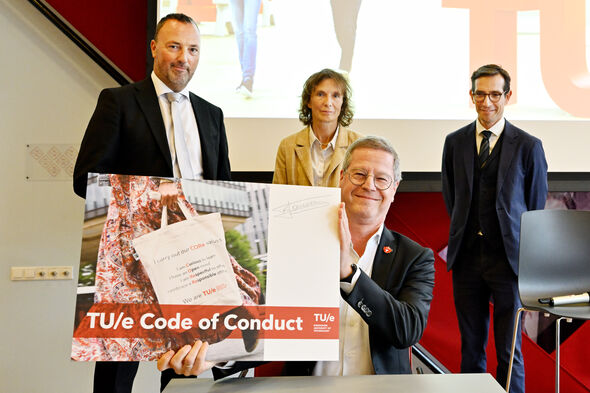
At the internal opening of the academic year, all three members of the Executive Board were the first to sign the new code of conduct. It was a purely symbolic moment, as the Executive Board members, like all TU/e employees, will also sign the code of conduct through the HR system InSite. The request is already waiting for everyone as a task in the system.

Discussion