- Research
- 01/06/2026

Nadia Erkamp automates experiments in self-driving labs
“What used to take me a whole day, the self-driving lab now handles in half an hour, while I work on something else.”
TU/e assistant professor Nadia Erkamp conducts research into phase separation in cells, a process that can cause neurodegenerative diseases such as Alzheimer's. What makes her research cutting-edge is that she has developed so-called self-driving labs using AI, which perform her complex experiments for her.
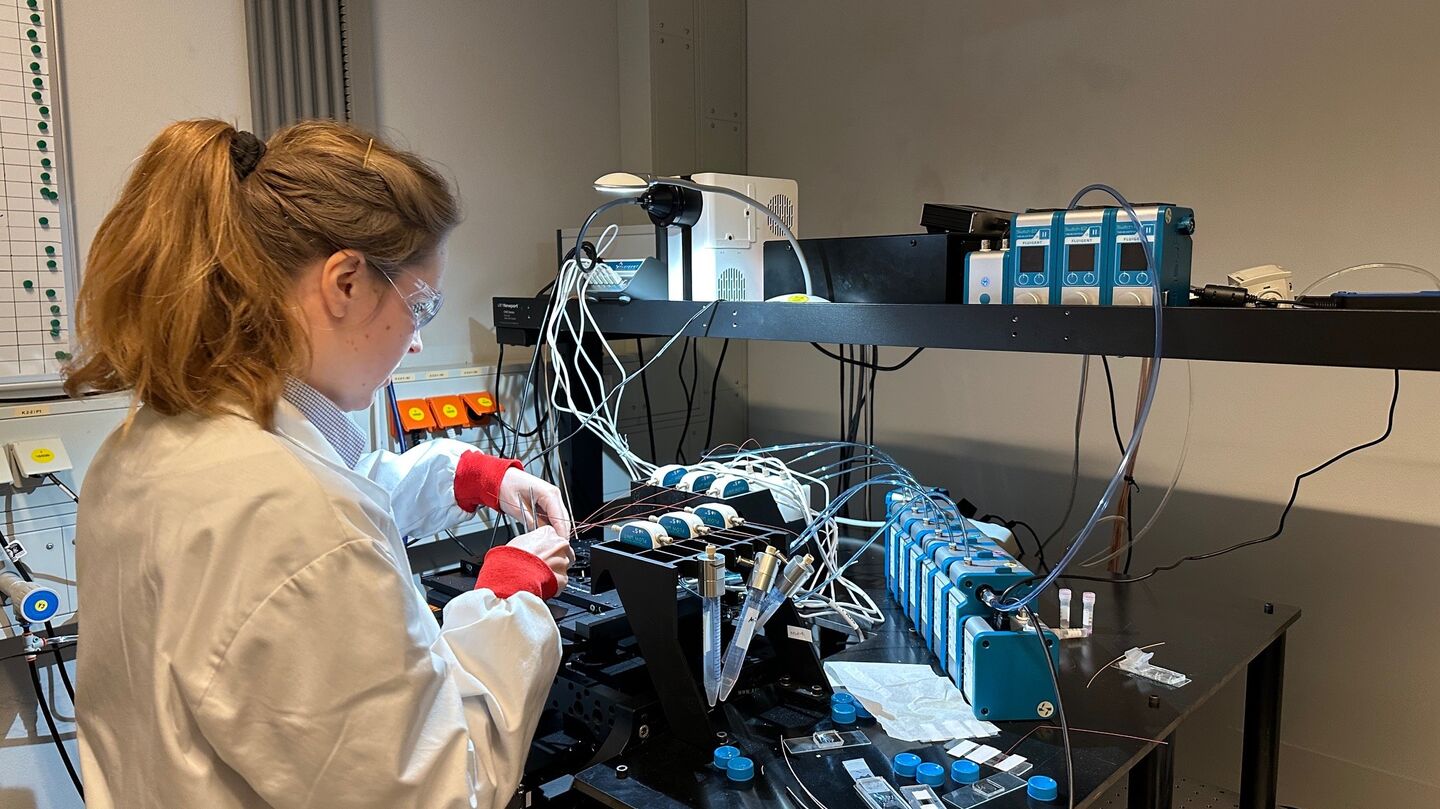
In the lab in the Ceres building, biomedical technologist Nadia Erkamp and her research group study how droplets form and function in cells, and why things sometimes go wrong during this so-called phase separation. Such an error in your body can cause you to become ill.
Erkamp is interested in the patterns that precede such failures. These are valuable to feed to AI, so that it can make predictions about possible upcoming diseases.
In this case, those predictions concern neurodegenerative diseases. These are conditions in which nerve cells in the brain or spinal cord slowly die, which leads to a progressive decline in cognitive or physical functions. Most conditions are chronic and incurable, such as Alzheimer's and Parkinson's.
Phase separation
In a healthy nerve cell, phase separation is a useful and normal process. Droplets are the visual result of this process. In neurodegenerative diseases, this process goes wrong due to factors such as aging, genetic errors, or cellular stress. For example, protein droplets in the cell can become viscous, clump together, or harden. Scientists have discovered that the notorious proteins behind neurodegenerative diseases like Parkinson's, ALS, Alzheimer's, and frontotemporal dementia all exhibit that phase separation behavior.
“My research is a combination of synthetic biology, physical chemistry, and machine learning,” says Erkamp. “Lately, I have been more occupied with creating those autonomous labs than with directly solving my research question.”
That is not a problem, because thanks to this investment, the computer now solves the problem for her. Of course, she has to monitor its work, but it makes far fewer mistakes than a human. And the self-driving lab also turns out to make very different choices than a scientist, more on that later.
30 seconds
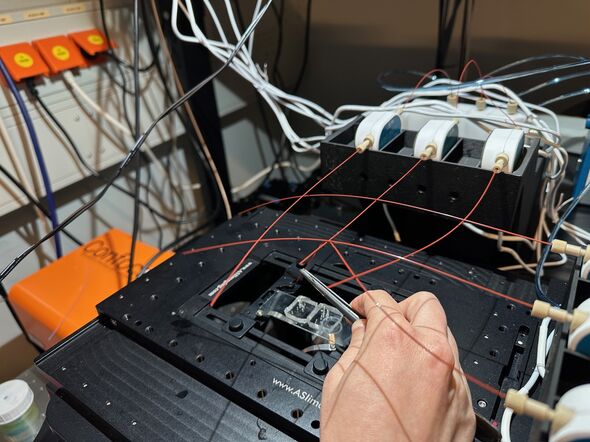
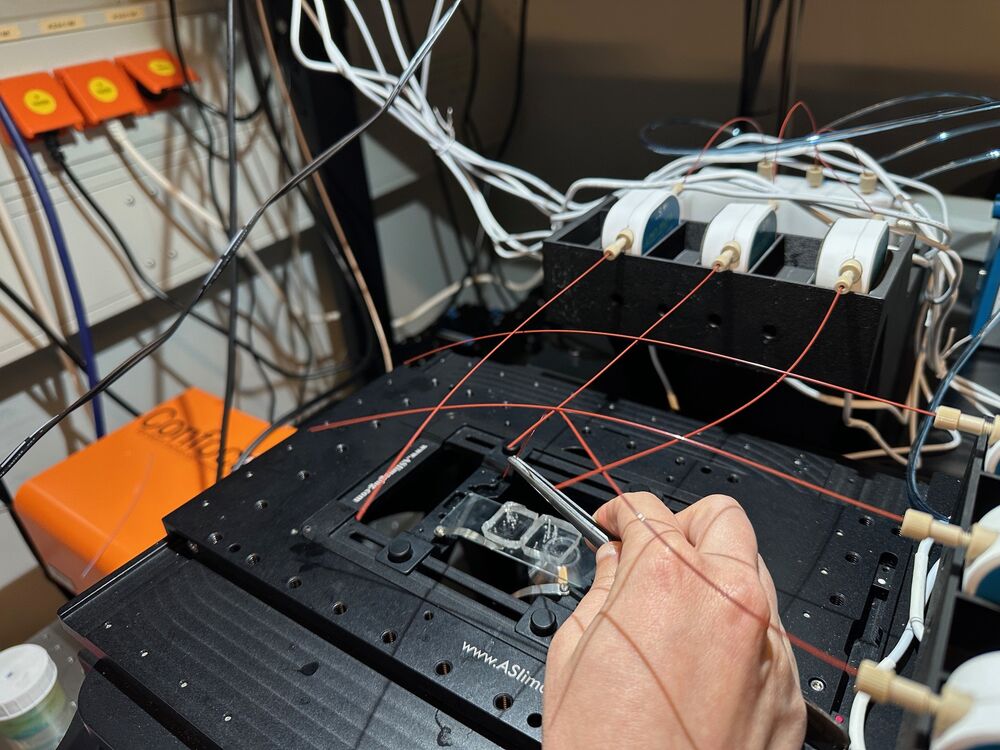
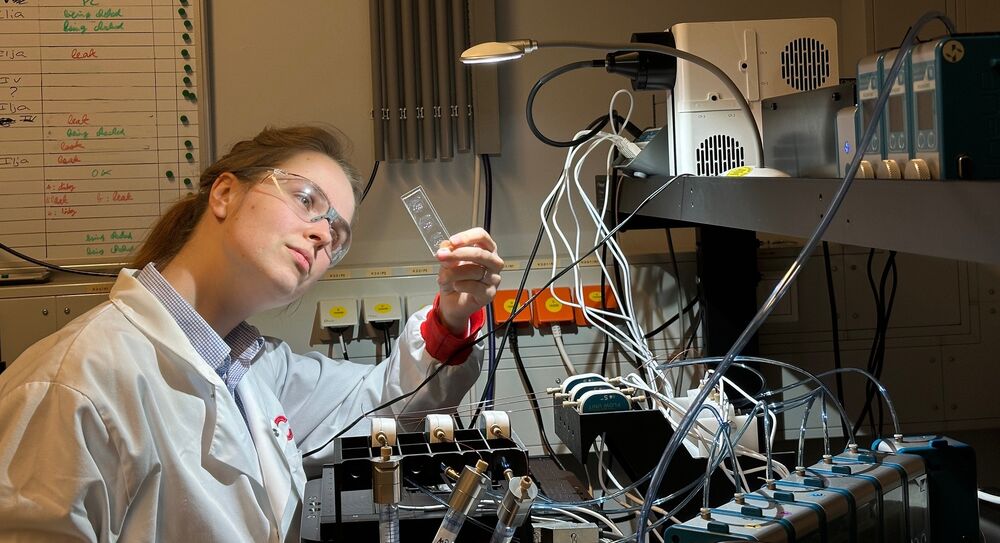
In the Ceres building, there are multiple self-driving labs that can perform experiments independently from start to finish. They also move items themselves, using robots. An experiment in an independently operating lab led by Erkamp proceeds as follows. A plastic chip with small holes is placed in the lab automatically into which the computer allows liquid materials to flow. These flow at a certain speed, creating various mixtures.
Meanwhile, the machine takes photos of the meeting of and the changes in the material. This means that phase separation can also be investigated in the lab without needing a physical body.
“The photos taken are analyzed by AI and a new sample is determined based on that. The self-driving lab then chooses, for example, slightly different flow velocities to optimize the experiment; I don't have to do anything else for that.”
The entire process, including analysis, takes about thirty seconds. The time savings for Erkamp are enormous. “During my PhD, I could study about fifty samples a day, and that consumed all my attention. Now the self-driving lab solves this in half an hour, while I do something else.”
More creative
“Thanks to AI, my work has become a much more creative process.” Erkamp beams when she thinks about the new possibilities this creates. “I now have more time and freedom to think about what kind of problems I want to solve, while the AI focuses on the process and how best to do so.”
Erkamp is not very worried about hallucinations like the ones ChatGPT sometimes experiences. “Our model is not based on language and it does not look at the probability of consecutive words. We calculate and receive warning messages if things go wrong.”
The AI knows exactly what to expect during the research. It has been trained for that. “Incidentally, our self-driving lab can also make mistakes; just like a human, it is not infallible. But the lab is more accurate than we are.” And if an analysis goes wrong, it is simply kicked out and the system starts again, so that one error does not infect the rest of the results.
What Erkamp has noticed while working with AI is that it makes very different choices regarding adjustments to the samples than she does herself. “Take the measurements. I tend to measure in whole numbers. But AI, for example, came up with a measurement at 8.3 micromolar (a unit of substance concentration, ed.). I would have chosen 5 or 10, for instance, but apparently we can learn the most in the experiment by measuring at 8.3.”
Imagination
Erkamp and her colleagues hardly have to do anything more regarding the experiments; it all happens automatically in the self-driving labs. Besides the time savings and optimization of choices during analysis, she sees another advantage here.
“The research we do here is very complex. There are many different variables and it involves non-linear correlations. The more complex it becomes, the harder it is for a scientist to determine the best next sample: how much liquid and how fast it should flow.”
For convenience, she briefly compares the complexity to graphs. “You can probably still imagine a 2D or 3D graph, but a 4D or 5D version is practically impossible to envision. It is the same with our experiments: they are so complex that it is difficult to visualize, let alone find the optimal solution. AI, however, can do that and calculates the optimal next step at lightning speed.”
Future
By deploying AI in this way, Erkamp is working towards a form of artificial general intelligence: flexible intelligence, comparable to the human brain or even better than it. This generally applicable AI has not really had its breakthrough yet, but it is expected that this will happen, and that it will have a major impact on society.
When exactly, however, remains the question. “But it is clear to me that collaborating with AI yields better research results than if I were to do it alone,” says Erkamp.
“Now that the self-driving lab is focusing on the experiment, I can think deeply about what we want to know and what we want to create. I never thought that as an experimental scientist I would be in the lab so little, and yet learn so much every day.”
Discussion