- Home Stretch
- 5 min
- 30/06/2026

Home Stretch | Fine-tuning the heart of the hydrogen truck
TU/e researcher develops more efficient fuel cell for cleaner freight transport
The first hydrogen-powered trucks have been driving on Dutch highways since this spring. TU/e researcher Rens Horst developed new materials that make the fuel cell—the heart of such a truck—more efficient, affordable, and sustainable. On Tuesday, June 30, he will defend his PhD dissertation at the Department of Chemical Engineering & Chemistry.
PhD candidate Rens Horst jokes that he is no longer allowed to participate in games of “hangman with difficult words.” Over the past four years—and even before that during his studies in Enschede—Horst has been working at TU/e on optimizing proton exchange membrane fuel cells, protonenuitwisselingsmembraanbrandstofcellen in Dutch.
With a thud, he places a “technical brick” on the table in front of us. This fuel cell stack—a collection of interconnected proton exchange membrane fuel cells—was given to him a few years ago during a Green Team Twente reunion. As a hydrogen systems engineer on this student team, Horst developed fuel cells for their hydrogen-powered car during his studies, where he discovered his passion for what he calls “professional tinkering.”
Less weight, more cargo
For passenger transport, battery-electric vehicles have now taken a clear lead over hydrogen-powered cars. For freight transport, however, fuel cells offer a promising route toward more sustainable trucking.
Horst picks up his fuel cell stack again. “Inside a fuel cell—or PEMFC, as it's called in English—hydrogen reacts with oxygen from the air. This reaction generates electricity, which powers an electric motor. In a battery-electric vehicle, that electricity comes from a charged battery supplied by the power grid.”
To power an electric truck with batteries alone, a significant amount of battery weight is required, Horst explains. That not only reduces the amount of cargo the truck can carry but also places a major burden on the electricity grid during charging.
“With green hydrogen—produced from renewable electricity through electrolysis—we can decouple the entire process from the power grid. Hydrogen is easy to store in tanks, for example, and there are also many developments underway in underground hydrogen storage.”
Refueling a hydrogen truck is relatively quick, but according to Horst, hydrogen’s biggest advantage over batteries is its high energy density.
“Per kilogram, hydrogen stores much more energy than a battery pack. And less weight means more cargo.”
Limiting factor
Although the first hydrogen-powered trucks entered service in the Netherlands this spring, there is still plenty of room for improvement, Horst emphasizes. Developments are moving rapidly. Thanks in part to his successful PhD research, the latest PEM fuel cells are considerably more efficient in several respects and will soon become even more sustainable.
Next to the “technical brick” on the table lies a cutaway model of a PEM fuel cell. Horst shows how a fuel cell consists of several layers.
A so-called bipolar plate supplies hydrogen to the cell and distributes it evenly across the catalyst layer through a layer containing tiny channels. This is where the actual reaction takes place, splitting hydrogen into protons and electrons.
A polymer membrane in the center acts as the electrolyte, allowing the protons to pass through to the oxygen side of the cell. The electrons are blocked and must travel through an external circuit to reach the oxygen side, generating electric current in the process. There, in the catalyst layer, the protons react with electrons and oxygen to form water.
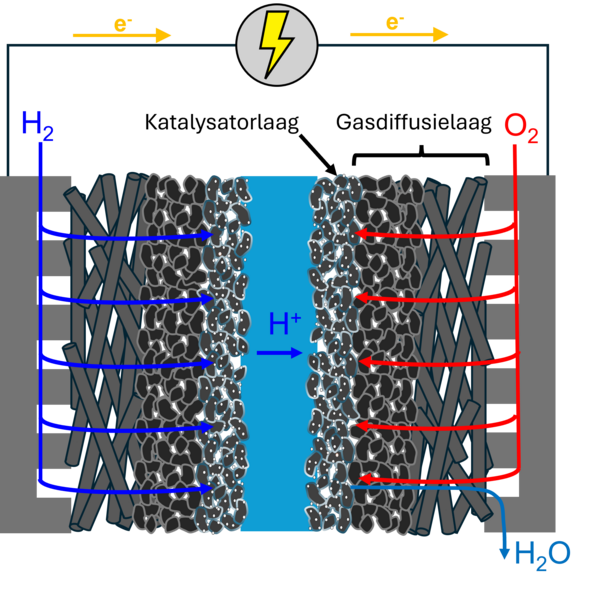
The oxygen side is particularly considered the limiting factor, Horst explains.
“The reaction proceeds more slowly there, making the losses relatively large. By developing new materials and improving material structures, we’ve been able to make several layers much more efficient, which significantly improves the performance of the PEM fuel cell as a whole.”
Less PFAS, greater efficiency
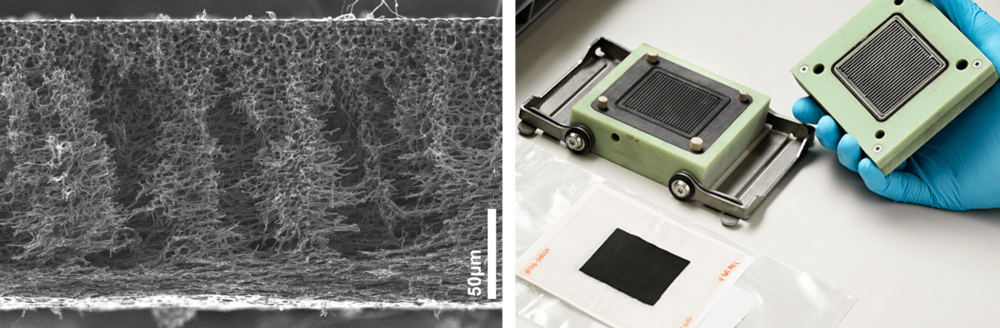
Horst therefore set out to develop a new gas diffusion layer using different materials. The current layer contains carbon particles combined with PFAS-based particles—a so-called ionomer—to quickly remove the water produced during the reaction, ensuring an optimal oxygen flow.
“By creating a water-repellent coating for the carbon particles, we can now replace the PFAS ionomer. That’s a positive development, because PEM fuel cells currently contain quite a lot of PFAS-based materials. Several researchers in our lab are working on PFAS-free alternatives.”
The new material not only makes the fuel cell more sustainable but also improves its performance. Thanks to Horst’s new production protocols, the surface of the carbon particles can now be modified to create a more efficient layer.
Professional tinkering
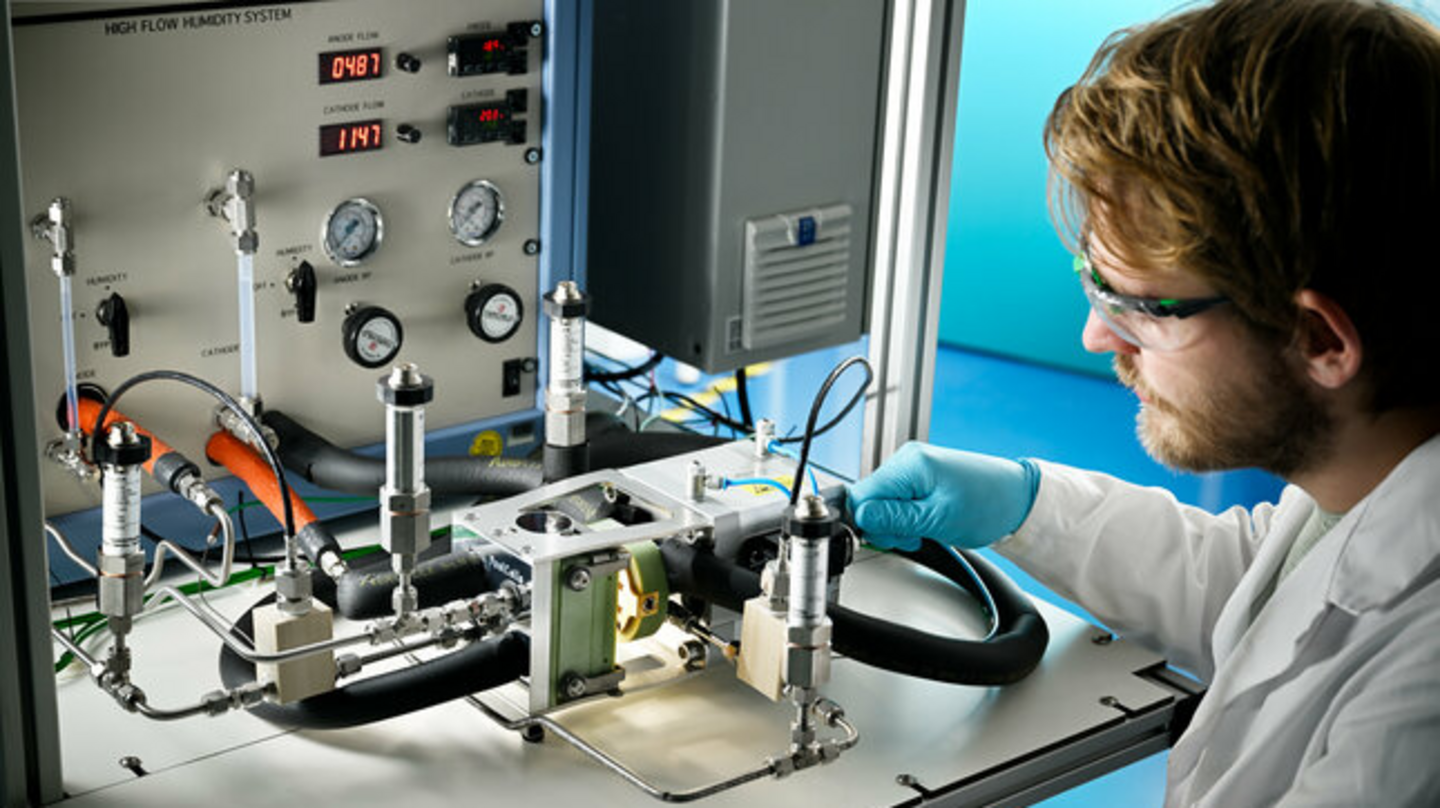
We walk into the laboratory, where two impressive test setups are standing. Horst built them himself from scratch—a year and a half of work—to measure how the new materials perform.
“I know exactly how everything fits together, right down to every single screw.”
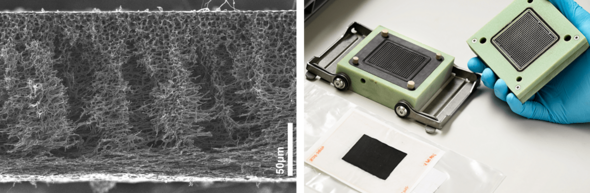
He points to a miniature version of a PEM fuel cell, about five square centimeters in size, that fits inside the testing device. The newest setup has a more professional appearance and is fully automated to run standardized testing protocols.
“We can now immediately test whether a modification works. For example, we've developed a new material for the base of the gas diffusion layer, with different pore sizes for gas and water. Using a laser, we can modify that layer in a highly controlled way to achieve even better results.”
Scaling up
An initial techno-economic analysis shows that this new base layer is also less expensive than conventional materials. Horst says his research has already resulted in two patents, and a postdoctoral researcher is currently working on launching a startup.
“German company EKPO Fuel Cell Technologies, which specializes in developing and manufacturing PEM fuel cell stacks on an industrial scale, is also very enthusiastic. According to them, our layer has the ideal mechanical properties.”
“We now want to continue testing it on a larger scale through this collaboration. Together with mechanical engineers, we’re also looking at industrial challenges. It’s exciting to see how fundamental research can be translated directly into practical applications.”
PhD in the picture
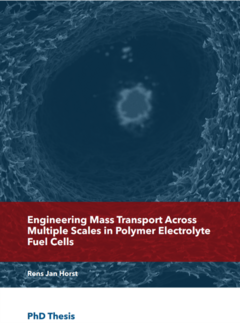

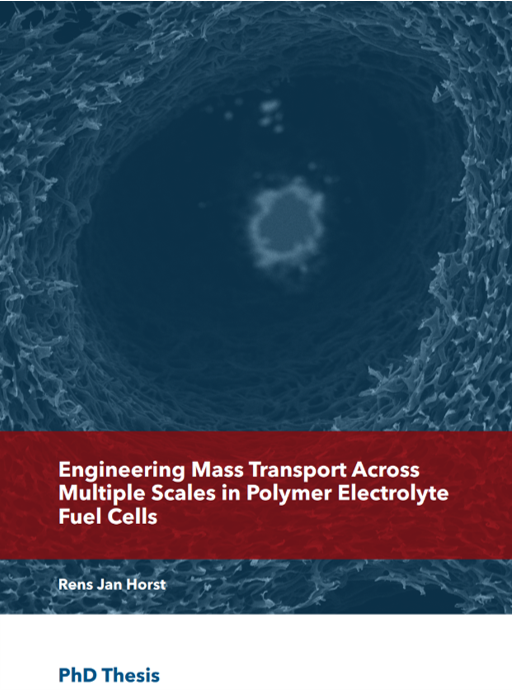
What do we see on the cover of your dissertation?
“We developed a new gas diffusion layer. The image shows a fuel cell whose top layer has been removed with a laser. You’re looking inside through the largest pore, which is really cool. The image perfectly matches my title.”
You’re at a birthday party. How do you explain your research in one sentence?
“I’m working on making freight transport more sustainable by developing a hydrogen-powered electrochemical energy conversion system that generates electricity.”
“Most people have at least heard of hydrogen-powered cars these days, and that usually leads to discussions about electric vehicles and public transportation. Thanks to a carbon footprint questionnaire, I know how much difference you can make by leaving your gasoline or diesel car at home. Since an electric car is still too expensive for me, I travel by train whenever I can. Policymakers should encourage those choices by making public transportation more affordable.”
How do you unwind outside your research?
“As a bit of a hobby nerd, I love building things. A little soldering, programming, and pretending to be an electrical engineer. In a way, my hobby has become my job. To relax after that, I’m a fair-weather athlete. I recently ran the Zwolle Half Marathon as preparation for the 21K of the Eindhoven Marathon. I often go for a run with a group of running colleagues during lunch breaks. It’s great that the campus is surrounded by so much greenery.”
What advice do you wish someone had given you when you started your PhD?
“Let curiosity guide you, and start out broadly with all kinds of side projects. I really feel at home in academia because of the freedom you have as a young researcher. Eventually, you can funnel everything down and focus on what works.”
What’s the next chapter?
“I’m very happy that, thanks to my supervisor Antoni Forner-Cuenca’s Vidi grant, I can stay with the group as a postdoctoral researcher for the next two years, just as my research is starting to pay off. It’s a fantastic, innovative environment with state-of-the-art expertise. It still seems strange to me that so much emphasis is placed on gaining international experience in order to continue an academic career, when we’re conducting world-class research right here.”
Discussion