- Home Stretch
- 18/05/2026

Home Stretch | From salad to soup
Marloes Remijnse uses mathematical models as a recipe against food waste
Roughly one-third of the food we produce ends up in the trash at some point. To better align supply and demand, TU/e researcher Marloes Remijnse translated our food chain into mathematical models. The result: a dissertation full of practical tips for caterers and consumers to help reduce food waste.
“Five rows of enormous heads of lettuce—there was no way we could eat all that. Meanwhile, the onions barely grew.” Marloes Remijnse knows better than anyone how difficult it can be to properly match supply and demand, even on a small scale. At age 14, she started her own vegetable garden at a community garden complex. She chuckles. “And trading heads of lettuce for a bunch of Swiss chard turned out not to be very successful for me.”
Still, those overly enthusiastic planting days and failed harvests got her thinking. Now, years later, she looks at our food chain through a mathematical lens to see where and how it can become more sustainable. On Tuesday, May 19, she will defend her dissertation—itself literally a fine example of reuse, more on that later—at the Department of Industrial Engineering and Innovation Sciences.
Harvest forecasting
According to Remijnse, flexibility is the key word. In a range of practical studies, she investigated different strategies to reduce food waste. She developed mathematical models to identify the best options for each situation. Those models are also meant to better map out the major troublemaker: uncertainty, Remijnse explains.
“It already starts with the farmer. We see that partly due to climate change, harvest forecasting is becoming increasingly difficult. Extreme drought or heavy rainfall can completely ruin yields. By feeding our models with specific data, we hope to gain more control over that.”
Remijnse obtained that specific data from companies, but also requested it from Statistics Netherlands (CBS) or the Royal Netherlands Meteorological Institute (KNMI), depending on the study. In her dissertation, she highlights three different examples: from a local food hub and efficiency at a vegetable processor to menu planning in a corporate cafeteria.
Vegetable box from the farm
Starting with the first example: local production and purchasing sound great. In the Netherlands, you increasingly see so-called “hubs” that bring products together in a short supply chain and distribute them from there, Remijnse explains.
“But my models show that this actually isn’t such a good idea. The volumes are relatively small and the logistics costs are high. A hub only becomes profitable when a company supplies multiple products.”
“In other cases, direct sales at the farm are more efficient from a logistics perspective. Like the potatoes, carrots, and beets you can pick up through No Waste Army directly from the farmer. Or a vegetable box from a local farm.”
Pesto from carrot tops
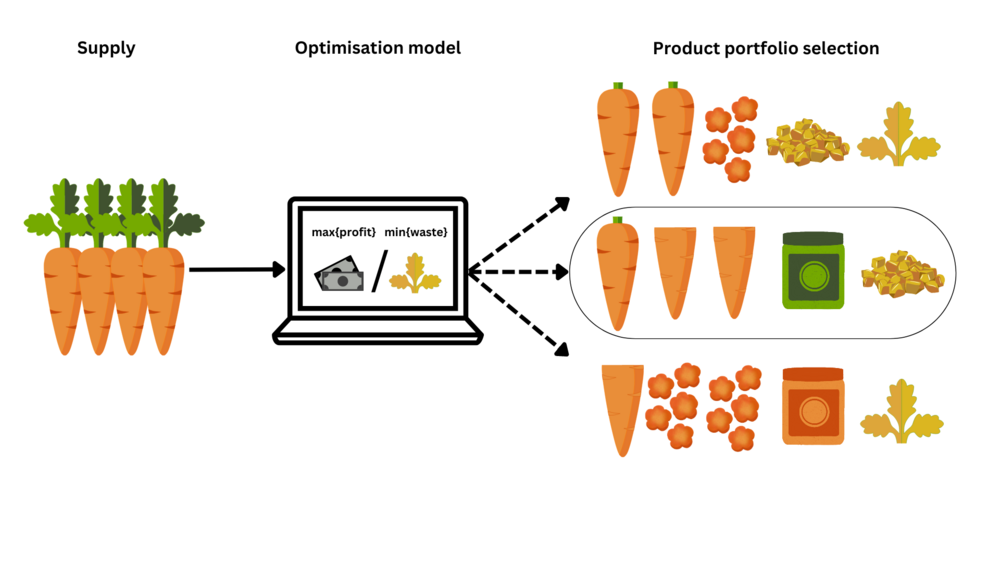
As a consumer, using up a kilogram of carrots is easy enough. But what’s the best thing for a processor to do with them? The possibilities are endless, according to Remijnse.
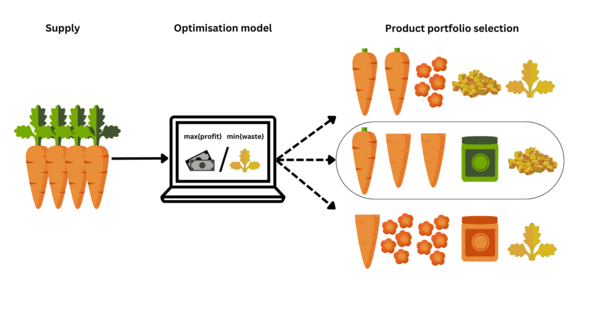
“You can easily make carrot juice from a lower-quality batch, and it can be stored in bottles for a very long time. But you can also use residual streams. The peels from snack carrots can go into the juice, and carrot tops make a delicious pesto.”
Together with a carrot processor, she examined which processes could lead to both greater profits and lower environmental impact. The outcome was somewhat surprising, because according to Remijnse, processing residual streams is not always the best option.
“An additional processing step can have a greater environmental impact than simply throwing away something like carrot tops. My models made that very clear. An even better solution is to reduce the residual streams themselves. Straight snack carrots, for example, instead of making round carrot balls for a packaged snack.”
Creative chefs
Taking a flexible and creative approach to available ingredients can truly make a difference, Remijnse believes. That applies to consumers, processors, and hospitality entrepreneurs alike. Uncertainty also plays a major role for caterers and restaurants. “By responding to fluctuating customer demand, a lot of waste can be prevented.”
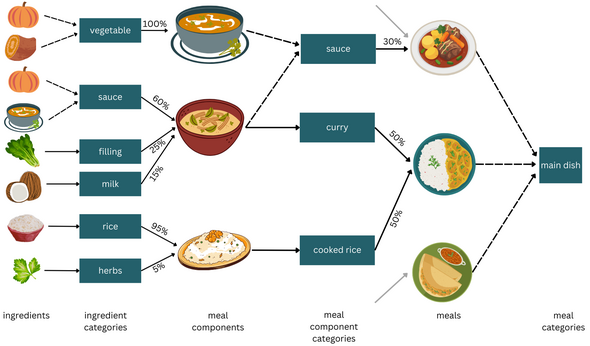
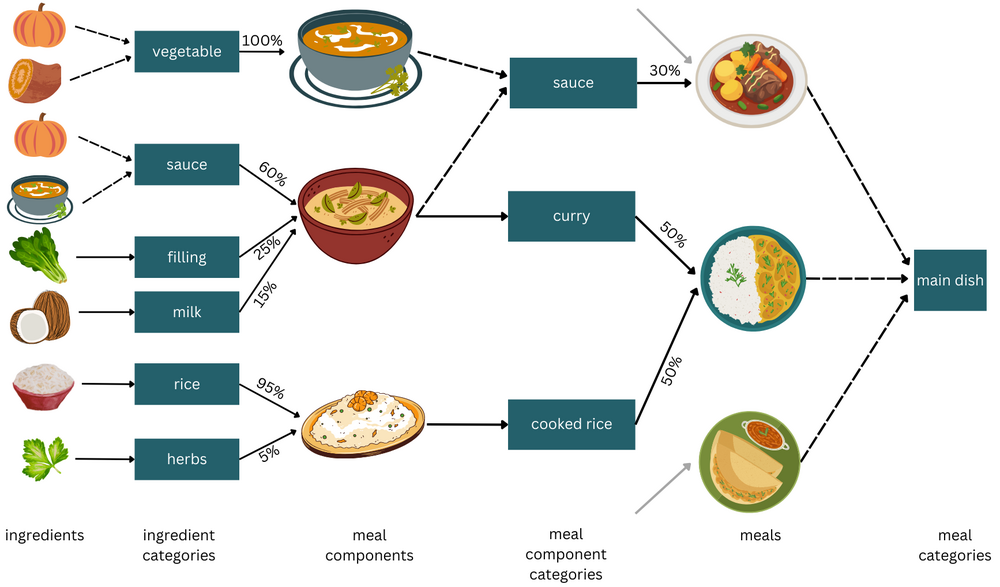
That’s why Remijnse studied several TU/e corporate cafeterias together with caterer Appèl, using the company’s data to see how improved menu planning could help. “By designing recipes so ingredients can easily be replaced and reused, you add extra flexibility. Depending on availability, you can use sweet potato in a salad, but pumpkin works too. And leftover pumpkin salad can become soup the next day.”
That does require an extra dose of creativity, Remijnse emphasizes. “A chef needs the freedom to decide day by day what will be cooked.” But because caterers can’t practically do much with the mathematical models she developed, she also tried to translate them into usable guidelines in her dissertation.
“Appèl is considering sustainability on multiple fronts and is open to a different way of thinking. There’s a good chance you’ll see some of that reflected in the TU/e cafeterias in the near future.”
Rabbit food
The guidelines are also useful for us as consumers, Remijnse concludes. She currently has leftover endive mash in her refrigerator, which she plans to turn into pancakes tonight. “Be flexible and reassess each situation. For example, eat plant-based meals more often.” Remijnse laughs. “People still often act as if that means living on rabbit food. Just recently in the media, people were saying the same thing about the updated Dutch dietary guidelines—‘nothing but lettuce for everyone.’”
As a former activities committee member of Vegan Student Association (VSA) Eindhoven—“where everyone is welcome”—Remijnse is happy to promote the biweekly VSA potlucks, which prove the opposite. “There’s always an enormous variety, and everyone brings something. It’s an accessible way for students and staff to get acquainted with plant-based food and try new things.”
Kohlrabi cover
And speaking of weighing options: if you do have to throw something away, Remijnse advises from an environmental perspective to discard ingredients rather than prepared meals. “For my PhD lunch, Appèl offered me a vegetarian No Waste option. They serve leftovers from other lunch events. Practice what you preach.”
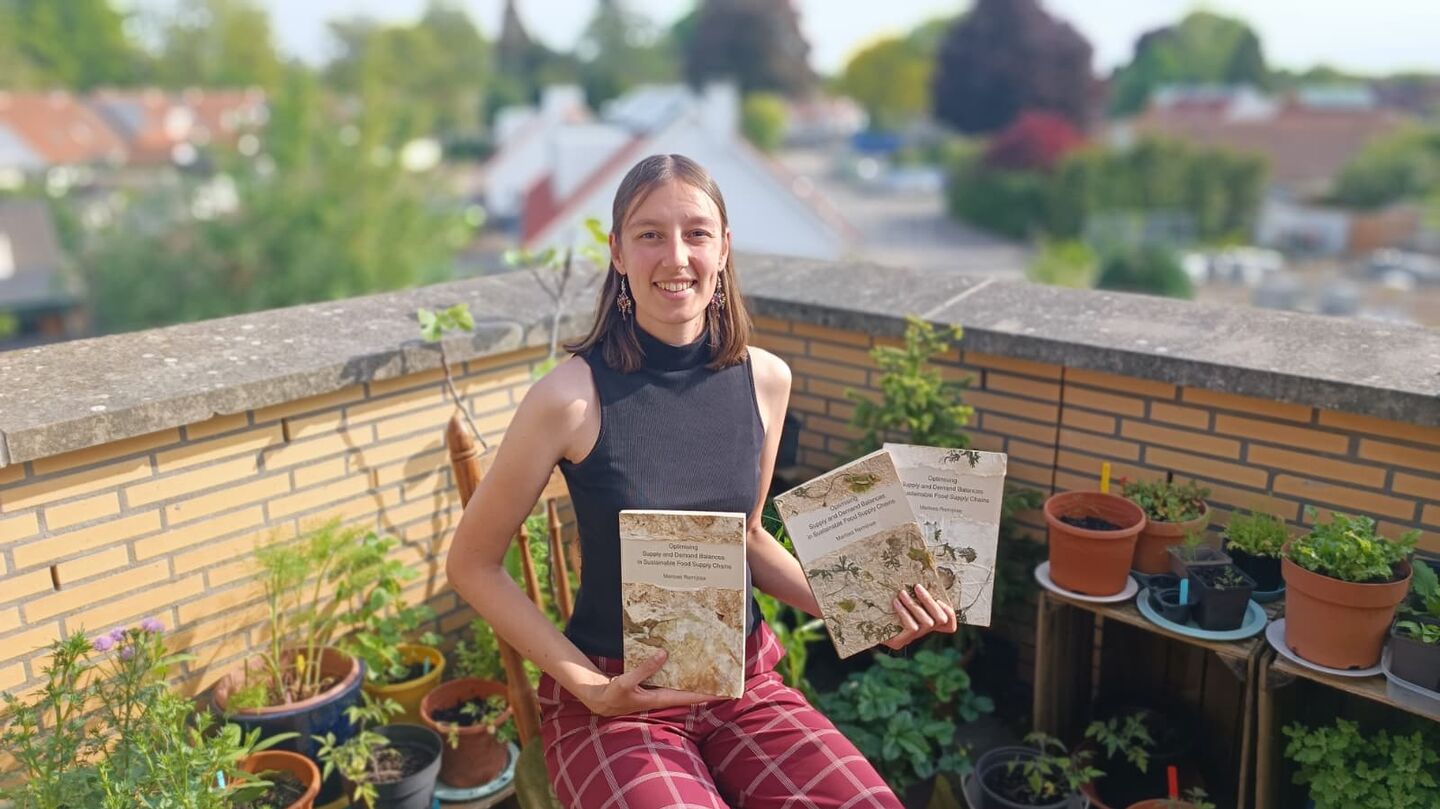
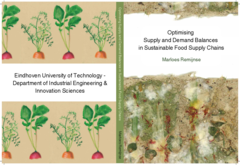
Because you’re unlikely to catch Remijnse throwing away food anytime soon—thinking creatively has made her inventive. So yes, you may even spot mandarin peels or leek leaves on the cover of her dissertation.
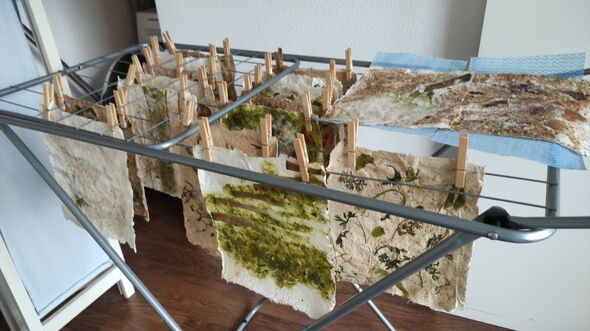
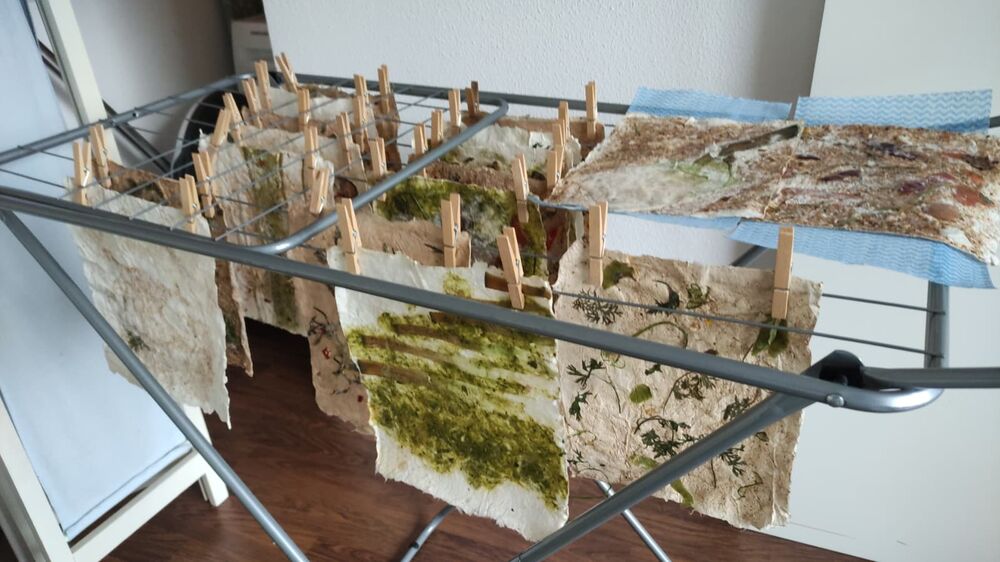
How exactly? “I partially ground up my organic waste into pulp and turned it into paper. The rest was incorporated as decoration. Every dissertation is unique, with Brussels sprouts, kohlrabi, or red peppers on the front cover. You won’t find any Swiss chard, though.”
PhD in the picture
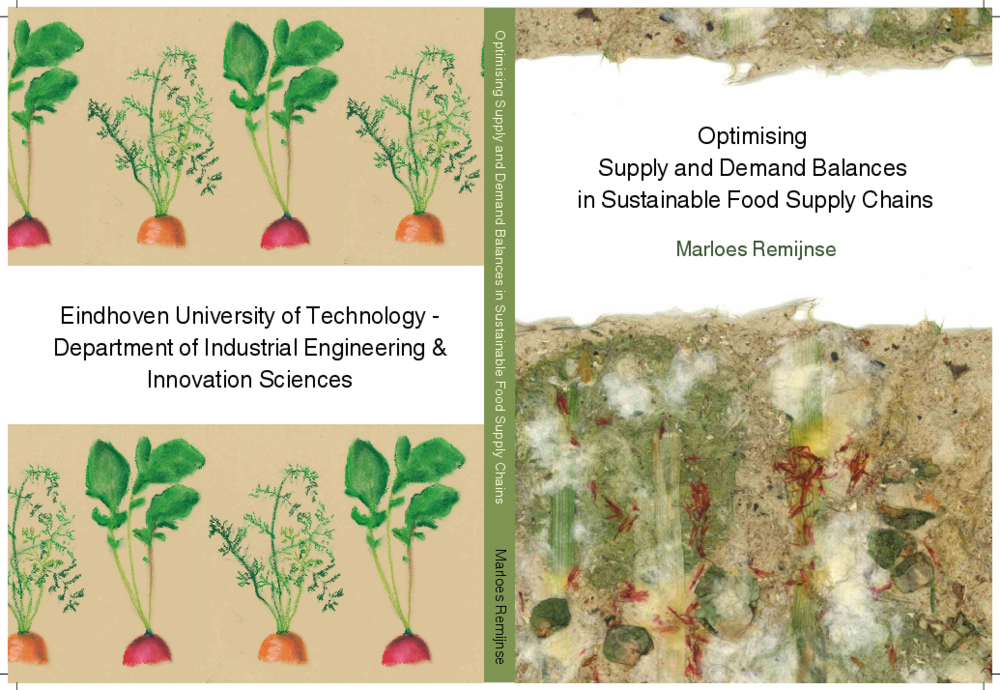
What do we see on the cover of your dissertation?
“My organic waste in paper form. Making it really was a family effort: together with my younger sister, mother, and grandmother, I spent hours making paper for my covers.”
You’re at a birthday party. How do you explain your research in one sentence?
“I study how food companies can operate more sustainably with less waste. Before you know it, people start exchanging tips about what they can do themselves to reduce food waste. By the way, did you know you can also eat radish leaves?”
How do you unwind outside your research?
“Not very surprising, but I love cooking and baking. A few fellow VSA members and I recently started a cooking club. It’s even more fun when the ingredients come from my balcony vegetable garden or from the Wasven vegetable box. As a volunteer, I weed between the vegetable fields there, so indirectly I benefit from the harvest.”
What tip would you have liked to receive as a beginning PhD candidate?
“A very practical one: make use of the High Performance Computing (HPC) Lab and the team of research data stewards. They can help you optimize and run code and store data.”
What’s your next chapter?
“I recently started as a data/process steward at hospitality wholesaler Sligro, where I help people with all kinds of data-related issues.”
This article was translated using AI-assisted tools and reviewed by an editor.
Discussion