- Research
- 5 min
- 10/03/2026

Home Stretch | Why reasoning flaws sometimes advance science
The unexpected power of imperfection in scientific research
Bias and laziness are often seen as bad habits, but surprisingly, they can sometimes lead to better results in science. Matteo Michelini’s PhD research shows that individual reasoning flaws can actually stimulate collective thinking. In this way, a group of “imperfect” scientists may even have a greater chance of finding the right solution than meticulous thinkers.
Michelini started his PhD at TU/e, but then his supervisor, Dunja Šešelja, decided to move to Ruhr-Universität Bochum after being offered a position there. “She didn’t want to leave me behind, and asked me to move along,” he explains.
His PhD project thus became a joint endeavor between the two universities, requiring Michelini to travel back and forth during the process. “The transition was challenging, and there was also quite a lot of bureaucratic hassle, but overall, it was a gift,” he says.
“In Eindhoven, we are much more hands-on and focused on practical questions, ethical frameworks, and policies. In Germany, it’s much more theoretical. It’s more like the old-school philosophy approach, where a bunch of people just sit and … think, you know,” he says, smiling.
“The fact that I could interact with so many different people and see how their approaches to philosophy can differ—that was such a profound and enriching experience,” he adds.
Collective effort
Interestingly, this experience gave Michelini a front-row seat to the very question at the heart of his research: how can scientists create better practices through interaction?
With a background spanning engineering, philosophy, and logic, he set out to understand what truly counts as good scientific practice—not just at the level of individual researchers, but for the scientific community as a whole. “Traditionally, philosophy of science focuses on individual scientists and what they should be doing,” he explains. “But that’s a narrow view. Science isn’t done in isolation; it’s a collective effort, built through interaction and collaboration.”
He emphasizes that the way scientists work together often matters more than the actions of any single researcher. “I’m a big team player myself. I wouldn’t have been able to achieve anything without the constant interactions with my colleagues,” Michelini says.
For that reason, his guiding principle was to put the group under the microscope: how do individual attitudes translate into collective behavior?
Digital community
To explore this, Michelini turned to agent-based modeling (ABM). “It’s like building a digital scientific community,” he explains. “You define how each researcher behaves—whether they’re open-minded, cautious, or stubborn—and then you let them interact.” The model simulates these interactions over time, showing how simple individual behaviors give rise to complex group dynamics and gradually shape collective outcomes.
This approach allows him to test which forms of interaction help science move forward—and which quietly hold it back. ABM is particularly useful for comparing contrasting scenarios, such as communities of biased versus unbiased scientists. “It’s really hard—or even impossible—to recreate some of these situations with real scientists,” he notes.
Slightly wrong
Surprisingly, Michelini’s simulations revealed a paradox: practices often considered problematic at the individual level can benefit the group as a whole. For instance, he studied how small misinterpretations of evidence affect the research process. When a scientist is slightly wrong, it can actually improve the group outcome.
“If all scientists interpret the evidence in exactly the same way, the whole team is likely to stop collecting information very early because everybody already agrees. This is likely to result in choosing the wrong theory,” he explains.
“But if each researcher has slightly different interpretations, even if some turn out to be wrong, it sparks debate and encourages looking at the problem from multiple angles. By exploring different theories, the team is actually more likely to arrive at the right one.”
This effect is known as transient diversity—the temporary state in which a community of scientists holds diverse, competing beliefs before eventually converging on a single conclusion. Michelini points out that while an individual’s misinterpretation would make them wrong alone, within a group these differences become strengths, encouraging better scientific inquiry.
Biases and laziness
The second part of Michelini’s thesis focuses on biases and scientific laziness—reasoning flaws usually seen as negative and problematic at the individual level. In his model, biased agents defend their preferred option without critically evaluating alternatives.
“It means you can only produce arguments in favor of your preferred theory,” he explains. “For example, if you believe that green hydrogen is the ultimate solution for decarbonization, you’re unable to generate arguments that contradict it.”
Laziness is closely related: it refers to the tendency to use arguments without carefully evaluating whether they are sound. “You just throw them out, even if they are weak, as long as they justify the view you’re already inclined to favor,” Michelini says.
He then looked at how these individual tendencies play out in group decision-making. While a single biased or lazy scientist might never question their own arguments, something surprising happens in a group: a team of biased and lazy scientists can sometimes outperform a group of virtuous, careful scientists.
“But only under certain conditions,” Michelini stresses. If time and evidence are unlimited, traditional scientific virtues—objectivity, thorough evaluation, careful reasoning—clearly lead to better outcomes. “But when time is tight and data is scarce, a group of lazy and biased scientists can actually do better,” he says.
Adversarial collaboration
The reason lies in how bias and laziness shape the group’s work. Bias creates a natural division of labor: “If we believe in two different theories, we’ll explore both,” he explains. That’s called adversarial collaboration — pursuing different approaches to see which works best. “It gives better results than if we all stick to theory A right from the start,” Michelini notes.
Laziness ensures ideas are shared quickly rather than over-analyzed individually. “If you have an argument, you can either evaluate it carefully yourself, or, if you’re lazy, present it straight to the group and let everyone evaluate it together.” It turns out the second approach works far better. “More heads and more eyes beat just one every time.”
“Good” scientific practice
Michelini’s research challenges traditional ideas of what counts as “good” scientific practice. It shows that behaviors often seen as flaws can, in the right context, benefit the scientific community. The key insight is that science is not just the sum of individual reasoning; it emerges from how ideas interact within a group.
“We should take this research further and explore different scenarios with real groups of scientists,” Michelini advocates. “For example, we could compare two groups: one where ideas differ and one where everyone converges from the start, and see which group performs better in practice.”
By focusing on collective dynamics rather than individual virtues alone, he believes we can foster better collaboration and, ultimately, enhance scientific progress.
PhD in the picture
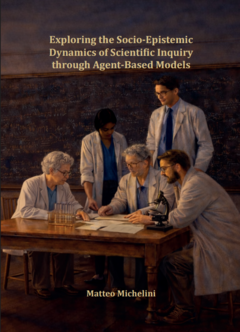
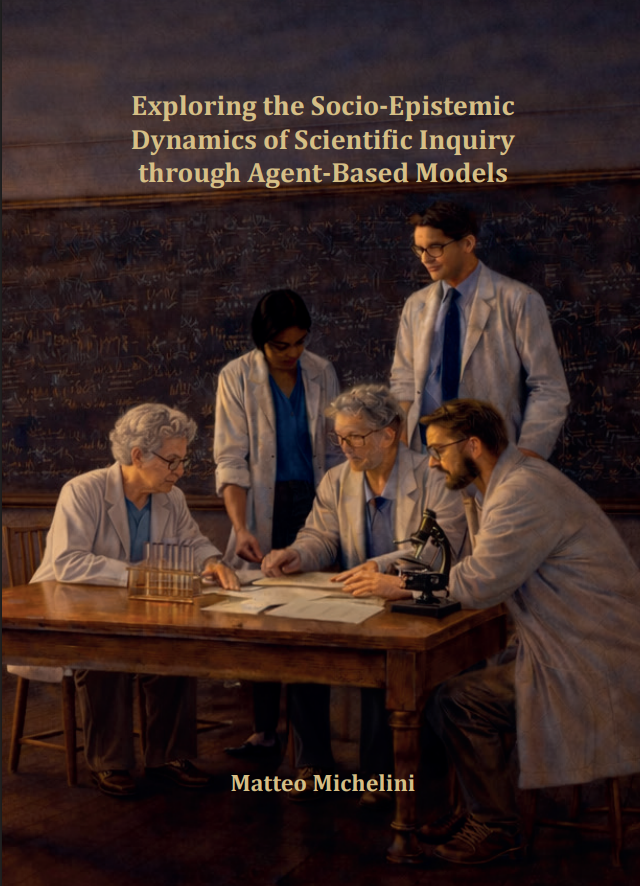
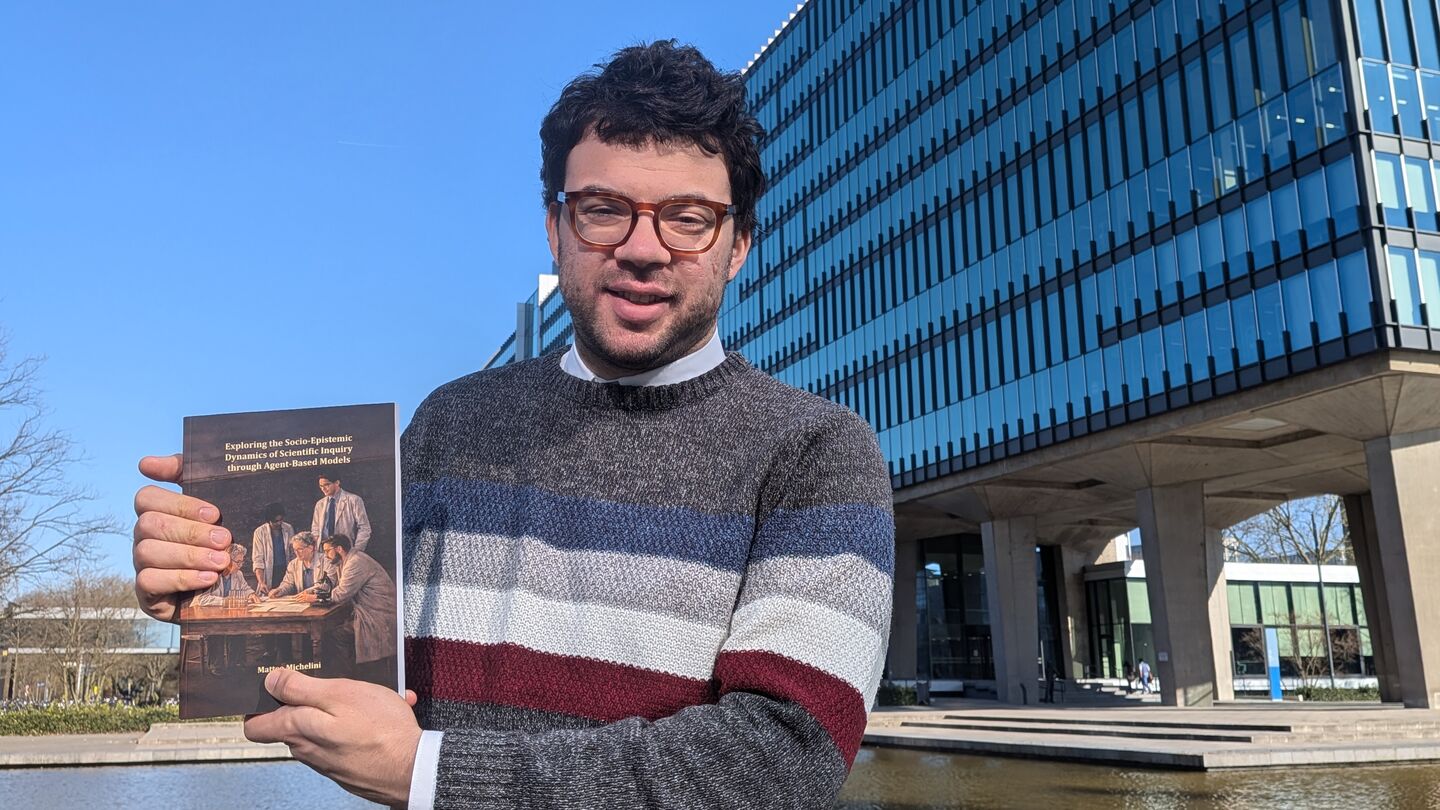
What’s on the cover of your dissertation?
“There is a group of scientists doing science together. I worked with the designer, Arina van Londen, to recreate the atmosphere of positivist artworks depicting science from the late 19th and early 20th century. The idea was to visually capture the collective dimension of scientific inquiry that my dissertation explores.”
How would you explain your research at a birthday party in one sentence?
“I study how people exchange ideas in groups and why, sometimes, reasoning together can lead to better conclusions than thinking alone.”
How do you blow off steam outside the lab?
“I enjoy a variety of activities: going on hikes, reading novels, and playing Dungeons & Dragons with friends. Whenever possible, my partner and I also travel around Europe to visit friends or host them at our place.”
What advice would you give your younger PhD self?
“One thing I’ve learned is that succeeding in academia isn’t just about being smart. What really matters is finding an internal motivation that makes the work meaningful to you and keeps you going, independently of external rewards. Once you have that, the rest is mostly about sticking with it and enjoying the ride.”
What’s the next chapter?
“I recently started a position as a fixed-term researcher at the Italian National Research Council. There, I will study the conditions under which democratic deliberation can lead to epistemic success. I’m excited about this next step and about becoming increasingly independent in my research. At the same time, I will dearly miss the support of my supervisors, professors Dunja Šešelja and Wybo Houkes.”
Discussion