- Research
- 5 min
- 04/03/2026

Home Stretch | The flexible future of bionic limbs
Smarter prostheses with less wiring thanks to flexible electronics
Smart prosthetic limbs can function almost as well as a real arm, hand, or leg. But the smoother and more advanced the bionic prosthesis works, the more wires need to be concealed. Using flexible electronics, TU/e researcher Kyle van Oosterhout has developed prosthetic technology designed to fit like a second skin.
For this athletic PhD candidate—an avid skier, snowboarder, and wakeboarder who can be found on the judo mat almost every weekend—it is hard to imagine life without an arm or a leg. Yet from the many conversations he had during his doctoral research, Kyle van Oosterhout knows that accidents can happen in the blink of an eye. And that a good prosthesis can truly make a difference.
With that awareness, he has spent the past few years laying the groundwork for a new generation of bionic limbs based on flexible electronics. On Thursday, March 5, he will defend his dissertation at the Department of Electrical Engineering.
Tangle of wires
He has trouble sitting still, Van Oosterhout admits with a laugh. And even in his dissertation, movement is never far away. If you quickly flip through the pages, it turns into a flipbook in which the bionic arm flexes its “muscles.” With a wink, Van Oosterhout says: “That’s going to result in quite a few well-thumbed copies.”
Turning serious, he continues: “Smooth movement is something we take completely for granted. With a prosthesis, that’s much more difficult. Thanks to AI, more and more is possible—but it also means more and more wires coming out of these smart prostheses.”
Because such a tangle of wires limits the wearer, Van Oosterhout looked for a solution that offers greater mobility and comfort. By developing a prosthesis with flexible electronics, he hopes it will eventually fit seamlessly onto the residual limb, like a second skin.
Drinking coffee smoothly
“When you reach for your coffee mug, your brain sends electrical signals through your nerves to your muscles. Those signals are converted into movement, allowing you to drink your coffee. Through the skin, you can pick up those electrical nerve signals and use them to move a prosthesis. In that way, your brain controls an artificial arm.”
Smooth movement requires an electrical circuit with many channels, which also consumes a relatively large amount of power. Current smart prostheses therefore involve what Van Oosterhout describes as a “substantial setup.” At the Emerging Technologies Lab, part of the Integrated Circuits research group, researchers are exploring how rapidly advancing flexible electronics can be used to optimize bionic limbs. Van Oosterhout now demonstrates that prosthetic electronics can indeed become more efficient and more accurate through the use of flexible printed circuit boards.
In its infancy
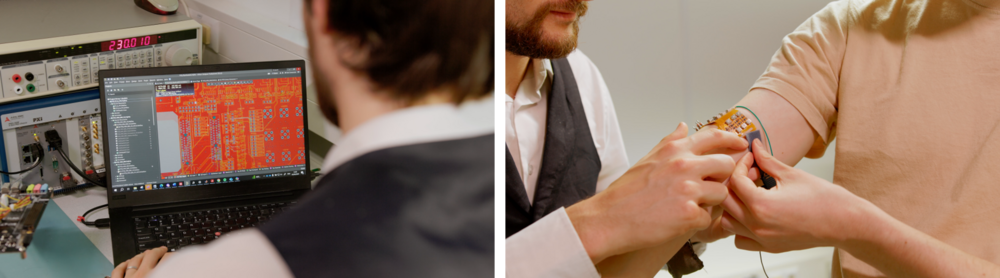
Behind his laptop, he created a new system. “I went back to amplifier designs from the 1970s. We wanted to move from many channels to as few as possible, while maintaining signal accuracy. By designing a new amplifier and multiplexer, we managed to achieve that—at least in simulation.”
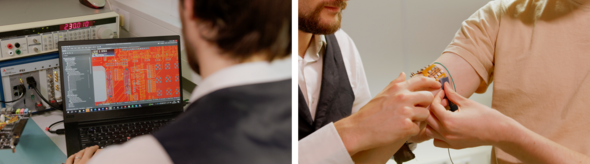
Because the technology is still in its infancy, actual production proved challenging, Van Oosterhout explains. “A startup company in the United Kingdom was eventually able to help us print the flexible electronics. And since we were one of their first customers, they even included the wafer—a round, flexible substrate used in microchip production.”
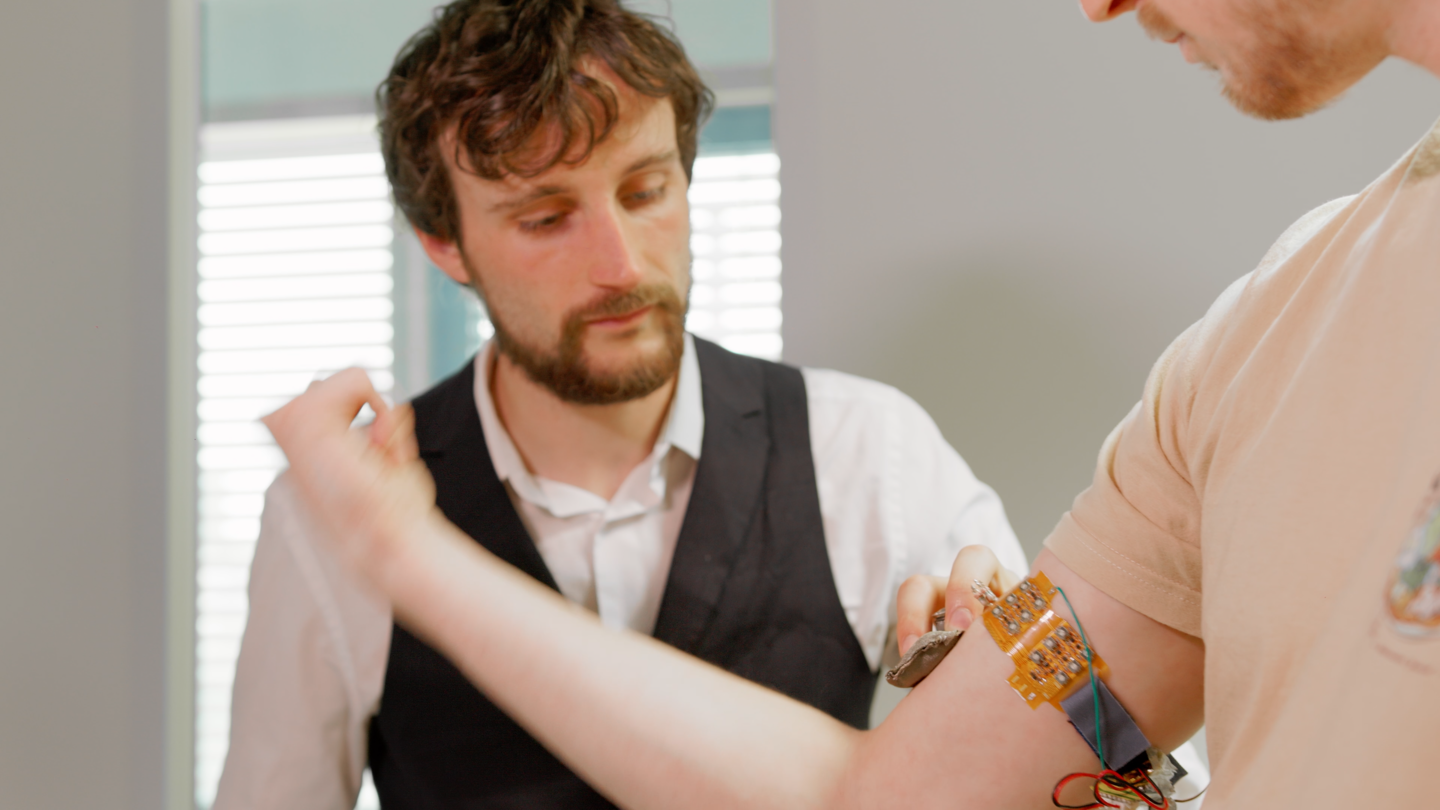
Connecting the flexible chip to existing electronics turned out to be an unexpected challenge, involving gold pins, tiny springs, and special adhesive—“conductive in only one direction.” But eventually, real testing could begin. And where would you be without good colleagues? Van Oosterhout laughs. “They volunteered as test subjects. With the flexible system on their forearm, we could see on a large screen that we were able to move a simulated prosthesis. That really was a goosebumps moment.”
In collaboration with the University of Twente, where there is extensive expertise in prosthetic control, researchers are now further optimizing Van Oosterhout’s prototype.
Palm tree
He also collaborated with the UMC Utrecht Hersencentrum to apply the flexible technology for people with locked-in syndrome (LIS). “In this condition, patients become completely paralyzed, for example as a result of ALS. They can no longer communicate, but they are fully conscious. A brain-computer interface could help them communicate, which would already be a major step forward.”
At the Hersencentrum, studies are underway in which a small opening is made in the skull of LIS patients to place a grid of electrodes, Van Oosterhout explains. “There is literally a ‘palm tree’ of wires coming out of the head through a thin cylinder. Because of the open connection to the brain, there is a constant risk of infection.”
According to Van Oosterhout, flexible electronics offer significant advantages in this situation. “One of the major problems with current implants is heat generation. A relatively large amount of power is needed to add as little noise as possible to the already complex brain signals. Flexible circuits could help address that.”
Improving patient care
Van Oosterhout used implant data from current studies to take the first steps toward developing a brain-computer interface based on flexible electronics. The initial results look promising. That motivated him to continue developing the technology as a postdoctoral researcher, he says enthusiastically.
“We are now looking at how we can amplify a signal without adding noise and how to digitize that signal. Ultimately, we hope to move toward wireless transmission, so we can eliminate that protruding bundle of wires. For a long time, I considered studying medicine. It’s rewarding to see that with innovative technology, I can now also contribute to patient care.”
PhD in the picture
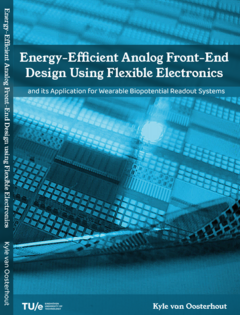
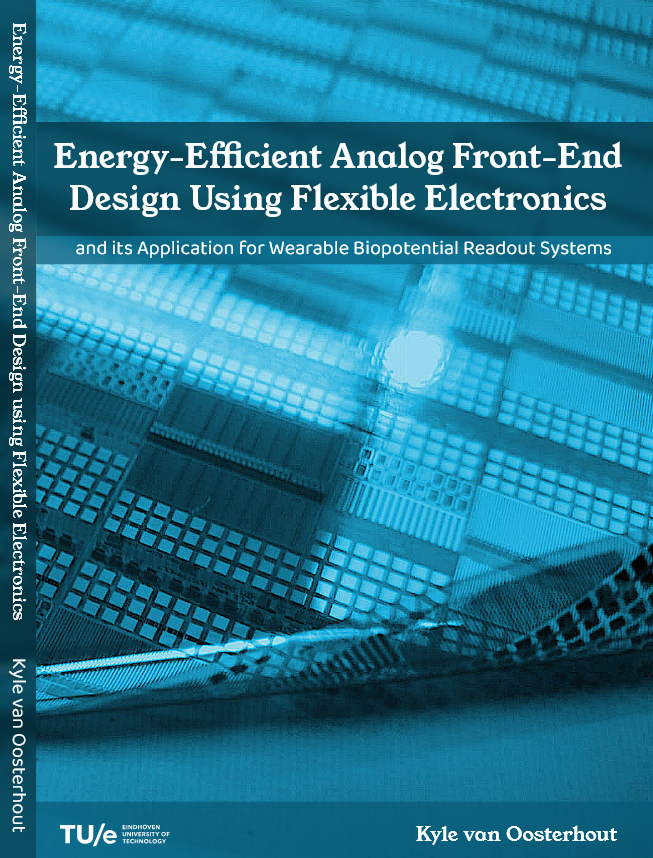
What do we see on the cover of your dissertation?
“A part of my flexible electrical circuits, on the wafer plate that was included with our order. A stroke of luck as one of the first customers of a startup—because that no longer happens.”
You’re at a birthday party. How do you explain in one sentence what you research?
“That I’m developing a new technology with flexible chips to help people control their prostheses. I work on robotic arms, basically.”
How do you unwind outside your research?
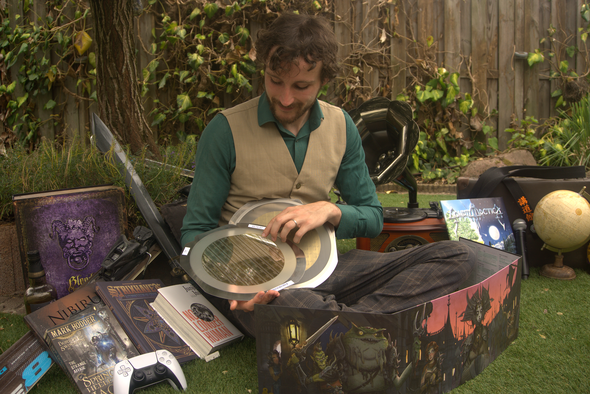
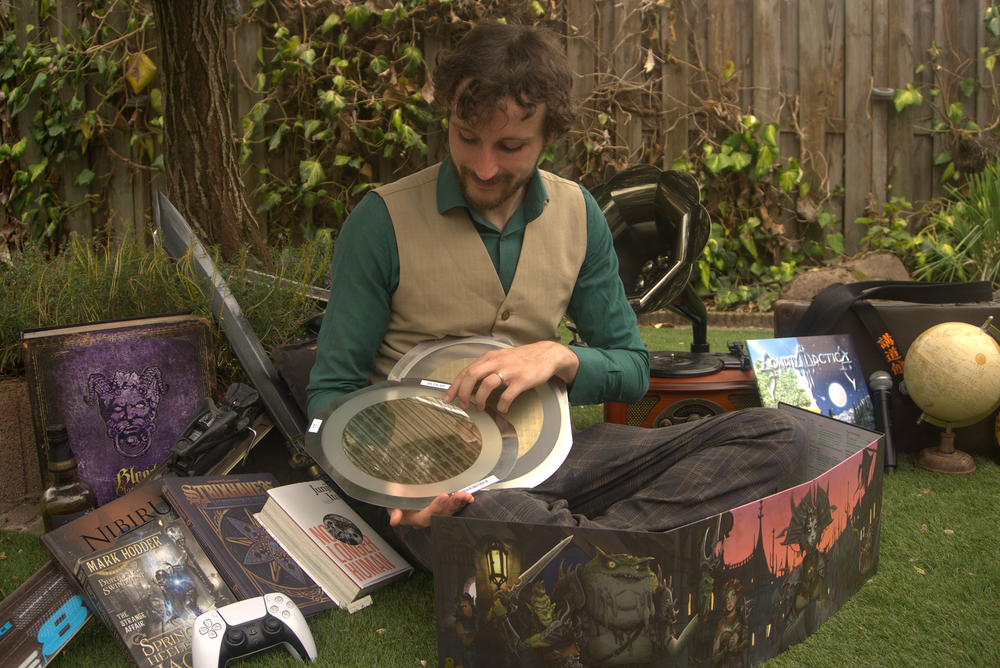
Van Oosterhout flips through his dissertation. “For my CV, I took a photo that says as much about me as possible. If you look closely, you’ll see all my hobbies: a judo belt, Dungeons & Dragons props, and a microphone because I love performing as a singer with my band Resonator.” (see the photo below the text box)
What tip would you have liked to receive as a starting PhD candidate?
“Not everything has to go right at the beginning. You also learn from setbacks, and they help you get through your PhD trajectory. In the final year and a half, you end up collecting most of your results anyway.” He smiles. “But as a starting PhD candidate, I probably wouldn’t have believed myself.”
What’s your next chapter?
“As a postdoc, I’m continuing where I left off as a PhD candidate, refining integrated circuits for brain-computer interfaces. I want to show that you can conduct top-level research in an international environment right here in the Netherlands. My wife has her job here, and we’d like to settle down—spending many years abroad doesn’t suit us right now.”
Discussion