- Research
- 5 min
- 17/03/2026

Home stretch | When drones land to deliver packages
How drones and humans will share public space
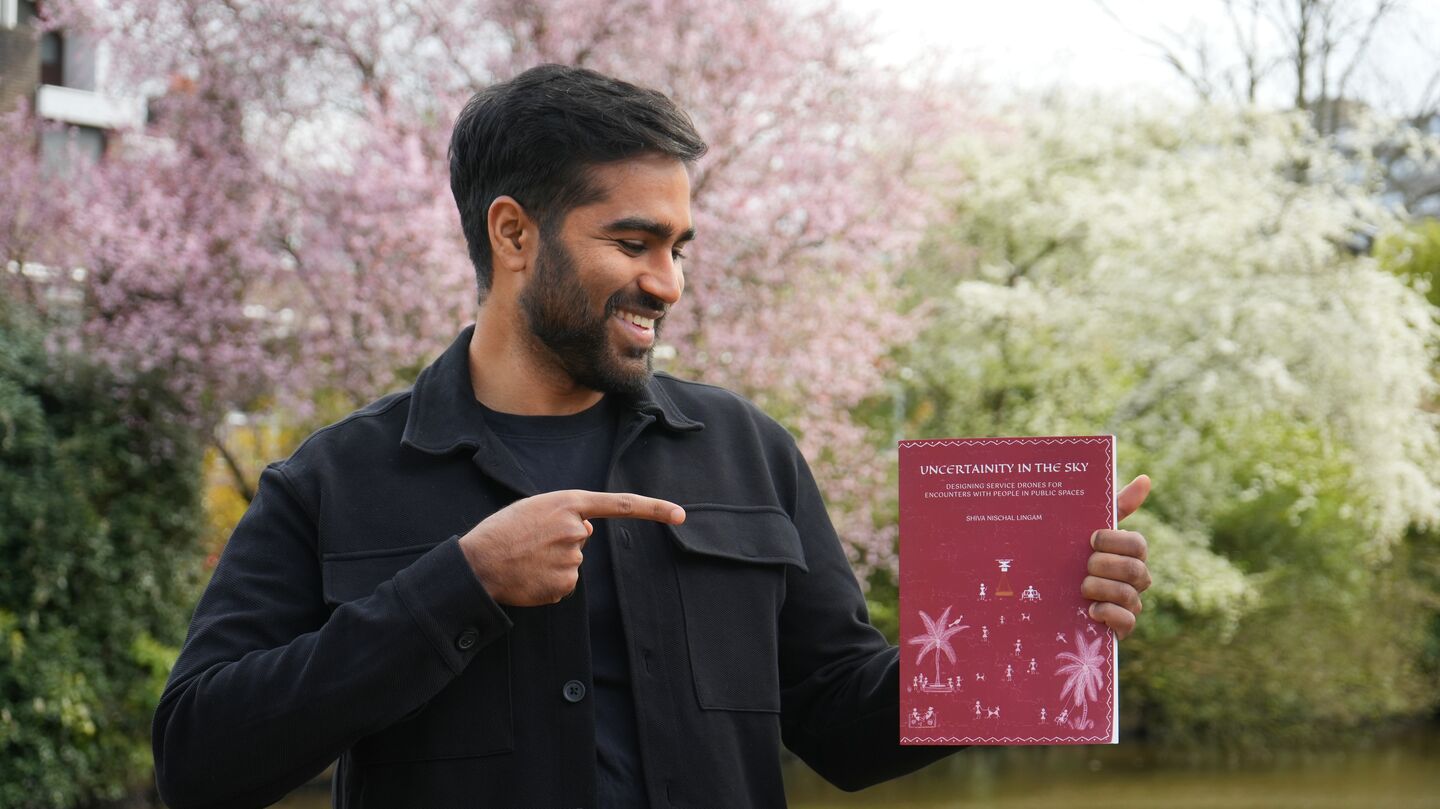
Drones are appearing more and more in our public spaces. Yet not everyone feels comfortable with a drone hovering above their head. In his PhD research at TU/e, Nischal Lingam explores how drones can be designed to integrate smoothly into public spaces without causing discomfort.
During his studies, Nischal Lingam became fascinated by how humans interact with new technologies such as self-driving cars. “My master’s thesis was about how automated vehicles can communicate with people, using visual interfaces and topics like that,” he explains.
Later, he came across a project on interactions between people and drones—and he was immediately hooked. I’ve always been fascinated by watching drones at events, maneuvering so precisely. There’s something cinematic about it, and I really love cinema,” he says. “I also like how it combines futuristic technologies with the human aspect. It’s something that all of us will have to deal with.”
Uncertainty
In some countries, drones are already delivering packages and even food. Their use is expected to grow rapidly, including in Europe, and to expand into areas such as delivering medicines or assisting in emergencies like fires or natural disasters.
For most people, encounters with drones are still a new experience. This unfamiliarity can make them feel uncertain or uneasy—about what drones might do, and how safe or trustworthy they are.
Lingam’s research, a collaboration between TU/e and the Royal Netherlands Aerospace Centre, focuses on how people who are new to drones—so-called novice users—interact with these flying machines. His goal was to understand what makes people feel uncertain or uneasy during these encounters, and to identify the factors that contribute to this uncertainty.
“The unknown aspect probably plays a big role,” he continues. “It’s basically a very strange experience for people—something that flies above your head, but isn’t a bird.”
Based on these insights, he aimed to design drones that take the needs of novice users into account and help reduce their uncertainty. Ultimately, his PhD research seeks to create drones that are not only functional but also trusted and comfortable for people to interact with in public spaces.
Roles and expectations
In his research, Lingam looked at people in two different roles when interacting with drones. The first role is a package recipient—someone who has ordered a delivery and is ready to pick it up. The second role is a bystander, someone who simply happens to see the drone passing by. He emphasizes that each group has different expectations and needs.
“The recipient wants to receive tracking information from the drone, so they know where, when, and exactly how the package will be delivered,” Lingam says. Bystanders, on the other hand, have different concerns. “It turns out that this group also worries about privacy, because they aren’t sure what the drone’s purpose is,” he explains. They mainly want reassurance that it is a delivery service drone—and not, for example, a spy drone.
More predictable
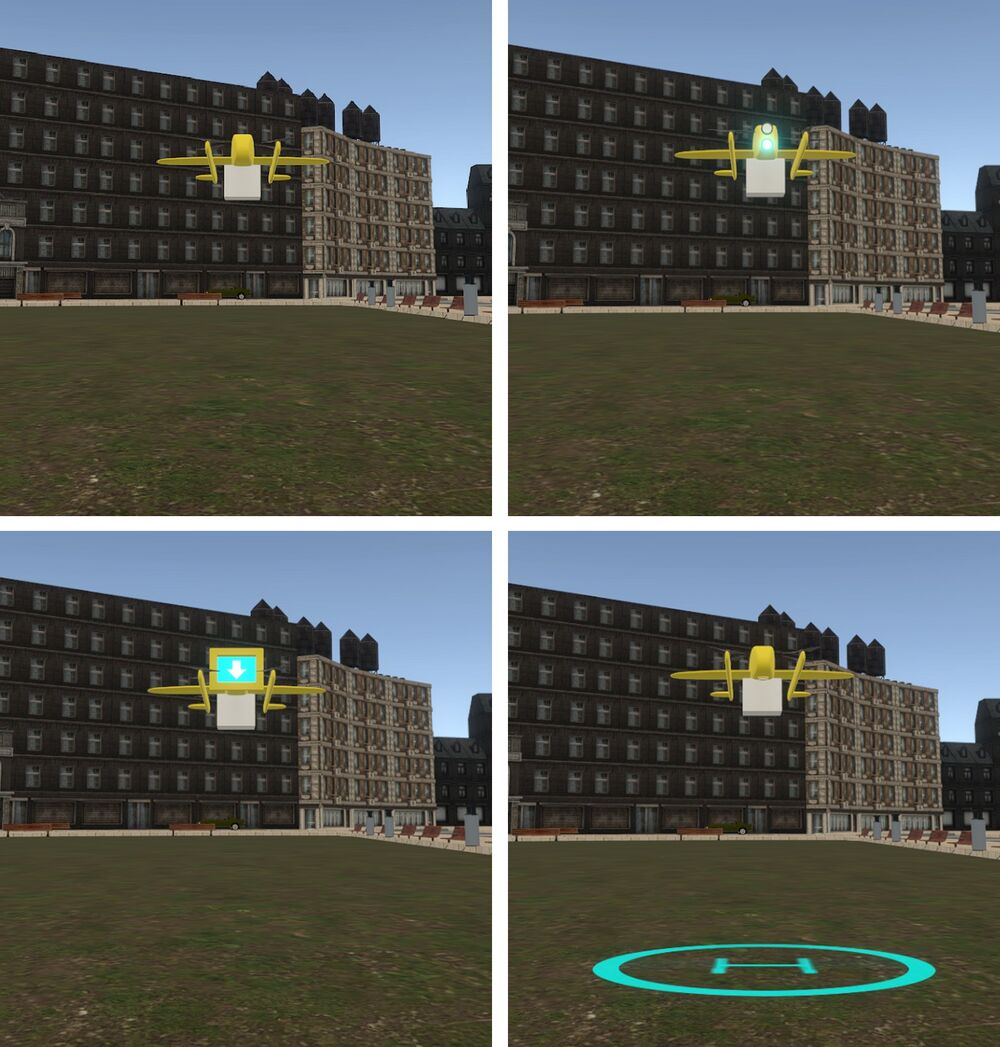
To address these concerns, Lingam focused on making drones’ actions more predictable. First, he identified the factors that cause uncertainty by conducting interviews and questionnaires with novice users. Then he developed visual interface concepts—using lights on the drone, small displays, and projections on the ground—to communicate the drone’s purpose, direction of movement, and planned landing or take-off.
“By making a drone’s actions more predictable, people feel safer and more comfortable,” Lingam explains. “It’s not just about showing drop-off or take-off intentions—the designs also provide cues for movement, warn if the drone is too close to the ground, and give spatial information to guide both recipients and bystanders.”
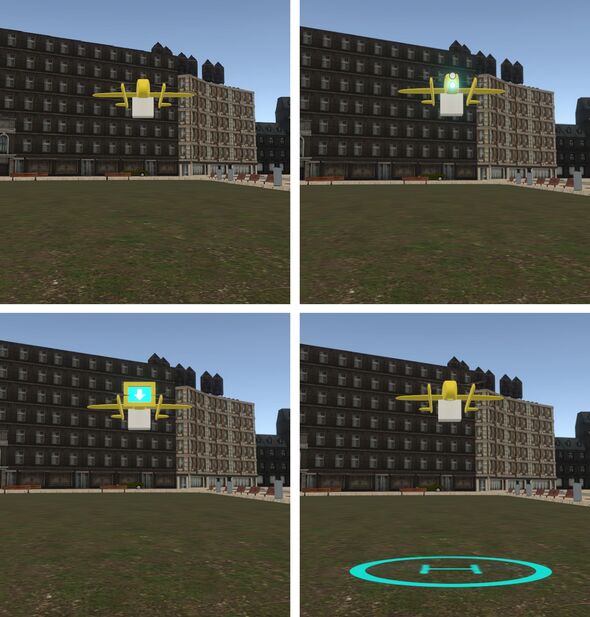
He refined these concepts step by step through focus groups and a series of online video studies, making sure they meet real user needs. The goal is to help drones integrate smoothly into public spaces without causing feelings of uncertainty and discomfort, while building trust.
Virtual reality experiments
Unfortunately, Lingam didn’t work with real drones while conducting his research. “Delivery drones are about 1 to 1.5 meters in size—they are quite large and heavy. Because of the current regulations, they are not allowed to come closer than 50 meters to people. Experiments with real drones are therefore not easy, which is why I relied heavily on virtual reality experiments.”
Using virtual reality allowed him to explore how different flying behaviors influence people’s feelings of uncertainty. For example, he studied reactions to drones delivering packages. He found that drones descending in a smooth, curved path feel much calmer and safer than drones flying straight down overhead. “Most drones fly in straight lines, because it’s more efficient,” he explains.
When a drone comes straight down above a person’s head, people often feel uneasy. This happens because of a perceptual effect: the brain tends to overestimate the closeness of an object directly overhead, making it feel as if the drone is right on top of your head—even if it is several meters away. Based on these findings, Lingam recommends a curved descent rather than a straight-line approach, as it feels safer, more predictable, and more comfortable.
Main takeaway
The main lesson from Lingam’s research is that people’s needs must be taken into account and translated into drone design. Those needs vary depending on a person’s role—whether they are receiving a package or simply passing by—and on the context in which the drone operates. “Understanding these interactions and carefully integrating drones into existing environments will be key to whether people accept them as part of everyday life,” he concludes.
PhD in the picture

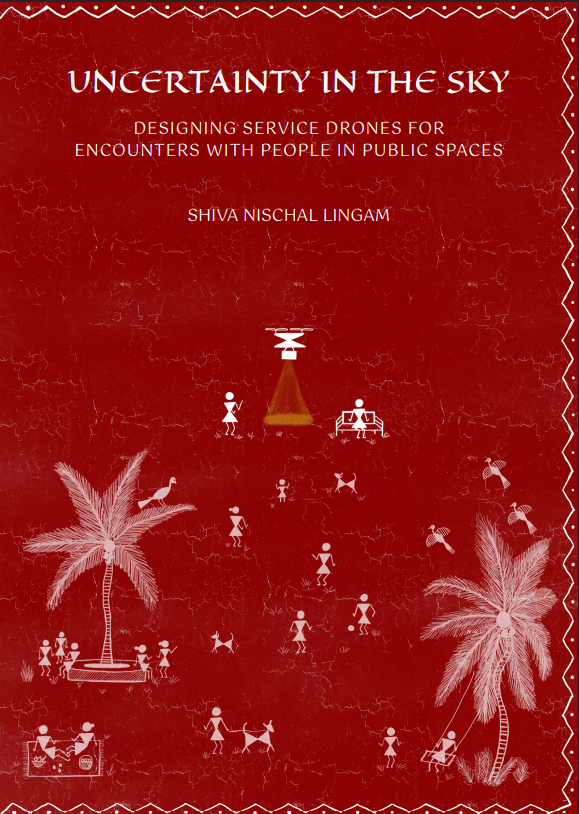
What is on the cover of your dissertation?
“It represents a possible future scenario in which drones become part of our natural surroundings. There are people and children, as well as birds and dogs, because they are also part of this environment. It’s interesting to imagine how they might react—they could be curious, scared, or even try to attack the drone. I wanted to show what this might look like, and at the same time, it’s a reminder that when introducing drones into these environments, we need to take everything into account.”
How would you explain your research at a birthday party in one sentence?
“I study what people need when interacting with drones, and how those needs can be translated into the design of drones so that people feel safe and trust them.”
How do you blow off steam outside the lab?
“During my PhD I realized I needed more discipline, which is why I started working out regularly. I had always been a bit overweight, but over the past few years I changed my mindset, became more committed to exercise, and lost more than 25 kgs of weight. In a way, that’s something the PhD journey indirectly brought me. Hitting the gym also always helped me relax when I felt stuck. Some of my best ideas were born there.”
What advice would you give your younger PhD self?
“Obtaining a doctoral title doesn’t mean you are smarter than other people. It means you’ve gone through the difficult journey of trying to find answers to complex questions. And that’s an ongoing process. Graduating after four years is not the end—it’s just the beginning. You need to keep practicing that skill and continue doing research. You’re not perfect or finished; you have to keep developing.”
What’s the next chapter?
“I’ve recently started at the Netherlands Aerospace Centre as a medior R&D engineer. I’ll be working on projects related to drones, such as how they can be deployed in firefighting scenarios. I’ll continue focusing on understanding how people perceive drones and how we can improve that experience.”
Discussion