
- Home Stretch
- 31/03/2026

Home Stretch | From molecular language to medicine
Molecular language and smart mathematical models help AI accelerate drug development
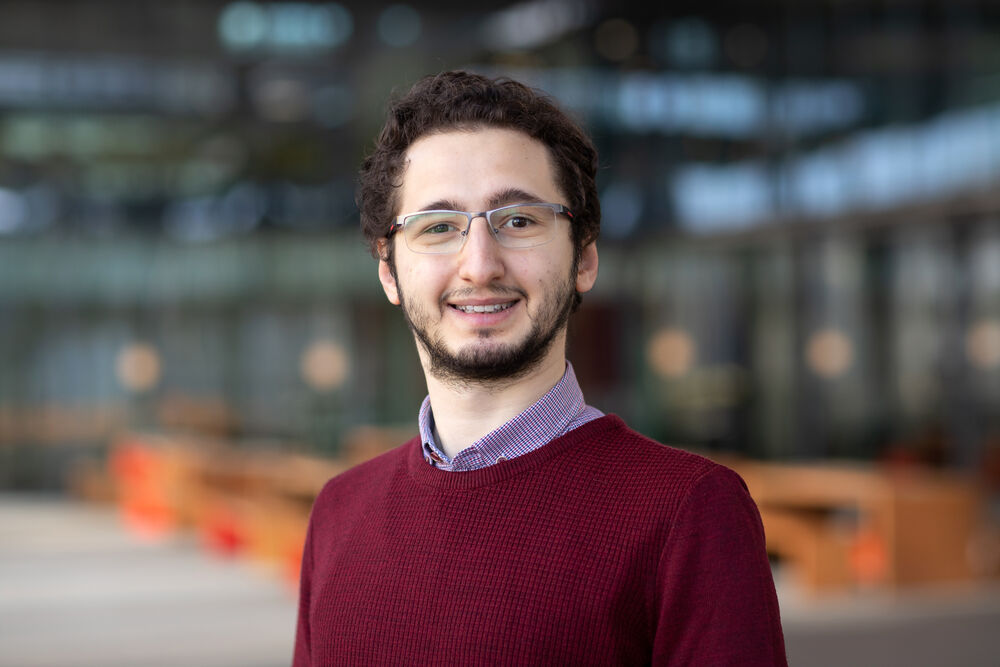
Drug researchers almost always exclude ‘negative’ data when training AI models. Yet these data can also lead to positive outcomes, as TU/e researcher Rıza Özçelik has shown. He learned the language of molecules and created an innovative deep learning paradigm to make the development of new medicines faster and more efficient via failed experiments. On Tuesday, March 31, Özçelik will defend his dissertation at the Department of Biomedical Engineering.
He is a man of language. An etymological dictionary is always within reach through an app on his phone. Just recently, he delved into the linguistic roots of his favorite dessert—künefe—and enjoyed that it derives from the word meaning “embrace”. “Maybe it’s a bit of a nerdy hobby,” Türkiye-born Rıza Özçelik laughs. “But it’s a way to gain more insight into culture and history. And understanding a language helps you communicate better.”
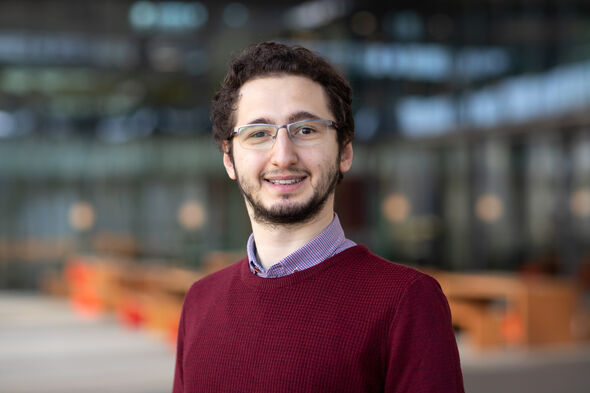
That same principle applies in the molecular world, Özçelik explains. In recent years, the rise of AI has led to major changes in drug research. “When you start a project to find a new medicine, you have a choice of around 10 to the power of 60 different molecules. That’s even more than the number of stars in the universe.” (For comparison: a million is 10 to the power of 6, ed.)
“We call this the “chemical space,” and it’s enormous. But thanks to mathematical models—and especially advances in deep learning—we can predict chemical properties much more efficiently and generate new molecules.”
String of beads
Over the past four years, Özçelik explored how deep learning can be used as effectively as possible in the search for new medicines. Understanding molecular language played a key role in this.
“You can describe any molecule using language by breaking it down into its building blocks. A molecule is essentially nothing more than a ‘string’ of components. A protein in your body can be translated into a sequence of amino acids represented by letters, and a small medicinal molecule can be represented as a sequence of atoms.”

Step by step, Özçelik learned the language of molecules, almost at the same time as he was taking Dutch courses. There was little doubt about leaving Istanbul for Eindhoven—“this project brings together all my passions”—but he did set one condition for himself: he had to invest in learning the language of his new environment.
“In both cases, you see letters and words—but what is the real meaning of an entire sentence? Only when the semantics are clear can you improve deep learning models. We feed them molecular language so the system keeps getting better at making accurate predictions. You can compare it to the smart keyboard on your phone, which predicts your sentences based on initial letters and words.”
Chemical search
During his PhD project, Özçelik developed five deep learning models that can now be used by researchers worldwide. “Each model has its own application. We started by establishing practical guidelines to improve the prediction of chemical properties and built general tools to support this.”
Together with researchers from the TU/e research group Chemical Biology and Italian collaborators, he then explored several case studies to make chemical searches more efficient. “We developed a model that can accurately identify where binding sites are located to a clinically important protein family, which is crucial for molecular interaction.”
To optimize what the body does with a drug—such as improving absorption—Özçelik developed a predictive model for suitable binding partners. “For researchers in the lab, this meant a much more efficient pipeline, as they only needed to test a limited subset of molecules.”
From negative to positive
He is most excited about a completely new approach to using deep learning in the search for new medicines. “We started feeding the model data in the opposite way. In the pharmaceutical field, far more ‘failed’ than successful molecules are found, so there is an abundance of ‘negative’ data.”
What initially seemed like an absurd idea, turned out to be surprisingly successful. “Extensive lab testing also shows that we developed a highly accurate model, in which a positive molecule can emerge from negative data. That’s good news for medicinal chemists.”
Of course, you have to be careful not to focus solely on designing “just another” model, Özçelik emphasizes. “By taking molecular language as our starting point and thinking outside the box, we aim to make developments in the field more robust. A solid foundation that other researchers can build on. And if that results in state-of-the-art models, that’s a very welcome bonus.”
PhD in the Picture

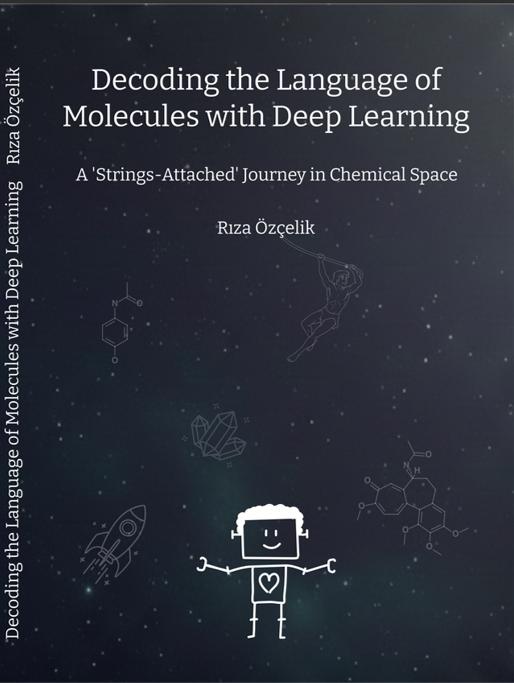
What do we see on the cover of your dissertation?
“The chemical space, with elements that are meaningful to me. There are a few references to papers—such as the rocket and the Tarzan figure—but also the molecular structure of the medication my wife needs to take daily to stay healthy.”
You’re at a birthday party. How do you explain in one sentence what you research?
“I look at how we can use AI to speed up the search for new medicines.”
How do you unwind outside your research?
“I’m a real homebody: I enjoy gaming—sometimes the silliest games help you relax the most—or watching a good series. But I also really enjoy traveling, preferably to new cities. New cultures, languages, history. Now that my PhD is finished, a trip to Florence is coming up soon, a city I fell in love via a video game..”
What tip would you have liked to receive as a starting PhD candidate?
“Follow your instincts when choosing your PhD position. You’re starting a challenging journey, where support can really matter at certain points. A fancy supervisor’s name alone won’t be enough. I had a very good first impression of my supervisor who was looking for her first PhD students, and that turned out to be a great choice.”
What’s your next chapter?
“For a long time, my dream has been to one day become a professor. For now, I’d first like to explore industry to gain a broader perspective, and I’ll be starting soon as a machine learning engineer in Amsterdam. My passion for research, teaching, and supervising students might still bring me back to academia at some point.”
This article was translated using AI-assisted tools and reviewed by an editor.
Discussion