- Research
- 4 min
- 17/04/2026
Home stretch | The complex reality of citizen participation
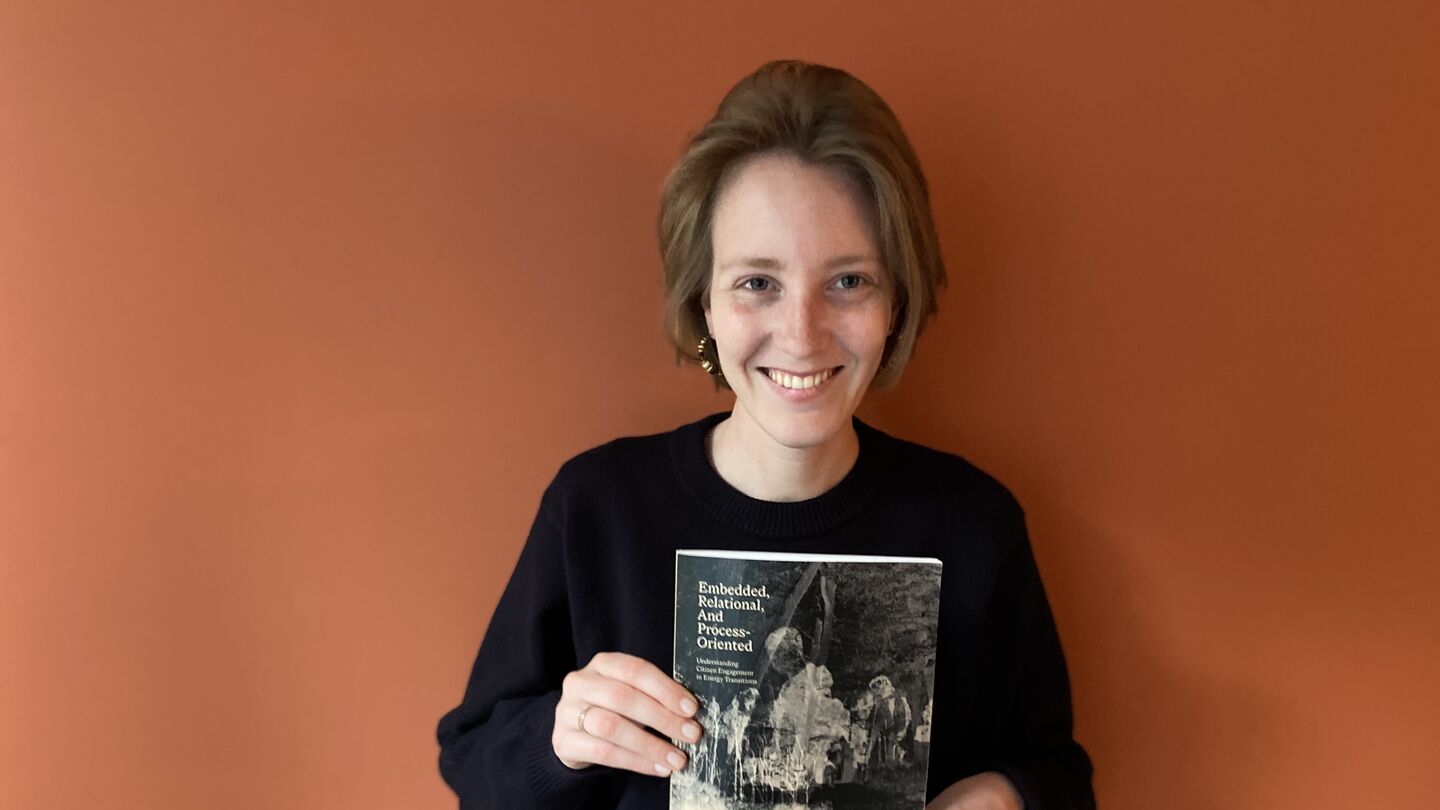
Citizen participation is widely seen as key to a successful energy transition. In practice, however, it often remains more of an ideal than a reality. In her PhD research at TU/e, Nikki Kluskens shows just how wide the gap is between that ideal and everyday practice—and why we need to rethink how we approach public engagement.
Her interest in the topic began on a personal level, rooted in frustration with how citizens are often discussed. “There’s a certain top-down tone, as if people don’t understand and don’t know what’s good for them,” Kluskens says. She sees this attitude reflected in both policy and academia.
At the same time, transition scholars strongly emphasize the importance of citizen participation. “There’s a constant call for it—we have to do this, because it’s crucial. But in practice, involving residents often turns into something you just check off a list.”
Efforts to increase participation don’t always produce the desired results. “We talk a lot about public support. For a successful transition, you need that, and to get it, you have to involve citizens.”
“Participation has even become a goal in itself, because we see the ‘active citizen’ as something inherently good. And yet it doesn’t always lead to the outcomes we’re aiming for.” According to Kluskens, this highlights the persistent gap between ideal and reality—the very tension at the heart of her dissertation.
Placed outside the system
Kluskens argues that a more fundamental issue underlies this gap. By treating citizen participation as something to be organized or created, citizens are effectively positioned outside the system—when in fact they are already an intrinsic part of it. “If you keep seeing them as external, your perspective is too narrow, and you miss what participation really means.”
In her research, she analyzes the assumptions surrounding citizen engagement: what it is, how it emerges, and how it is linked to desired outcomes. Her goal is not necessarily to improve outcomes, but to deepen understanding.
Resistance
In public debate, citizens are often expected to act as active stakeholders, on the assumption that this leads to empowerment and engagement. Kluskens stresses that this is just one perspective. “It creates a kind of false closure—the idea that you can clearly define what ‘good’ participation looks like, while reality is far more complex.” If you take a broader view of participation, she argues, the way you assess outcomes changes as well.
Citizen participation is not a single, uniform concept, but takes many different forms and expressions, as she demonstrates in her dissertation. She illustrates this with a case study. In some neighborhoods, residents are required to disconnect from natural gas and are offered district heating as an alternative. But not everyone experiences this as progress; for some, it feels like a new form of dependency on a single energy provider.
“Such reactions are often dismissed as resistance,” Kluskens says. “But you can also see them as a form of agency—people consciously choosing not to take part.”
This raises a fundamental question: does active participation always lead to greater empowerment, or can resistance itself be a legitimate form of engagement? “By expressing opposition, people can actually feel more empowered,” Kluskens argues.
Reorientation
“We really need to rethink how we view citizen participation. It shouldn’t be treated as a tool or a checklist, but as a practice that reflects how we relate to one another,” Kluskens concludes.
Participation, she says, cannot be captured within a single fixed paradigm. Instead, it calls for design principles—guiding considerations that shape how engagement is organized and encouraged. Participation should not only be seen as a means to an end, but also as a way to strengthen relationships between people.
The barriers that make participation more difficult also deserve serious attention. Financial stress, other obligations, or simply a lack of time can all limit people’s ability to get involved—and these are all valid reasons. At the same time, this underscores how strongly participation depends on context, emerging from the interplay between different actors and circumstances. It is not solely the responsibility of citizens, but a shared responsibility.
Diverse needs
In her dissertation, Kluskens analyzes eleven case studies, ranging from local wind to solar energy projects. She looks not only at citizens, but specifically at their interaction with other stakeholders, such as municipalities, housing corporations, and energy providers. Themes such as public support, empowerment, and implementation are central throughout.
One key finding is the diversity within communities. In neighborhoods participating in the Dutch government’s natural gas phase-out program—often pilot projects in more vulnerable areas—tenants, homeowners, and residents’ associations live side by side, each with their own interests and starting points.
Yet in policy, residents are often treated as a single, uniform group, with the assumption that they primarily need to be “taken care of.” According to Kluskens, this can backfire: “If you arrange everything for people, you also take away part of their engagement.” Moreover, people want to be involved in different ways: some contribute to technical discussions, others focus on costs and benefits.
This calls for more space and flexibility—not predefining what residents need, but enabling multiple forms of engagement.
An open perspective
In policy documents, citizen participation is often prescribed and actively promoted. This instrumental approach is not necessarily wrong, but its narrow framing can obscure the fact that people are already participating in many different ways—just not always in the ways policymakers expect.
According to Kluskens, this requires a more open perspective: observing what is already happening, rather than continuing to organize participation from the top down. That same openness, she argues, is often needed in academic research as well.
“The assumptions you hold shape the research you conduct and the results you obtain—and that leads to a limited view of reality,” she explains. “In the energy transition, the focus is often on shifting from fossil fuels to renewable energy. But what if you define energy more broadly—as something that sets things in motion?”
“If you broaden your frame,” Kluskens concludes, “you not only see more forms of engagement, but also different—and often more nuanced—outcomes of participation.”
PhD in the picture
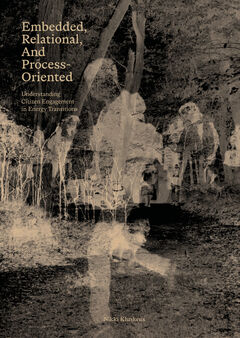

What is on the cover of your dissertation?
“All the images show people embedded in their environment, placed within a context. I wanted to show that a person cannot be seen separately from their surroundings. Because multiple images are layered on top of each other, it creates depth. At first, you mainly notice the main features, but the longer you look, the more details emerge. That’s my message: we shouldn’t focus on just one aspect, but on the whole in all its complexity.”
You’re at a birthday party. How do you explain your research in one sentence?
“I study citizen engagement in the transition from fossil fuels to renewable energy.”
How do you unwind outside your research?
“I love salsa dancing, riding motorcycles, and I’m working on my own voice-over business. I trained in voice acting, and I absolutely love it. It’s about much more than having a pleasant voice—you can convey so much in a playful way. It’s my dream to land a great voice-over or acting job someday, like narrating a documentary or voicing a cartoon character.”
What advice would you give your younger PhD self?
“A PhD suited me very well because I was able to truly make it my own and bring my personality, interests, and creativity into the research. I’ve learned that you shouldn’t just focus on ‘how things are supposed to be done.’ You have to dare to shape it in a way that fits you. A dissertation is often treated as something very formal, but I think you achieve more if you let your character come through.”
What’s your next chapter?
“I’m currently working at Zuyd University of Applied Sciences in Sittard. I’d like to further explore how all these different forms of participation can contribute to strengthening democracy. I also really enjoy teaching.”
Discussion