
- Campus
- 02/12/2025
Student uses master’s project to highlight TU/e cleaners
Giving visibility to the unseen people on campus—that’s what Industrial Design master’s student Jens Vervoort set out to do with his final project. To achieve this, he followed the cleaners from Asito. The result is a video project and an installation in Atlas, “to make people aware of what cleaners do.”
In the middle of the hall of Atlas this week, there’s a toilet bowl on display. Anyone who flushes it sees a video inside the bowl of a cleaner showing a photo of a completely smeared toilet. It’s a scene she encounters regularly while working at TU/e.
A little further on stands a cleaning cart with the question: “When was the last time you spoke to a cleaner?” The cart is also part of Vervoort’s installation, with which he hopes to make TU/e students more aware of the presence of cleaners and what they contribute to the university.
Lack of respect
“I like diving into a world I don’t know. That’s exactly what I did with the cleaners.” By following them, Vervoort discovered that the cleaners—even in the way they clean—each have their own character. “Supervisors can immediately tell which cleaner did a certain space, for instance if some streaks are left on a mirror. And they all have their own route, which they follow the same way every day.”


He also became aware of how little respect cleaners receive from students. “Many people don’t even say hello, and students leave trash behind in lots of places. They assume the cleaners will take care of it, but that’s not actually part of their job. Picking up trash is different from cleaning.”
Quiet heroes
Two Mechanical Engineering students, who stop to look at the installation as they pass by, recognize what he’s saying. “I sometimes leave things lying around in MetaForum,” admits Benedek Kakuk. His fellow student Teun de Wit often sees dirty coffee mugs left behind by others. When asked what they think of the installation, the students first respond unconcerned. According to Kakuk, the fact that we spend time on topics like this shows that humanity has become a bit too comfortable.
What happens next is exactly what Vervoort hopes to evoke with his project. As he talks with the students and shows them more of the installation, awareness starts to grow. “Now that I think about it, it’s true that I often see cleaners at work, but at the same time they’re invisible to me,” Kakuk acknowledges. “They’re a bit like moms: quiet heroes. You come home and your room is clean and tidy, even though you didn’t do anything yourself.”
“I’m glad you reached that insight,” Vervoort tells the student. Interactions like these, he says, show the importance of his work. The installation wasn’t a requirement for his final project; he wanted to create it because he genuinely hoped to make a difference for the cleaners.
Message
Vervoort will present his project within his program next week, during Demo Day. He’ll receive a grade later, but he already knows he wants to continue down this path. His plan is to start his own company to amplify the voices of marginalized groups.
For now, however, it’s time for the TU/e cleaners to gain more visibility. In the video inside the toilet bowl, the photo of the smeared toilet appears again. “Wow!” the Mechanical Engineering students exclaim. “What kind of coffee did the person who did that drink?” De Wit jokes.
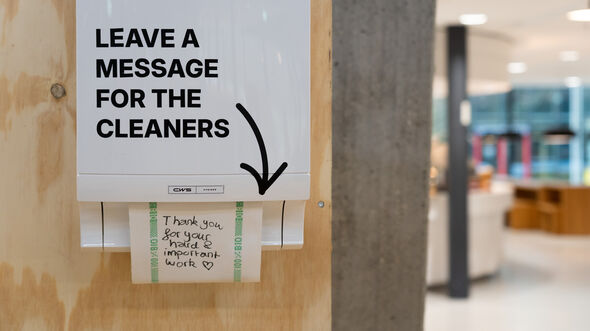
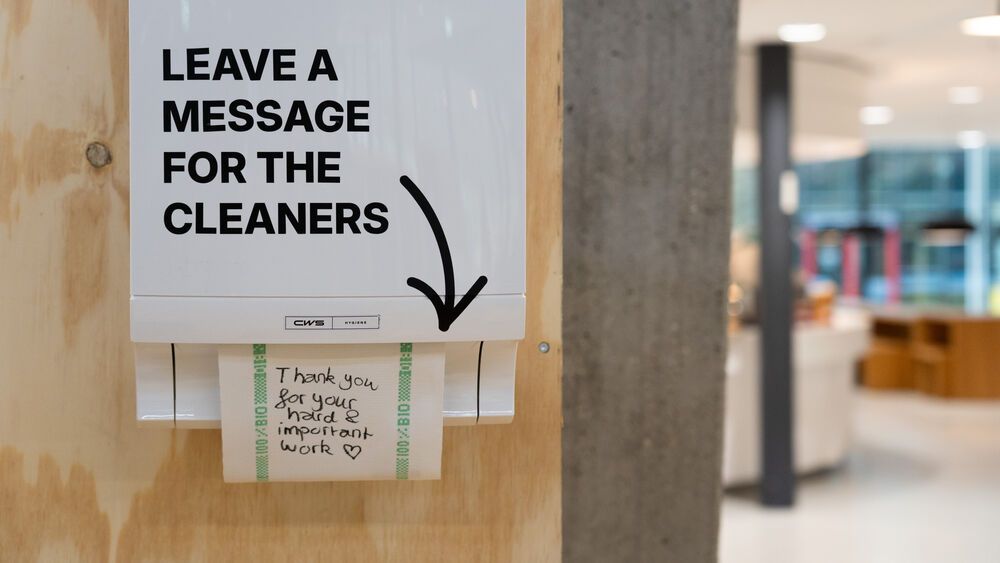
But after seeing the video and talking with Vervoort, the students head over to a paper towel roll hanging as part of the installation and write a message for the cleaners. “I can’t wait to take out that roll on Thursday and read what everyone wrote,” Vervoort says.
This article was translated using AI-assisted tools and reviewed by an editor.
Discussion