
- Campus
- 20/01/2026

Crying babies have ‘plagued’ Traverse for over a decade
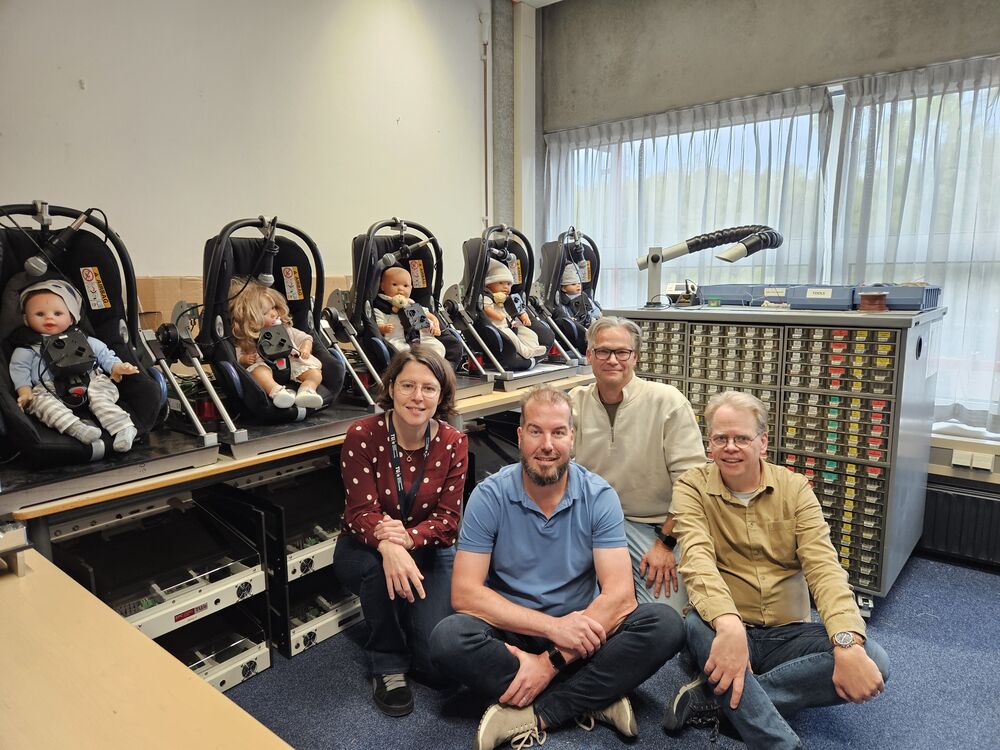
Sometimes as many as five of them cry at once: the (fake) babies used in the Rock Your Baby course. First-year Electrical Engineering students at TU/e are tasked with developing a system that automatically calms the babies by rocking them back and forth in exactly the right way.
You could see it as a kind of rite of passage: every first-year Electrical Engineering student has to endure the test and listen to hours of crying. Each year, the Rock Your Baby project fills the hallways of Traverse with mechanical wailing sounds and has almost achieved cult status.
For example, the lustrum band of study association Thor sings about it in the song Sjaarzenleven: ‘Bij Rock Je Baby, o zoveel herrie’. There is also a special election poster from student party Groep-Eén—which is based in the same building—featuring one of the baby dolls. And than there's the Harry Potter baby with a lightning-shaped scar on its forehead.
Rocking
That last one is the favorite of professor Anne Roc’h, who has been in charge of the Challenge Based Learning course for the past five years. “I think he’s cute.” Together with a team of fifty people—half staff members and half teaching assistants—she guides three hundred students on their mission to calm the babies, that technicians of TU/e equipped with a heartbeat and crying sounds, as quickly as possible.
The students do this by building a system that measures the baby’s heart rate and the volume of its crying, and then adjusts the speed and intensity of the rocking so that the heart rate drops and the crying stops.


The babies are causing quite a stir in Traverse.
Groups of students are doing their best to calm the babies, but it’s proving to be no easy task.
There are around 250 ways to successfully complete the assignment, Roc’h estimates. The students have to figure out their own approach, using knowledge they have gained in other courses. “For example, they need to program, design a circuit, and be able to work with signals and communication protocols.”
Much of the required information is already embedded in the curriculum, confirms Michel van Eerd, head of the project’s technical support. “But there are also a few things that are genuinely new to them. For instance, they have never worked with a transistor before, but now they need one to successfully complete the project. They have to figure out for themselves how such a component works.”
Deafening
That calming the babies is no easy task becomes clear during the final demonstration last Thursday, when the groups present their projects for the assessment. In some rooms, the crying is deafening, and the rocking does not always seem to help.
The fact that many groups fail to stop the crying does not mean they fail the course, Roc’h emphasizes. “That’s not what we assess them on. It’s about the entire process, in which students learn to design, make choices, test, collaborate, and present their final product under pressure.” A classic example of Challenge Based Learning. The project has been around since 2012, making it an early adopter of this approach.

Still, disappointment is palpable among groups that do not succeed: “It worked yesterday.” Further down the hallway, cheers erupt from a group that does manage to calm their baby. Other students go a step further, designing their system so that it still rocks the baby into calm even if the heart rate signal is not perfectly clean.
Another group has created animations showing what each component does on small screens. They animations include a crying baby and a cradle rocking back and forth.
Community
At the end of the day, the student assistants select a winner for the funniest or most innovative design. This happens during the closing drinks, where the students can recover from all the crying.
“That’s where we come together as a community,” says Roc’h. According to her, this aspect is crucial to the course. “Older students help the first-years, and teachers are present every week to support them. Together we create a safe environment where students can experiment, make mistakes, and learn to try again.”
She believes this experience lays the foundation for their future careers, in which they will encounter Challenge Based Learning many more times. Perhaps the crying dolls have also given the students a preview of what awaits if they ever have children of their own. In that case, one instructor’s advice for the demonstrations might come in handy: “Always bring earplugs.”
This article was translated using AI-assisted tools and reviewed by an editor.
Discussion