
- Student
- 12/06/2026

International student numbers drop, TU/e keeps growing
For the first time in twenty years, the Netherlands has fewer international students than it did a year ago, according to new figures released by Nuffic. Technical universities are an exception to this trend: both TU/e and Delft University of Technology recorded an increase in international student enrollment this academic year.
This academic year, nearly 130,000 international students were enrolled in a full bachelor's or master's degree program in the Netherlands. That is 133 fewer students than in the previous academic year, according to the latest figures from Nuffic, the Dutch organization for internationalization in education.
The growth in the number of international students had already been slowing in recent years. Three years ago, enrollment increased by 7 percent, followed by 5.4 percent two years ago and 3 percent last academic year. The country has now entered a period of slight decline.
The main reason is a drop in new enrollments: fewer international students are starting degree programs in the Netherlands. Applications to universities of applied sciences (HBO institutions) fell by 3 percent, while applications to research universities declined by 4 percent. Nuffic expects the overall international student population to continue shrinking in the coming years.
German students
Although they still represent the largest group of international students in the Netherlands, the number of German students has been declining for years. In 2021, approximately 24,600 German students were studying in the Netherlands. This year, that number has fallen to 18,200. It marks the fifth consecutive year of declining enrollment from Germany.
According to Nuffic, the first drop in 2021–2022 may have been linked to changes in Germany's educational requirements for psychotherapists. Demographic decline may also play a role. However, that does not appear to tell the whole story: in other countries, such as Portugal and France, the number of new German students is actually increasing.
Ellen Tomesen, head of the science and education team at the Dutch embassy in Berlin, points to additional factors besides changing regulations and demographic trends. She cites the ongoing housing shortage in the Netherlands and suggests that the nationwide halt to active recruitment of international students may also be reinforcing the downward trend.
Chinese students
The total number of students from the European Economic Area (EEA) remains stable for now, thanks to growing enrollment from Southern and Eastern Europe. Applications from Spain, for example, increased by 28 percent.
Outside the EEA, the largest decline is among Chinese students, who remain the biggest group of non-European international students. New enrollments from China fell by 28 percent.
According to Nuffic, one explanation may be that Chinese universities are performing increasingly well in international rankings, encouraging more students to remain in China. China is also experiencing demographic decline, with fewer young people entering higher education. After China, the largest groups of non-EEA students come from Turkey and India.
Engineering programs
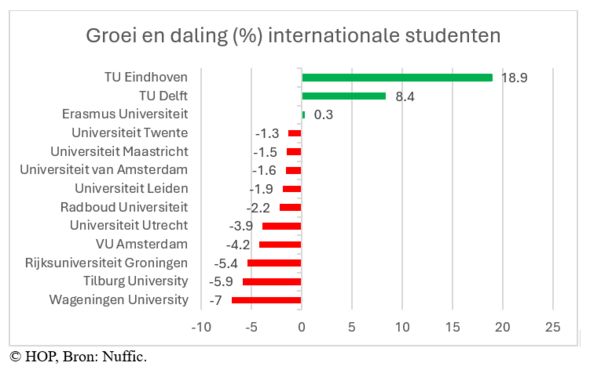
At Dutch research universities, international enrollment continued to grow in engineering and technology programs. As a result, the universities in Delft and Eindhoven are the only institutions to report growth this academic year, with increases of 8 percent and 19 percent, respectively.
All other universities recorded a decline in international student numbers, with the exception of Erasmus University Rotterdam, where enrollment remained virtually unchanged.
Discussion