
- Student
- 15/06/2026

Demo Day: self-driving tractors and a robot that tidies up
TU/e students from the Honors Bachelor Program showcased what they had been working on alongside their studies over the past two years during the annual Demo Day on Friday. In the Auditorium, interdisciplinary teams presented a wide range of projects: from a household robot to tractors that cultivate the fields autonomously.
Every academic year, the TU/e Honors Bachelor Program concludes with a Demo Day. The two-year program is designed for bachelor’s students seeking additional challenge alongside their regular degree.
Students from different study programs collaborate in eleven thematic tracks. During the demo fair, the 43 interdisciplinary teams presented the results of their collaboration to fellow students, lecturers, coaches, and other visitors.
In total, 211 students took part in this edition of Demo Day. Among the projects are AI solutions for healthcare, systems that map behavior and mobility, and concepts related to the energy transition and smart cities.
Combining expertise
One of the teams focusing on the energy transition is Splitter. The team develops software intended to make the production of green hydrogen via electrolysis more efficient and cost-effective.
Hydrogen is used in a wide range of industries, from fertilizer production to the metals industry, but is still largely produced worldwide using fossil fuels. By optimizing the electrolysis process, the team hopes to contribute to making these sectors more sustainable.
For Computer Science student Charlie Johnston, the collaboration with students from other disciplines was especially valuable. “I usually work mainly with software, but in this project chemistry and mechanical engineering also played a major role.”
“It was precisely that combination of different expertise that made it interesting. Everyone brought their own knowledge, and together we could work on a solution with societal impact.”
Clean up toys
While some teams focus on major societal challenges, others look for solutions closer to home. The Handy Cleaner team developed a robot that can pick up, sort, and clean objects such as toys, paper, and other items from the floor.
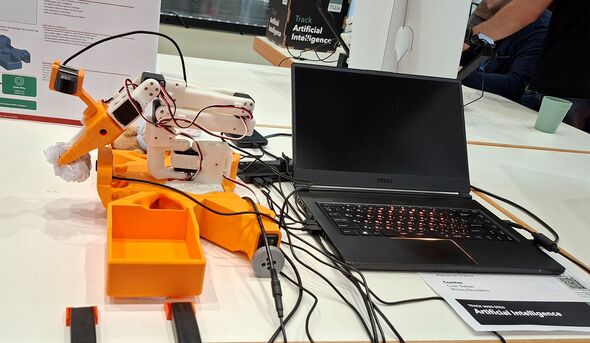
“My brother has a small child and often complained about having to clean up toys scattered all over the floor,” says Computer Science student Rovshan Ayyubov with a laugh. “We wondered whether a robot could take over that task.”
By making household robots more efficient, parents could save a significant amount of time. “If parents spend less time cleaning, they have more time for things that really matter, such as spending time with their children.”
For teammate Mechanical Engineering student Francisco Fernández Gutiérrez, the main value lay in the freedom the project offered. “We could organize everything ourselves and make our own decisions,” he says.
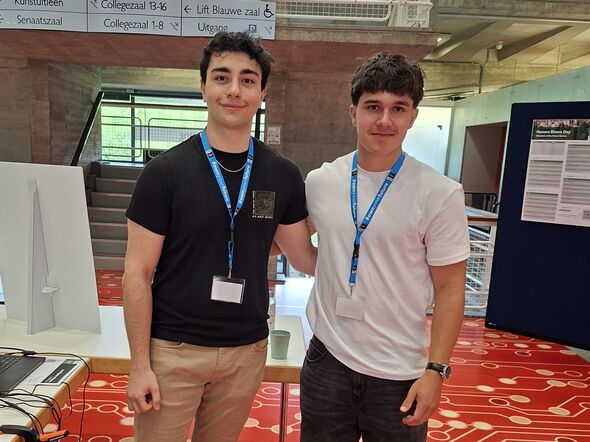
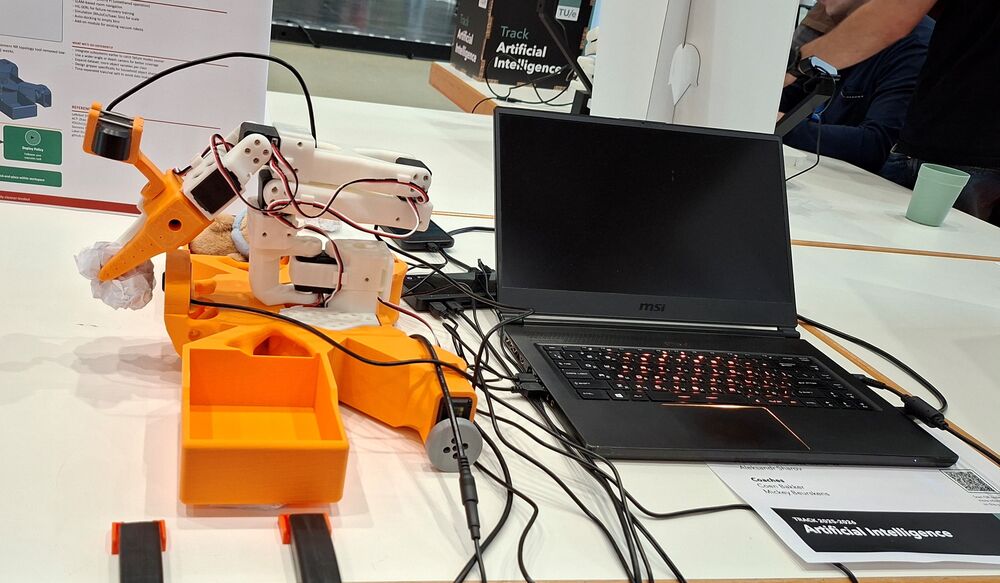

“It’s also special to develop an idea step by step into a working prototype.” He points to the robot picking up a piece of paper from a table. The team started the project last year and is determined to continue working on it next year as well.
Automation of agriculture
Within the Autonomous Farming project, students are working on a system that enables tractors to operate autonomously and automate agricultural tasks such as sowing and harvesting. The system is also designed to be compatible with existing agricultural machinery, so farmers do not need to purchase new tractors.
“You can simply integrate the system into an existing tractor,” explains Industrial Engineering student Miguel Cachide Basto. “The agricultural sector is aging, and at the same time people are leaving the profession for other jobs. Automation is therefore a necessary step to make the sector future-proof.”
For Mechanical Engineering student Shraavanik Suresh Kumar, personal motivation also played a role. “All my grandparents are farmers. The idea that we are developing technology that can help them and people like them was a huge motivation.”
Although the Honors program is something students follow alongside their regular studies and therefore requires extra time and energy, both students find it worthwhile. “You learn an enormous amount, you meet many people, and in the end you work on something that – hopefully – really has an impact on the world.”
Curious about the other projects? Check out the brochure with an overview of all participating teams and projects. The main photo at the top shows the Multi-Terrain Mobility System project.
This article was translated using AI-assisted tools and reviewed by an editor
Discussion