
- Research
- 04/09/2026

TU/e and Fontys students team up to ‘babysit’
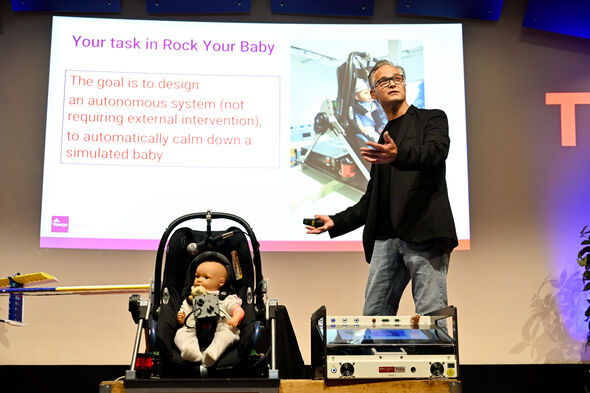
For the first time, TU/e and Fontys students are taking a course together. Rock Your Baby is an existing Challenge-Based Learning course in Electrical Engineering in which students have to figure out how to calm down fake babies. Starting this academic year, both the students and supervisors for the course will come from both institutions.
Anyone looking around the Blauwe Zaal at the university, where the new joint course offered by TU/e and Fontys is being kicked off, will see a lot of students gathered together. It is only when they are asked which institution they study at that the students standing up to answer reveal who is from the university and who is from a university of applied sciences. They appear to be sitting completely mixed together. “Just one big group of students,” someone concludes.
That is exactly the idea behind the course, says lecturer Sjoerd Hulshof: bringing TU/e and Fontys students closer together so that they know about each other and can learn from one another. It also makes it easier to transfer from one institution to the other.
And that is desirable, the dean of Electrical Engineering (EE) recently told Cursor, because one-third of first-year students in the program drop out and would normally be lost to the field of electrical engineering.
The dean’s new plan, which involves working closely with Fontys especially during the first year of the program, is intended to change that. It should make it easier for first-year TU/e students to transfer to higher vocational education if that proves to be a better fit for them.
After completing their higher vocational education, they can then easily return to TU/e for a master’s degree. And hopefully, after that, continue working in the Brainport region.
Rock Your Baby
The new joint Rock Your Baby course is part of this broader plan, Hulshof explains. In terms of content, he says, the project did not require much adjustment. Rock Your Baby is an established course that is well known – or notorious – among EE students because they have to listen to hours of baby crying. The course is worth five credits.
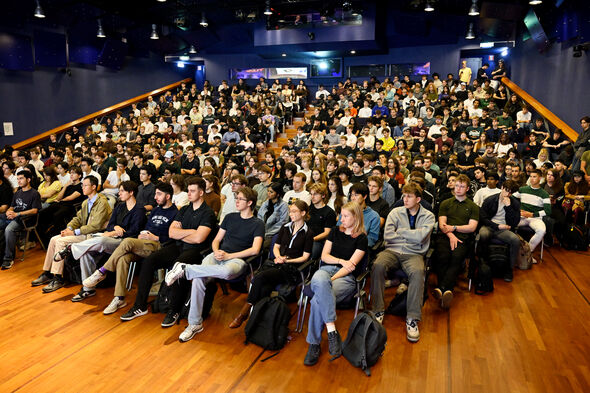
“Fontys is simply joining the project,” Hulshof says. A total of 250 TU/e students and 120 Fontys students form 42 mixed teams. They are supported by around 100 lecturers, design coaches and student tutors from both institutions. Classes take place in Traverse, Neuron and Fontys building Nexus, which is about 100 meters from Flux but which most TU/e students had never visited or even heard of – until now.
As part of the collaboration with Fontys, a few minor adjustments have been made to the course materials. The course will also have more structure, because Hulshof says students at both institutions need it. “We have now introduced many more checkpoints into the project.”
Teamwork
According to the lecturer, all students start from scratch. “Students coming from pre-university education (VWO) generally have a little more prior knowledge of mathematics and physics. But the funny thing is that it is of no use to you at all in this course, because it is mainly about the process of working together to arrive at a design. The most important thing in this course is teamwork.”
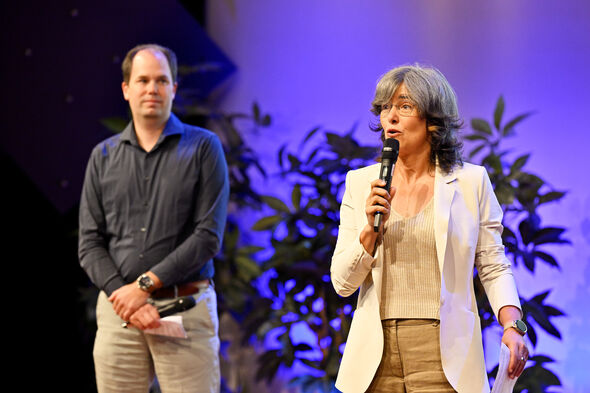
Ines Lopez Arteaga, Dean of the TU/e Bachelor College, emphasizes the same point at the start of the gathering: “The best engineers are not defined by what they know, but by how they work together, how they learn from others and how they embrace new challenges,” she tells the students. “I ask you to take the first step now. Be open to new experiences, participate actively and work together.”
New challenge
Not all first year EE students at TU/e take the Rock Your Baby course. A new project was added last year using the same modules and approach, but in a different context.
In that project, students have to send a signal to a ‘satellite’ (in the form of a modified 3D printer head that rotates). To accommodate all the additional Fontys students joining Rock Your Baby, this new project has now been significantly scaled up.
“We are going to think about another new challenge,” Hulshof says. “That way, we can run different projects in a smaller setting. This is a lot of fun on such a large scale, but it is also a tremendous amount of work.”
This article was translated using AI-assisted tools and reviewed by an editor.


Discussion