- Home Stretch
- 6 min
- 24/02/2026
Home Stretch | Smarter control helps overloaded power grid
Better distribution on the overloaded power grid through smart simulation and flexible consumers
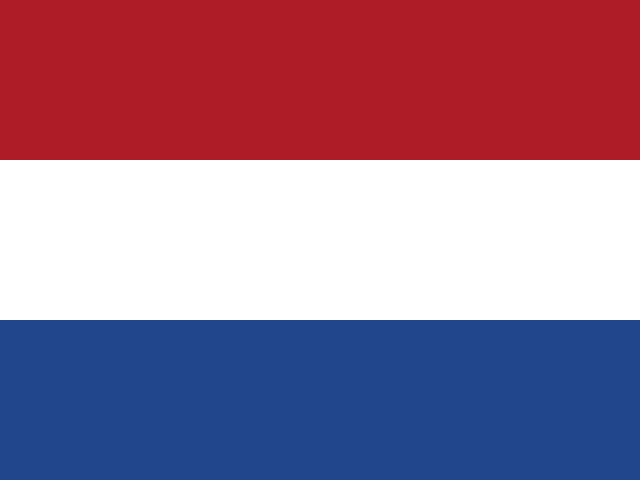
Our electricity grid is under pressure, which is increasingly leading to congestion. With new insights from TU/e energy technologists Bart van der Holst and Gijs Verhoeven, grid operators can now use existing capacity more efficiently and effectively. A new simulation tool also allows them to more precisely encourage flexible behavior among consumers.
Have the two TU/e researchers themselves started thinking differently about their own electricity use? They nod in agreement. “While writing my dissertation, I spent more time at home. Before pressing the start button on the washing machine, I would first check how much power our solar panels were generating,” says Gijs Verhoeven.
His colleague Bart van der Holst will soon be moving from his apartment to a house he has bought and is already busy making it more sustainable. “Right now, I still rely mostly on fossil fuels, but we’re figuring out how to change that. In a flexible way,” he adds with a laugh.
More than four years ago, Van der Holst and Verhoeven began their PhD journeys on the same day. That marked the start of an intensive collaboration in which the two searched for solutions to balance the load on the power grid more evenly.
The result speaks for itself: two dissertations full of practical insights and a smart simulation tool that grid operators can immediately put to use. Van der Holst will defend his dissertation today, Verhoeven will take the podium a few months later, on May 7.
Waiting lists for grid connections
Across the Netherlands, problems with electricity supply are becoming increasingly common. In some places and at certain times, the grid is simply too crowded—a phenomenon known as congestion—and this has major consequences, Van der Holst explains. “Not only for the energy transition, but also for economic growth and housing construction.”
He lists several examples. “New companies face long waits for an electricity connection, existing companies cannot expand, new housing projects are delayed due to the lack of connections, sustainably generated energy cannot always be fed back into the grid, and new charging stations and wind turbines cannot be connected.”
The biggest challenges occur in the high- and medium-voltage grids, which are used to transport electricity over long distances to businesses and residential neighborhoods. But as consumers, we also feel the impact of these higher-level grid issues in the low-voltage grid, Verhoeven adds.
“On top of that extra pressure, our electricity demand is growing. We’re increasingly driving electric vehicles, cooking electrically, and using electric heating—often at the same ‘peak moments’: between 7 and 9 a.m. and between 5 and 8 p.m. Those peaks have already become so high that grid operators sounded the alarm this winter: due to overload, temporary power outages at certain times could not be ruled out.”
Charging later
Expanding grid capacity with additional cables and transformers is necessary, but it takes a great deal of time, money, and scarce technical staff. For that reason, it is not seen as a short-term solution. As a result, research is underway into how grid operators can make more efficient use of existing capacity.
Together with TNO and several grid operators, Van der Holst and Verhoeven focused within the project Built Environment Electrification (GO-e) on flexibility as a way to relieve pressure on the grid. Their research shows there is clear potential here.
“You might think that turning on your washing machine or heat pump doesn’t make a difference in the bigger picture,” says Verhoeven, “but we demonstrate that flexible behavior really does help reduce grid congestion.” This could mean charging electric vehicles later, using batteries to temporarily store energy, or companies shifting their electricity demand.
A complex game
To enable that flexibility, Dutch grid operators have been using two instruments in recent years—the first in Europe to do so, Van der Holst explains. The first involves capacity restrictions applied a day in advance, in consultation with the consumer. “In exchange for compensation, you are limited at certain times of the day in the amount of electricity you can draw.”
The second instrument is known as redispatch. In this case, users indicate in advance what they expect to need. The grid operator can then specify at which times less or more electricity should be used. Van der Holst studied in detail how these two instruments can be combined to address congestion even more effectively.
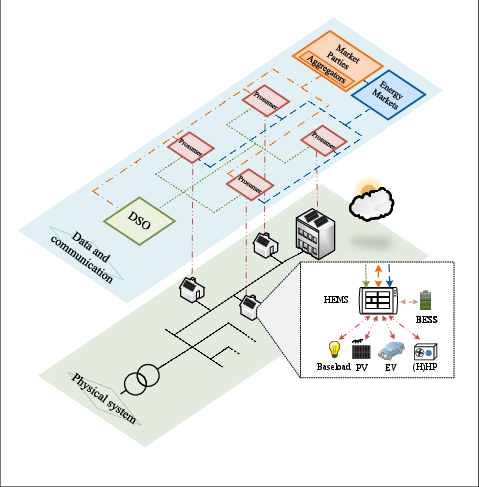
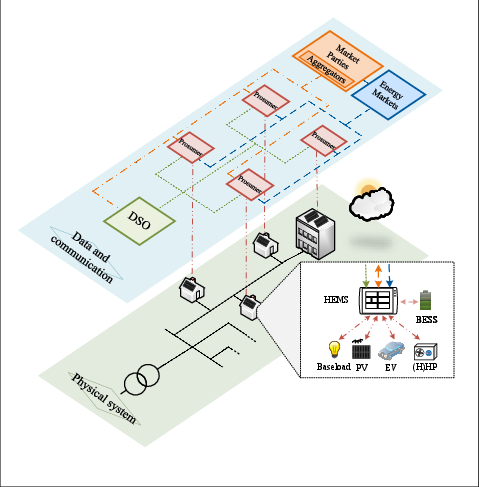
He describes it as a game between grid operators, electricity users, and commercial flexibility providers. “Each party has its own interests, expectations, and information. By simulating their interactions in a virtual environment, we can explore strategies that would be difficult, expensive, or risky to test in real grids.”
Where a grid operator might currently choose between instrument A or B, Van der Holst and Verhoeven examined in a large-scale simulation study what happens when both instruments are used simultaneously. Their findings show that significant gains can indeed be achieved.
A new toolbox
In addition, Van der Holst studied how a grid operator can deal with uncertainty to arrive at an ideal combination of both instruments. “Many factors influence electricity use, which makes precise forecasting complex. With this toolbox, grid operators have new options to better regulate overload on our power grid.”
To stimulate flexible behavior among electricity users, grid operators can also introduce financial measures, such as different types of tariffs. Verhoeven calculated various scenarios involving variable contracts and tariffs. His simulations show that combining tariffs with the previously mentioned capacity-restriction and redispatch contracts can, in certain situations, lead to a better distribution of electricity use, significantly increasing available capacity.
Flexible laundry
However, Verhoeven also issues a warning. “If you financially incentivize users to consume more electricity during off-peak hours, that may initially work well to limit overload. But you quickly run the risk that the valley becomes the new peak — in other words, more and more people using electricity at the cheapest times. Our simulations show that in that case, we could actually be worse off.”
The two TU/e researchers believe that a tariff linked to the level and timing of the highest energy consumption — a weighted peak tariff — could be a more robust way to distribute electricity use more evenly throughout the day. Above all, they advocate flexibility. Not only from electricity users, but also from grid operators, Van der Holst concludes.
“We’re facing increasingly serious problems, so action is definitely needed now. But don’t lock in the path we choose completely. We’re dealing with a dynamic system, so it’s essential that we can keep adjusting the controls. Thinking differently pays off. If every household shifts its use just a little, it can already make a big difference at the neighborhood level.”
PhD in the Picture | Bart van der Holst
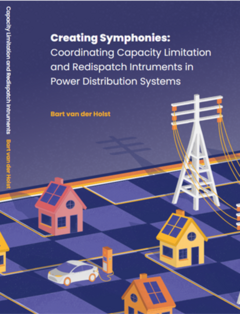
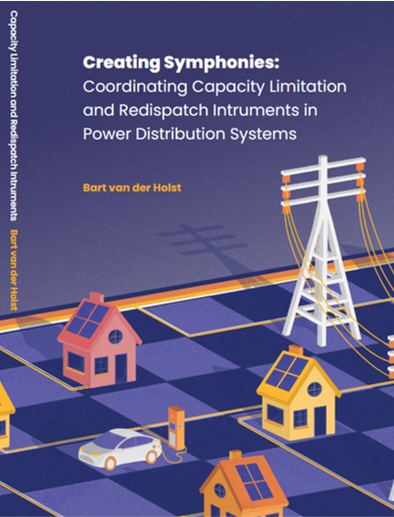
What do we see on your dissertation cover?
“All credit for the design of my dissertation — including the cover with inside flap — goes to my girlfriend. I wanted the key elements of the power grid on it, from high-voltage pylon to solar panel. They’re placed on a chessboard to visualize the game between grid operator and end user.”
You’re at a birthday party. How do you explain your research in one sentence?
“I study how grid operators can tackle power grid congestion by smartly combining multiple tools.” He admits he receives quite a few general energy-related questions from people around him. “The energy world can be confusing, and there’s a lot going on: solar panels, tariffs, home batteries …”
How do you unwind besides your research?
“Besides sports, I’ve picked up a new hobby and recently started playing guitar. I try to play favorite songs by John Mayer, but they’re not the easiest.”
What tip would you have liked to receive as a starting PhD candidate?
“A PhD trajectory can be quite individual, so actively seek collaboration. We joined an ongoing project with multiple partners, including industry partners. I found that very educational and it was rewarding to see how my research could be applied in practice.”
What is your next chapter?
“Since October, I’ve been working at grid operator Enexis as Energy Transition Expert, helping in practice to unlock the power grid through greater flexibility. During my PhD project, I focused on the day ahead; now I’m looking at the long term. What developments do we expect up to 2050, and what role can flexibility play?”
PhD in the Picture | Gijs Verhoeven
What do we see on your dissertation cover?
“I’m still working hard on the design. The grid of my hometown, Bergen op Zoom, will be on the front, and Eindhoven — my second home of sorts — on the back. During our project, a map was created dividing the entire Netherlands into different types of grid neighborhoods based on behavior and grid load. Those are the different colors you see.”
You’re at a birthday party. How do you explain your research in one sentence?
“How using electrical devices differently can prevent grid congestion, and how a grid operator can optimally manage that flexibility.”
How do you unwind besides your research?
“Mainly by exercising a lot: road cycling, mountain biking, padel. Unfortunately, the last one is on hold due to a torn ACL. After surgery, I now have to gradually build back up.”
What tip would you have liked to receive as a starting PhD candidate?
“I completely agree with Bart: strong collaborations are worth their weight in gold.”
What is your next chapter?
“I’ve just finished my manuscript and now have a new role within our Electrical Energy Systems group. As a research coordinator, I bring together different scientists within the university to work on innovative projects with a broader focus. I hope to be a connecting force.”
This article was translated using AI-assisted tools and reviewed by an editor.
Discussion