- Research
- 4 min
- 27/01/2026

Home stretch | How lighting shapes our sense of safety
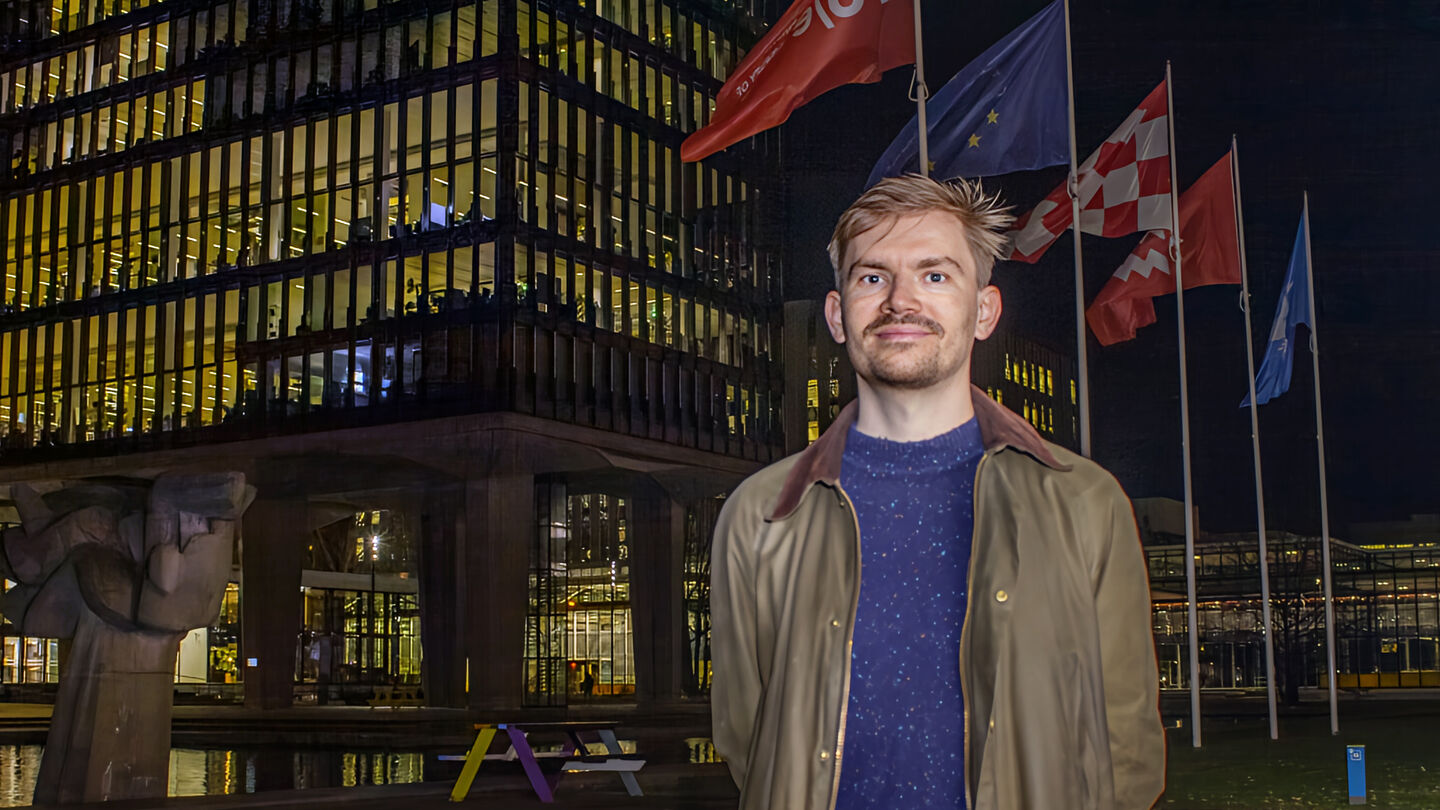
The more street lighting there is, the safer you feel in public spaces. Right? But psychological research into the effects of light shows that it isn’t that simple. TU/e PhD candidate Richard Jedon studied how lighting, perception and internal tension together shape how safe pedestrians feel.
Richard Jedon’s PhD research is part of Lightcap, an international research project that brought together fifteen researchers from different disciplines. The consortium focused on the complex relationships between light, perception, attention and cognition.
In his own work, Jedon studies psychological phenomena such as attention, alertness and attentiveness—terms that are often used interchangeably, but each capture a slightly different aspect of how people engage with their surroundings. “My research specifically focuses on pedestrians,” he explains. “I look at how they perceive their environment, how attentive they are, and how likely they are to respond to potential hazards—for example, noticing an approaching car.”
The curb
This way of perceiving the environment is closely linked to safety, Jedon argues. In his dissertation, he therefore examines the impact of public lighting, such as streetlights, on pedestrians’ attention and safety. Importantly, safety consists of two distinct components.
“First, there is objective safety: how likely is it that something actually happens to me because I fail to notice a risk in time? Alertness plays a key role here,” says Jedon.
Traditionally, research on lighting has often focused on visibility—whether lighting conditions allow people to see objects clearly, such as a curb. “But our findings show that visibility alone is not enough. It also depends on whether people are paying attention. If I’m not attentive, I might still miss the curb and trip over it.”
The second component is perceived safety, which does not necessarily correlate with actual risk. “People sometimes feel unsafe in places where the actual risk is low, at least according to police statistics,” Jedon notes. “That paradox makes the relationship between lighting, attentiveness and safety particularly fascinating.”
A step in the dark
With a background in psychology, Jedon had little prior experience with light, making his PhD research very much a step in the dark. During his studies, he developed an interest in environmental psychology, a field that explores how our surroundings influence our behaviour and well-being. Pursuing a doctorate at a technical university, however, meant stepping well outside his comfort zone.
“I didn’t really know much about light specifically, but essentially, it is part of the environment that affects us,” he says. “Light is a tool we use, but how,exactly and whether it is effective are questions we tried to answer.”
Paradoxically, increasing the sense of safety through bright lighting might actually reduce real safety.
“A sense of safety can make us pay less attention to our surroundings,” explains Jedon. “In contrast, in the dark we become more alert: we engage not only our sight but also other senses and carefully observe all the stimuli around us.”
Arousal
The initial field study took place right at TU/e campus. This real-world setting, however, also meant that many uncontrollable environmental factors were at play—such as unexpected fireworks. For that reason, Jedon moved his experiments to the laboratory, where he could further investigate the effects of light and psychological arousal under controlled conditions.
There, he used auditory stimulation to manipulate arousal—the level of physiological activation—and examined how this affected participants’ perception of their environment. Arousal was measured using both subjective self-reports andphysiological measurements of skin conductance, a marker of sweating.
Jedon distinguished between two types of arousal: energetic arousal, a positive form of activation that stimulates the body and prepares it for action, and tense arousal, which is more closely associated with stress and anxiety.
“When we stimulated energetic arousal, participants felt safer. When we stimulated tense arousal, the opposite was true,” Jedon explains. “This allowed us to demonstrate that our internal state can influence how we perceive our surroundings.”
Frightening sounds
In a follow-up study, the researchers manipulated anxiety by exposing participants to frightening sounds, such as recordings of traffic accidents or violence. The goal was to examine how anxiety levels affect the perceived need for lighting.
“We showed them street images and asked whether there could be less light in that setting,” Jedon says. Participants with elevated anxiety felt a need for higher levels of illumination. “This shows that internal psychological mechanisms not only influence how we perceive our environment, but also what we expect from it.”
Creative design
In the final study, Jedon sought to bring everything together. He returned to the TU/e campus and, in collaboration with local designer Philip Ross—TU/e alumnus and the new director of the light festival GLOW—created an alley with specially designed, creative lighting. Jedon and Ross examined how different types of lighting affected feelings of safety, experimenting with various light patterns and visual effects.
One of Jedon’s conclusions is that every environment has its own specific characteristics, which makes collaboration with designers essential in adapting lighting to its context. “Not everything can be captured in tables, and there are no universal rules. That’s why I don’t provide concrete recommendations in my work,” he says. Still, the research shows that it is not only the intensity of light, but also its visual effect that influences how we experience our surroundings.
Energy-efficient
This insight is particularly relevant because lighting in public spaces is increasingly being reduced—for environmental reasons, to limit light pollution, and to cut costs. The goal is to apply lighting only where and when it is needed, and to the extent that it is truly necessary.
“One of our goals was to determine what that necessary level is and how to achieve it,” Jedon says. That level, it turns out, can vary depending on a range of internal factors. “Different internal mechanisms can make us feel comfortable in a particular environment, even when the lighting is exactly the same as somewhere else. And conversely, when light is used creatively, people may feel safer even at lower light levels.”
According to him, the key to safer—and more energy-efficient—public lighting lies in the tension between people, environment, and design.
PhD in the picture
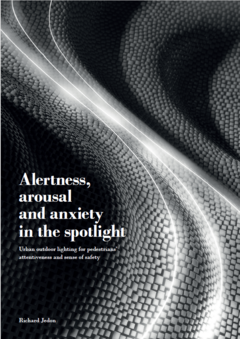
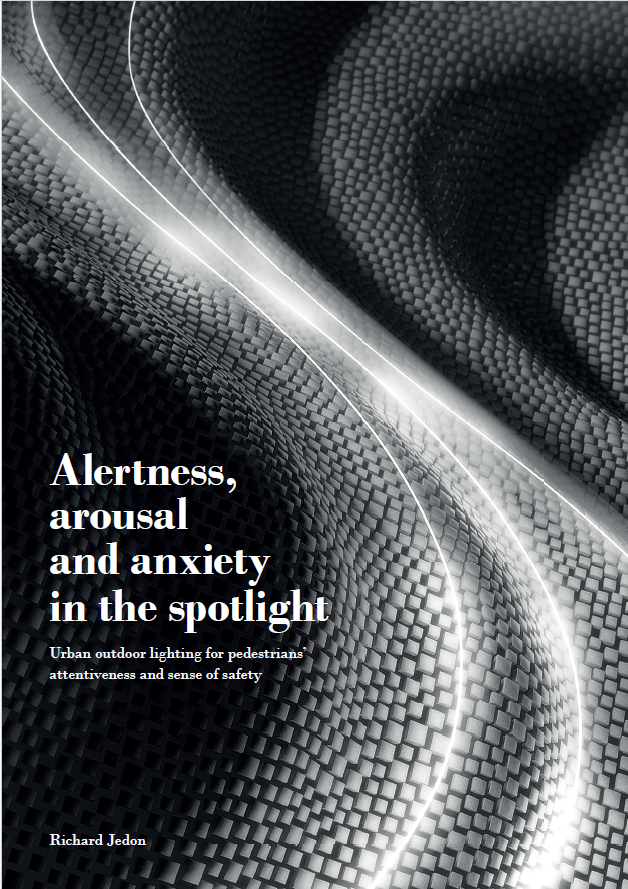
What’s on the cover of your dissertation?
“It features an abstract graphic design with three light lines, representing the three key concepts at the heart of my research: alertness, arousal, and anxiety.”
How would you explain your research at a birthday party in one sentence?
“I study what people actually need from public lighting – and how we can design it to meet those needs.”
How do you blow off steam outside the lab?
“I’m interested in architecture, I enjoy swimming, and I’m currently learning Portuguese. I also like mixing cocktails and mocktails. And I’m a big fan of electronic music, which often makes heavy use of light effects, as well as horror movies which play on feelings of fear. So in a way, many of my hobbies connect back to my research.”
What advice would you give your younger PhD self?
“At the beginning, it’s easy to feel overwhelmed by all the possible directions you could take. You have to make choices and stand by them – many things will fall into place over time.”
What’s the next chapter?
“I’d like to move into applied research. The part of my PhD I enjoyed most was the final study, where we worked with a designer to explore real possibilities of a specific environment. I like responding to societal needs and helping translate theoretical research into concrete applications.”
Discussion