
- Research
- 27/05/2026
TU/e researchers ‘design’ stained-glass window for Paradiso
Music venue Paradiso has gained a new stained-glass window. To create it, researchers Pim van der Hoorn and Mike van Santvoort unleashed algorithms on public data from the Dutch House of Representatives. The visualization itself was also generated by an algorithm: “We pressed the button, and whatever came out would become the artwork.”
The moment they pressed the button was tense: what if it produced an error? PhD candidate Mike van Santvoort from Mathematics & Computer Science (M&CS) admits the researchers made sure that would not happen. “I didn’t want to put my signature on a window displaying an error,” he says with a laugh. Pressing the button was part of the design process. The idea was to let the algorithms do the work and to accept the final result exactly as it emerged.
According to assistant professor Pim van der Hoorn, the artists collaborating with the researchers might even have accepted the design if an error had appeared. The work is part of the series De Moderne Moraal (The Modern Morality), in which artists Berend Strik and Hans van Houwelingen address contemporary developments. With this twelfth window, De Staat (The State), they aim to show the growing influence of politics and technology on everyday life.
Data from the Dutch House of Representatives
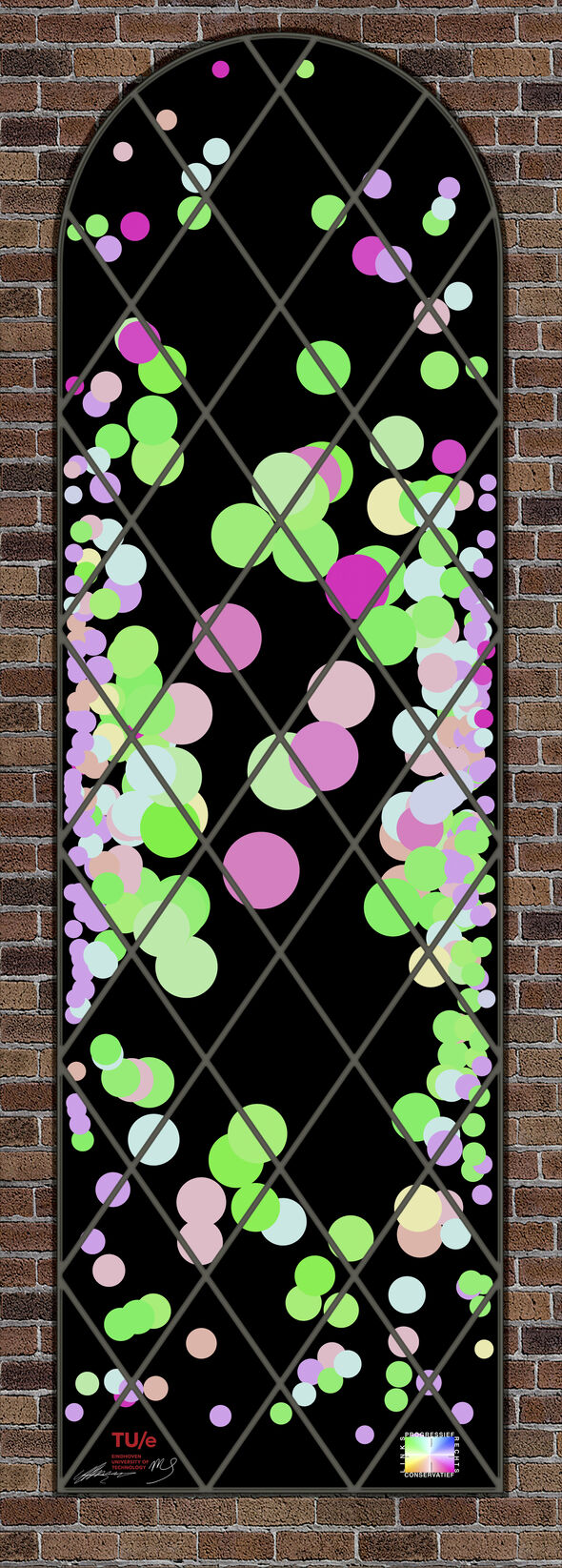
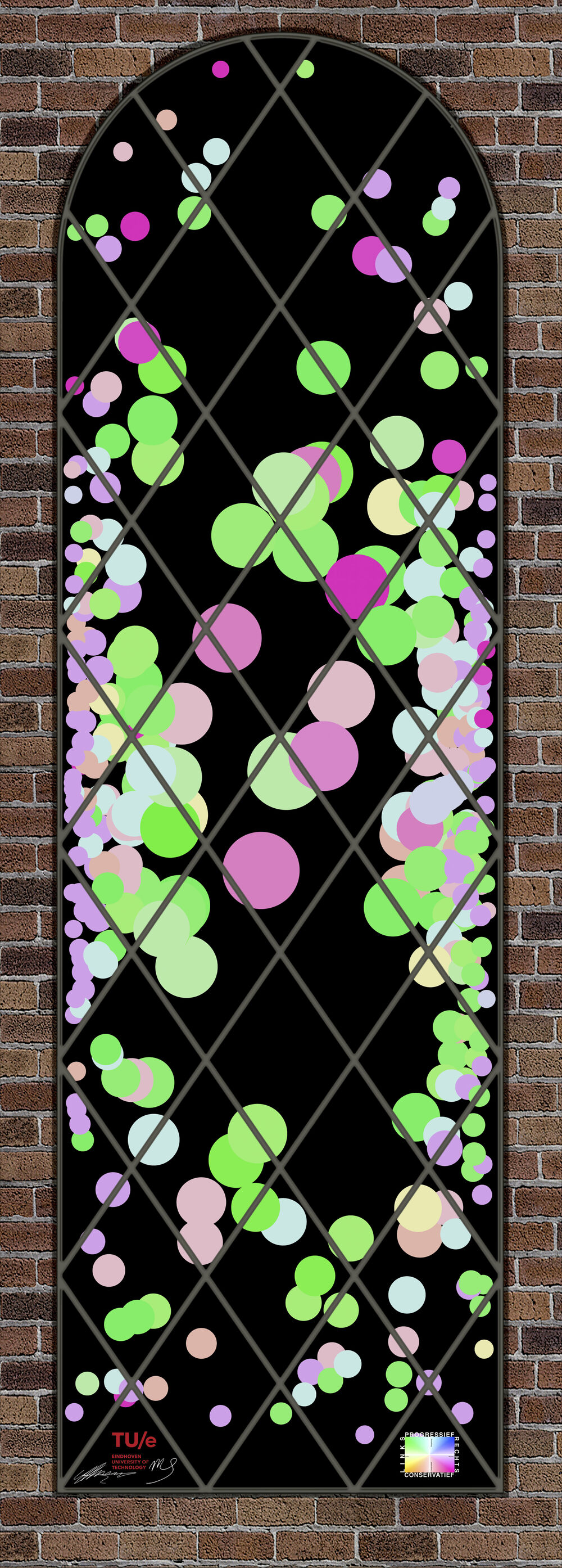
The final result is not a window covered in error codes, but a composition of colored spheres against a blue background. It is a visualization of a political “network” based on data from the Dutch House of Representatives. “We basically scraped the entire public database of the House of Representatives and analyzed how often politicians collaborated on motions,” Van der Hoorn explains. They used data spanning from 2003 to 2023.
The researchers then used the PageRank algorithm to assign each politician a score indicating how central they were within the network. “The main reason for choosing that specific algorithm is that you can see it as the mother algorithm of the internet. It was the foundation of Google,” says Van der Hoorn. He considered it especially fitting for this project because the artists were partly inspired by the rise of recommendation algorithms that shape social media timelines.
The higher a politician’s PageRank score, the larger their sphere appears in the window. The researchers deliberately chose not to identify the politicians by name. “The window is a way of visualizing the Dutch state through the lens of algorithms,” Van der Hoorn explains. “We are not claiming this is the way to determine who the most important politician is.”
The colors do indicate where the spheres fall on the political spectrum. At the bottom of the stained-glass window, there is even a legend explaining this classification (see image above).
Networks
By approaching the data as a network, the researchers were able to apply their own expertise to the project, Van der Hoorn explains: “We analyze complex systems by modeling them as networks.”
Van Santvoort uses a similar approach in his PhD research on cancer cells: “I create networks of cells communicating with each other, based on patient data from cancer tissue samples. That allows me to study what the network reveals about how cancer tries to deceive the immune system.” Social interactions, road systems, parliamentary data—you can approach all of them as networks.
Outside their comfort zone
Even so, the project pushed both researchers outside their comfort zones. According to Van Santvoort, mathematicians are good at abstract thinking, but turning those abstractions into something visually appealing is an entirely different challenge.
Van der Hoorn says the experience taught him the value of simply trying something new from time to time. When the project first came his way through a chance meeting with one of the artists at a café terrace in Paris, he strongly doubted whether he could contribute anything meaningful. “I said: I’m not an artist, I’m a mathematician. So know what you’re getting into.”
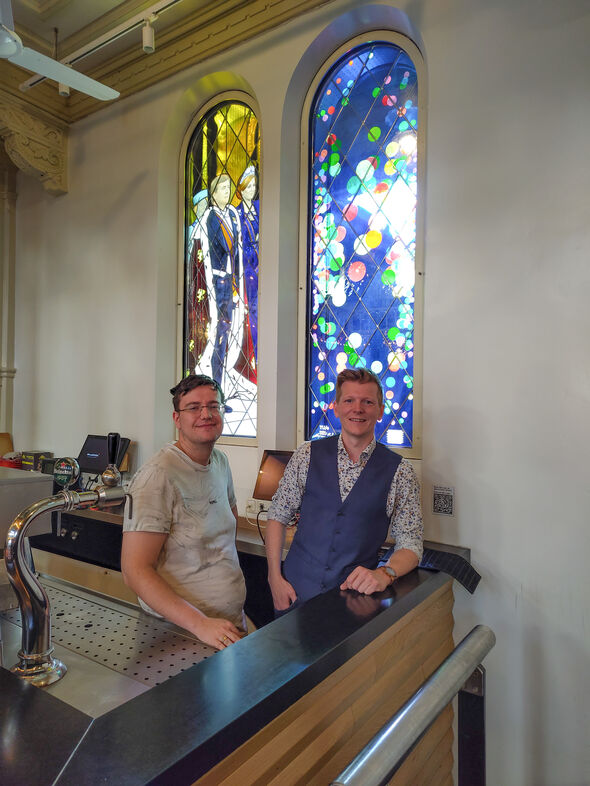

Van der Hoorn initially even suggested other researchers instead. But the artists were certain: they wanted to work with him. Now his work is on display at Paradiso—a venue he, like Van Santvoort, had never visited before this project. Van Santvoort, however, immediately agreed when Van der Hoorn invited him to join. “All I thought was: stained-glass windows in Paradiso with my signature on them? I’m in. Everybody needs a good side quest.”
This article was translated using AI-assisted tools and reviewed by an editor