- Research
- 4 min
- 21/09/2026

Home stretch | Understanding cancer through math
Building a bridge between mathematics and biology
What happens when you put a mathematician to work on a biomedical problem such as cancer? TU/e PhD candidate Mike van Santvoort is using mathematical models to unravel how cancer cells communicate with immune cells—and how they manage to deceive the immune system.
A journey from biology to mathematics and back is the title of his dissertation. It aptly captures the path Mike van Santvoort has taken during his PhD research. A mathematician by training, he found himself immersed in the world of biology, where he explored cancer cells, immune cells, and the ways in which they behave.
It was quite a leap, he admits. But above all, it was an interesting one. “One of the reasons I decided to do it is that it’s an incredibly fascinating problem,” he says. “I thought it was really cool to learn so much about it during my PhD and to work together with biologists.”
A common language
But collaboration across different disciplines doesn’t happen automatically. “One of the challenges is that you have to find a common language. I had to learn to understand what the problem was and exactly what the biologists needed. In turn, I had to convince them that my mathematical models were relevant. Anything new and complicated-looking doesn’t immediately inspire confidence.”
Until then, the biologists had largely relied on machine-learning models to make predictions. These models are powerful, but they have one major drawback: they operate as a black box. They process a lot of input and produce a prediction, without making clear how they arrived there. “I wanted to develop models that not only make predictions, but also provide insight into how they got there.”
When cancer develops
So what exactly is the problem he is tackling? Van Santvoort is not only a mathematician but also trained as a mathematics teacher—a combination that has proved useful during his PhD. “I enjoy explaining complicated things to other people in a simple way,” he says. He takes us to the moment when cancer develops.
“When a cancer cell emerges, it can start dividing very rapidly, causing a tumor to form,” he begins. “But your body has all kinds of mechanisms to prevent that. For example, it often recognizes that a cell has mutated and quickly destroys it. And if a tumor does develop, the immune system can recognize the cancer cells and try to eliminate them.
“The problem arises when cancer cells start defending themselves against this response. They produce certain proteins that help suppress the immune system. You can compare it to a social network. The cancer cells start behaving in a way that makes everyone else think: these are normal cells behaving properly, we should leave them alone.”
Take it easy
One way they do this, is by using a protein called PD-L1. “It’s like a little stub on the membrane of a cancer cell that sends a signal that essentially says: take it easy, there’s nothing wrong here.” Immune cells are, after all, quite aggressive.
Traditionally, biologists study individual interactions to determine which proteins are responsible for sending that message and thereby weakening the immune response.
“Once we know that, we can use immunotherapy. There are many different types, but the basic idea is that we specifically block the message sent by cancer cells, allowing the immune system to do its job undisturbed and clear out the cancer cells.”
The challenge—and the point where Van Santvoort’s own research begins—is that cancer cells can use many different ‘words’ to deceive the immune system. “We can analyze those very well individually, but in my research I’m trying to develop models of how the entire network of cells functions. Rather than looking only at individual interactions, we study a very large group of cells and how they communicate with one another.”
Better predictions
The mathematical approach he uses is called random graphs. In this branch of mathematics, networks are constructed based on random choices, much like rolling a die.
“My models were specifically developed for this problem and applied to data from real patients. Based on a biopsy, we can see which genes are activated in the tissue. We use that information to try to build a network of cells and determine how they influence one another. We can then predict which type of immunotherapy is most likely to work for a particular patient.”
But the models can do more than make predictions. “We can also look at which communication patterns are associated with a patient having a worse outcome. That can help us identify new proteins or cells that may play a role. So the model doesn’t just have predictive value; it can also generate new ideas for research.”
Building a bridge
Van Santvoort’s dissertation primarily provides fundamental insights, both for mathematics and for biomedical engineering. The next step is to further validate his models and translate them into clinical practice. In the coming years, that task will fall to his colleagues in biomedical engineering.
For the PhD candidate, the greatest satisfaction lies in connecting two worlds. “Sometimes I felt a bit like an idiot, because I was sitting right between mathematics and biology. In biomedical engineering, I was an outsider, but among the more fundamental mathematicians, I didn’t feel completely at home either. The fact that I ultimately managed to build that bridge and translate mathematics into biology, really does feel like an achievement.”
PhD in the picture
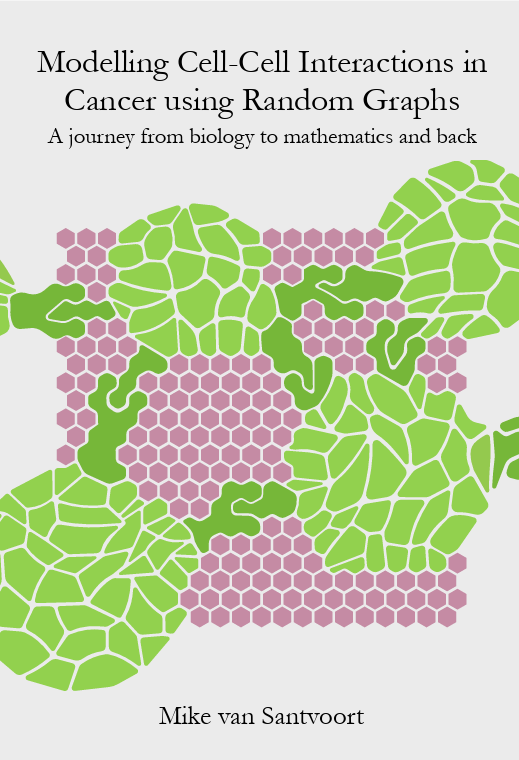
What do we see on the cover of your dissertation?
“You see a nicely organized grid—that’s how the data I work with are often visualized. You also see things growing out of it, symbolizing how cancer develops in the body. The two colors—green and purple—represent the biomedical and mathematical sides of my thesis, respectively. I use those colors throughout my dissertation to distinguish between the different aspects of my work.”
You’re at a birthday party. How would you explain what you’re researching in one sentence?
“I study how cancer cells and immune cells communicate, so that we can understand how cancer cells deceive the immune system and figure out how to counteract that.”
How do you unwind when you’re not doing research?
“I really enjoy making music. I play the drums, and it gives me a great outlet for my creativity. I also enjoy visiting friends, both in the Netherlands and abroad. During my PhD, I learned Norwegian and got to know a lot of Norwegians. That’s why I like going to Norway—they show me around the country.”
What advice would you have given yourself when you were just starting your PhD?
“I would advise PhD candidates to take their teaching responsibilities seriously and not see them as something they simply have to do on the side. If you take teaching seriously, you learn the art of presenting and explaining: how do you make sure people understand what you’ve done? On top of that, many of the insights I present in my thesis emerged from discussions with students. So my teaching responsibilities also led to better research.”
What’s the next chapter?
“That’s still open, but ideally I’d like to work as a teacher. Education is truly my passion, and I definitely want to continue with it in some form.”
Discussion