- Research
- 4 min
- 16/09/2026

Home Stretch | When liquids get stuck
Theoretical physicist Corentin Laudicina sheds new light on the mystery of glass
It is one of physics’ mysteries: what happens when a liquid transitions into a special solid form, the glass phase? TU/e PhD candidate Corentin Laudicina modeled the dynamics of particles in a supercooled liquid and found an illuminating piece of the puzzle.
Before diving into the mystery of glass, theoretical physicist Corentin Laudicina takes us back to high school physics for a moment. Although he has spent years studying exactly what happens in a material during the glass transition, he also understands that his research is not the easiest thing to explain off the cuff at the cafeteria table.
According to school textbooks, matter can exist in three different states: gas, liquid, and solid. Think of water vapor, liquid water, and ice. The molecules that make up the material are the same, but the way they can move differs greatly, Laudicina explains.
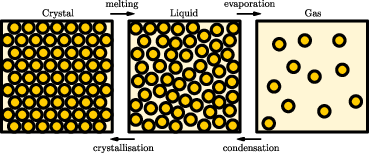
He pulls out his dissertation and shows a figure from the introductory chapter. “The higher the temperature, the more freely the molecules can move. In a solid, they are arranged in a crystal lattice – in a fixed position, at a fixed distance from one another – but in a liquid, they can move without having a fixed position relative to each other. In the gas phase, those movements are even freer.”
Liquid drinking glass
But in addition to these three familiar phases, there is also a fourth phase that a material can enter when it is cooled quickly enough: the glass phase. And there is something unusual about it, Laudicina explains.
“The strange thing about a material in the glass phase is that it behaves like a solid, while its internal structure is more like that of a liquid. There is no rigid crystal lattice, but rather a disordered structure. So, in a sense, a drinking glass is liquid.”
To better understand the glass phase, Laudicina and his colleagues from the Soft Matter & Biological Physics group therefore study specifically what happens when a liquid is cooled. They focus on a material’s viscosity, or, in other words, how thick and slow flowing it is.
“As the temperature drops, the molecules become progressively less able to move. Around the glass transition, however, the viscosity increases extremely rapidly – much faster than you would expect. And yet the material’s internal structure barely changes. That is the core of the mystery of glass.”
Complex computer simulations
On his laptop, Laudicina shows the livestream of a famous experiment conducted by the University of Queensland in Australia. We see an inverted funnel containing a motionless black substance.
“This pitch-drop experiment shows how viscous a liquid can become. Pitch – a viscous component of asphalt – is rock-hard at room temperature. But it is actually an extremely viscous liquid. It is so viscous that, on average, only one drop falls from the funnel every ten years.”
To understand why materials behave so differently during the glass transition from what you would expect based on their structure, you need to be able to track the movement of millions of particles over long periods of time. A microscope cannot do this directly. So theoretical physicists – who, according to Laudicina, are primarily “striving for simplicity” – turn to computer simulations.
“We reduced the molecular complexity of real liquids to a model liquid: a system of perfectly spherical particles that interact with one another in relatively simple ways.”
Using these simulations – which were so complex that he ran them through the TU/e Supercomputing Center – Laudicina was able to show that major changes in viscosity are related to particles moving heterogeneously.
Crowded festival
Not all particles in a supercooled liquid move at the same speed: some barely move at all, while others form groups that move together.
“A bit like at a festival, where, in the crowded areas, everyone has to move a little if you want to get a beer at the back of the field.”
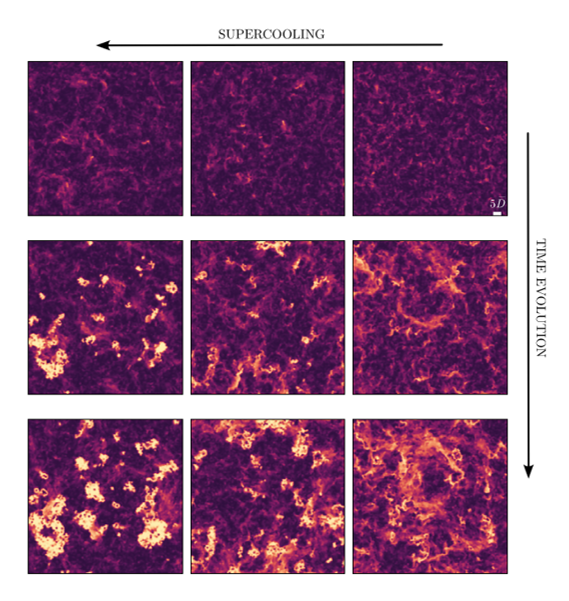
Laudicina investigated how these clusters change as the liquid cools and how this relates to the gradual slowing of the liquid during the glass transition.
By precisely measuring the different clusters and tracking them over longer periods of time, Laudicina discovered something striking. As the liquid cools, the clusters initially become larger. But below a certain temperature, they start to become smaller again.
Older theories, which do not take these clusters into account, predicted that they would continue growing indefinitely, causing the liquid to suddenly become stuck. According to Laudicina’s findings, the opposite happens: the clusters effectively put a natural brake on their own growth. This, he says, explains why no abrupt transition is observed in the laboratory or in computer simulations.
“Our equations were missing a kind of feedback mechanism,” he explains. “They could predict that the clusters would grow, but not that their growth would eventually slow itself down. Once we incorporated that feedback into the theory – and that was certainly not an easy task – the sharp transition previously predicted by the theory disappeared. What remained almost perfectly matched what we see in the simulations.”
From glass to cancer cells
According to Laudicina, the discovery could offer a new perspective on research into the glass transition. Still, he immediately emphasizes that this is primarily fundamental research.
“On an intellectual level, this could certainly be important. We now have a better understanding of how processes in the glass phase work. And what is interesting is that this physics does not stop at liquids.”
“Take a tumor. The cells in a tissue are packed together just like the particles in our simulations. They can become stuck in a similar way, but can also suddenly start moving again and invade the surrounding tissue. Within our group, we are working with cell biologists to investigate this from a physics perspective. There are strong indications that these cells undergo something that closely resembles a glass transition. A very interesting link.”
And surprisingly, it does not stop there, Laudicina emphasizes in conclusion. Similar physical problems can also be found in computer science and machine learning.
“That is why you have to be careful about labeling this kind of research simply as ‘knowledge for knowledge’s sake.’ Precisely because the same ideas keep appearing in places where you would not expect them, it is certainly worth understanding them at a fundamental level.”
On Wednesday, September 16, Laudicina will defend his dissertation at the Department of Applied Physics and Science Education.
PhD in the picture


What do we see on your dissertation cover?
“On the front are all kinds of clusters of particles moving at different speeds, taken from my simulations. On the back, you see a mathematical representation of them, along with a cartoon version of me thinking hard about it. My PhD research was actually largely about thinking. Sometimes behind the laptop, but mostly just with pen and paper.”
You’re at a birthday party. How would you explain what you study in one sentence?
“I study the viscosity of cooling liquids because it behaves very differently from what we expect. But to be honest, I find it quite difficult to talk about my research with people outside physics. So I quickly change the subject.”
How do you unwind outside your research?
“I absolutely love cooking, and I travel all over the world through it. As the child of expats, I grew up in many different places and became familiar with many different flavors. Because I must follow mathematical rules strictly at work, I mainly cook by feel. Nothing is more relaxing than stirring a pot of good food.”
What advice would you have liked to receive as a beginning PhD candidate?
“Nothing goes according to plan. So being a little flexible definitely helps, as does a healthy dose of not being afraid to fail. Because that is bound to happen at some point during your PhD.”
What is your next chapter?
“I am currently exploring opportunities outside of academia. I love research, but I mainly want to focus on solving tough problems. Over the past few years, I have built up a pretty good toolbox for solving complicated problems, a strength I believe I can use anywhere.”
Discussion