- Research
- 4 min
- 02/11/2026

Home stretch | Searching for autism in the brain
What can a glimpse inside the head reveal about how autism works?
Autism can manifest itself in many different ways. But what happens in the brain? TU/e researcher Sjir Schielen set out to find answers. For his PhD research, he analyzed MRI scans from nearly a thousand people, looking for patterns that could help us better understand autism.
“Everyone knows the word, but few people know what it actually means,” says Sjir Schielen. This is partly because autism manifests itself differently in every individual. Even for scientists, autism remains a complex phenomenon that is not easy to explain.
“The first scientific descriptions of autism date back to the 1940s. Since then, the scientific understanding of autism has changed several times,” he explains.
A wide range of characteristics
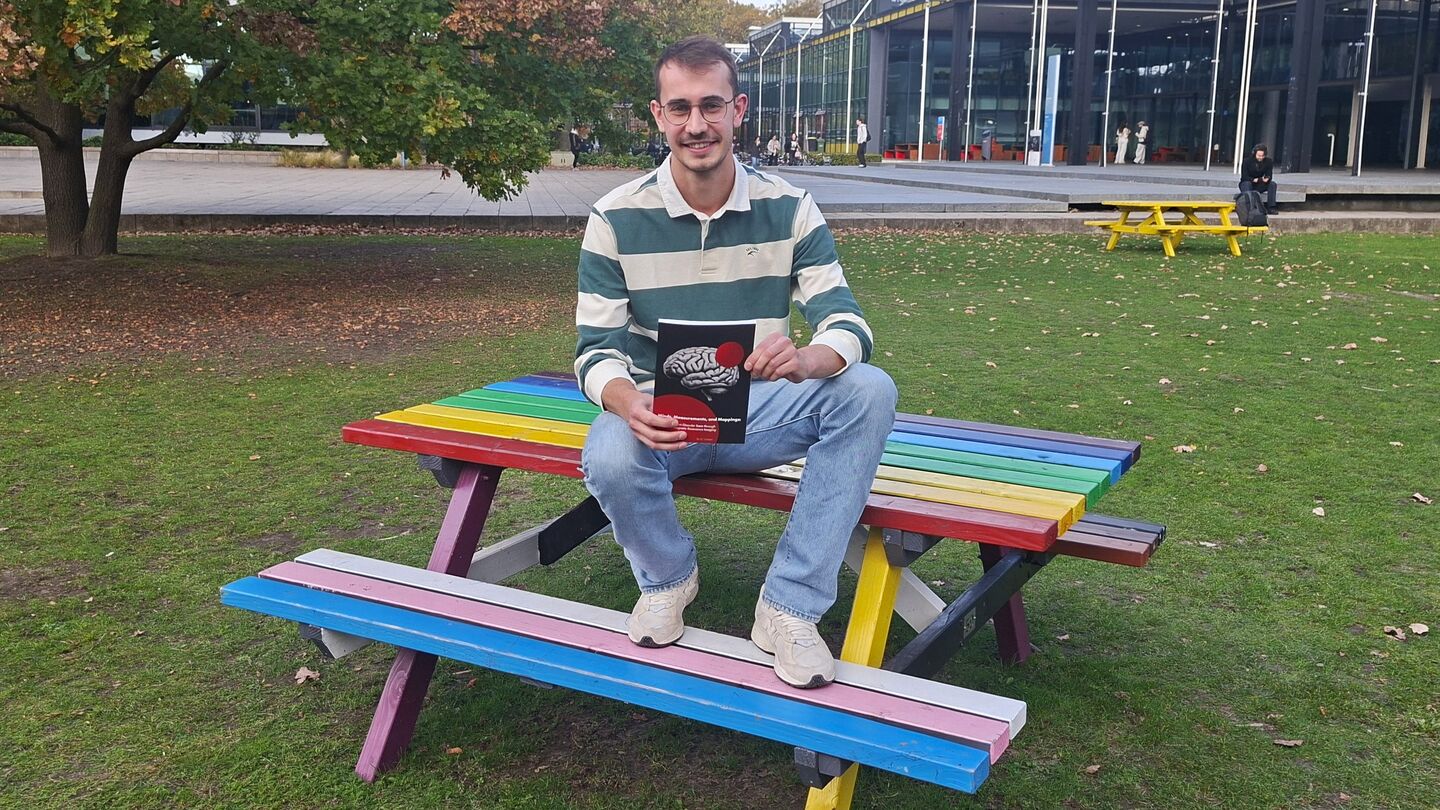
Today, we speak of an autism spectrum, encompassing a wide range of behavioral patterns that are considered atypical. “You can compare it to a rainbow, with all its different colors,” Schielen explains. “There is no single identifiable cause, either; it is most likely the result of a combination of different factors.”
Many of the characteristics associated with autism are familiar. They can include differences in social communication and interaction. For example, people with autism may have difficulty interpreting nonverbal cues, keeping a conversation going, or picking up on unwritten social rules.
They may also have a strong need for predictability and established routines, or become deeply absorbed in specific interests. Repetitive movements or behaviors are also common. In addition, they may process sensory input differently, causing them to experience light, sounds, or certain types of touch particularly intensely.
Difficult to diagnose
Not everyone exhibits all of these characteristics, and the extent to which they experience them varies considerably from person to person. Furthermore, some people with autism learn to adapt their behavior to social expectations. For example, they may consciously make eye contact or teach themselves to ask questions during a conversation. This is known as masking or camouflaging. While it can help people navigate social situations, it can also require considerable effort.
Diagnosing autism is therefore no easy task, as there is no single test that can provide a definitive answer. Diagnosis is based on the individual’s own experiences, behavioral observations, and information from parents or other people close to them. Together, these sources provide insight into the characteristics of autism an individual exhibits and how they affect everyday life.
“Diagnosis is inherently a subjective interpretation. Neurotypical behavior is the starting point, but what is normal, and when does behavior genuinely deviate from that norm? It is difficult to determine where to draw that line,” Schielen says.
What happens in the brain?
A biomarker—a measurable indicator in the body that can identify autism—could help define autism more precisely and make diagnosis more objective. Schielen is therefore investigating whether brain scans can provide clues that could lead to a more objective diagnostic approach.
“We want to see whether we can link symptoms to what we observe in the brain and to the functional interactions taking place there. And if we identify certain differences in the brain, we want to know whether they are also associated with differences in behavior.”
To investigate these patterns, he analyzed MRI scans from several hundred people with autism obtained from an online database. He compared them with scans from a control group of almost the same size, consisting of people without autism. “I studied the interactions within the brain and tried to identify relevant patterns.”
“At the group level, we see differences in how brain networks function in people with and without autism. For example, we see differences in the functioning of the auditory network, which processes sounds, and in networks that control the body's movements,” Schielen explains.
“But this does not apply to everyone. Just as people with autism differ from one another in their behavior, we also see considerable variation in their brain activity. There is no single fixed pattern that occurs in everyone with autism.”
Only part of the picture
Schielen believes a straightforward way to diagnose autism is unlikely to emerge anytime soon. “The spectrum is simply too broad.” There are several ways to study autism, but none provides the complete picture.
Current diagnostic methods focus primarily on behavior: how does autism manifest itself in a particular individual? At present, this is the best method available for diagnosing autism, but it does not tell us the whole story of what is happening inside the brain.
To illustrate this, Schielen uses the example of an elephant drawn by someone who has never seen one before. “The animal has a trunk, four legs, and large ears, but it still doesn’t look anything like a real elephant.” In the same way, looking only at the outward signs can never give us a complete understanding of autism.
Brain scans, on the other hand, offer a glimpse into the underlying processes, but they do not automatically reveal how those processes relate to behavior. “That is complicated because you are comparing two approaches, each with its own limitations. They each tell part of the story, but exactly how those parts fit together is still unclear,” he says.
Towards a more complete picture
One possible next step is to look not only at the differences between people with and without autism, but also at the relationship between specific characteristics and brain activity. For example, researchers could investigate whether people with heightened sensitivity to sound exhibit particular patterns in the auditory network, which processes sounds. This shifts the focus away from autism as a broad category and towards the specific characteristics that make individuals different from one another.
Other areas of research may also contribute to a more complete understanding of autism. Scientists are investigating the role of genetic factors and the microbiome: the collection of microorganisms that live in and on the human body. “By combining these different insights, we hope to gain a better understanding of how the various factors are interconnected,” Schielen concludes.
Sjir Schielen will defend his thesis on November 2 at the Department of Electrical Engineering.
PhD in the picture
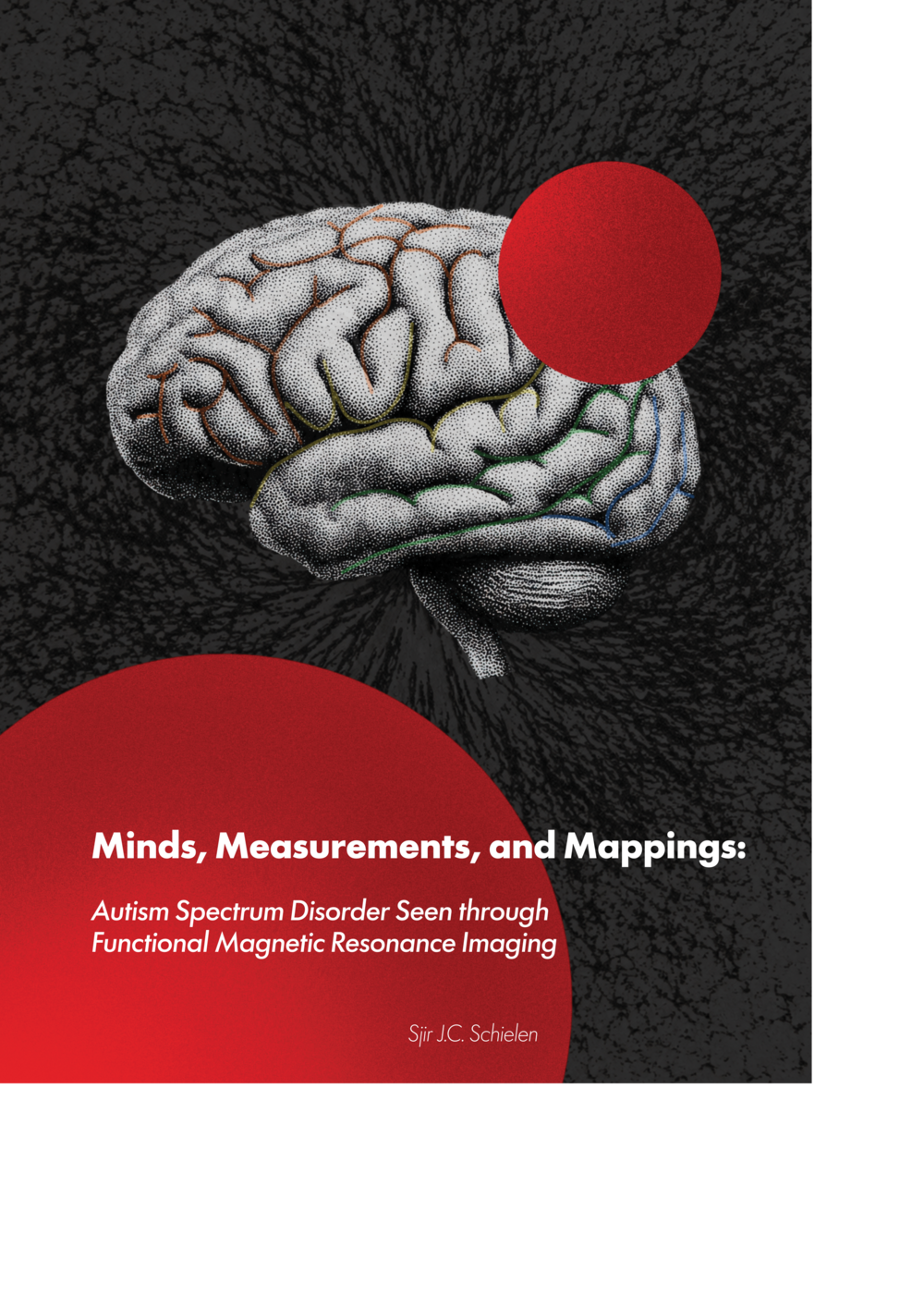
What do we see on the cover of your dissertation?
“The three central themes of my research: MRI technology, the brain, and autism. On the back cover, you can see iron powder aligning itself along magnetic field lines under the influence of a magnetic field. This refers to the magnetic principle that plays an important role in MRI. On the front cover, there is a brain with rainbow colors running along its folds. This is a subtle reference to the autism spectrum.”
You’re at a birthday party. How would you explain your research in one sentence?
“We use MRI to study the brain and learn more about autism.”
How do you unwind outside of your research?
“I really enjoy bouldering. I also like meeting up with friends for a drink or a game. And when my mind feels completely full, going for a run always helps me clear my head.”
What advice would you have liked to receive when you first started your PhD?
“Your motivation can sometimes dip a little during your PhD. That’s why it’s important to find things that keep you motivated and help you push through. For me, it was the conferences I attended during my PhD, often in special and inspiring locations. They were always something exciting to look forward to and gave me something to work towards.”
What’s your next chapter?
“I’m looking for a job in industry. I don’t know exactly what I want to do yet, but I’m very interested in medical signal processing. That includes MRI, but also other medical measurement and imaging techniques used in hospitals, such as EEG and ECG.”
Discussion